
[Paper Review] VN-EGNN: E(3)-Equivariant Graph Neural Networks with Virtual Nodes Enhance Protein Binding Site Identification
VN-EGNN extends EGNN with virtual nodes to learn and predict binding site centers, achieving state-of-the-art DCC/DCA on COACH420, HOLO4K, and PDBbind2020 datasets.
Being able to identify regions within or around proteins, to which ligands can potentially bind, is an essential step to develop new drugs. Binding site identification methods can now profit from the availability of large amounts of 3D structures in protein structure databases or from AlphaFold predictions. Current binding site identification methods heavily rely on graph neural networks (GNNs), usually designed to output E(3)-equivariant predictions. Such methods turned out to be very beneficial for physics-related tasks like binding energy or motion trajectory prediction. However, the performance of GNNs at binding site identification is still limited potentially due to the lack of dedicated nodes that model hidden geometric entities, such as binding pockets. In this work, we extend E(n)-Equivariant Graph Neural Networks (EGNNs) by adding virtual nodes and applying an extended message passing scheme. The virtual nodes in these graphs are dedicated quantities to learn representations of binding sites, which leads to improved predictive performance. In our experiments, we show that our proposed method VN-EGNN sets a new state-of-the-art at locating binding site centers on COACH420, HOLO4K and PDBbind2020.
Motivation & Objective
- Motivate improved binding site identification using 3D-equivariant graphs and virtual nodes to model hidden geometric entities like binding pockets.
- Develop VN-EGNN by extending EGNNs with multiple virtual nodes that learn center representations and mitigate oversquashing.
- Evaluate VN-EGNN against diverse binding site benchmarks (COACH420, HOLO4K, PDBbind2020) and baselines.
- Provide analysis on equivariance, expressiveness, and the effect of virtual nodes on learning binding site centers.
Proposed method
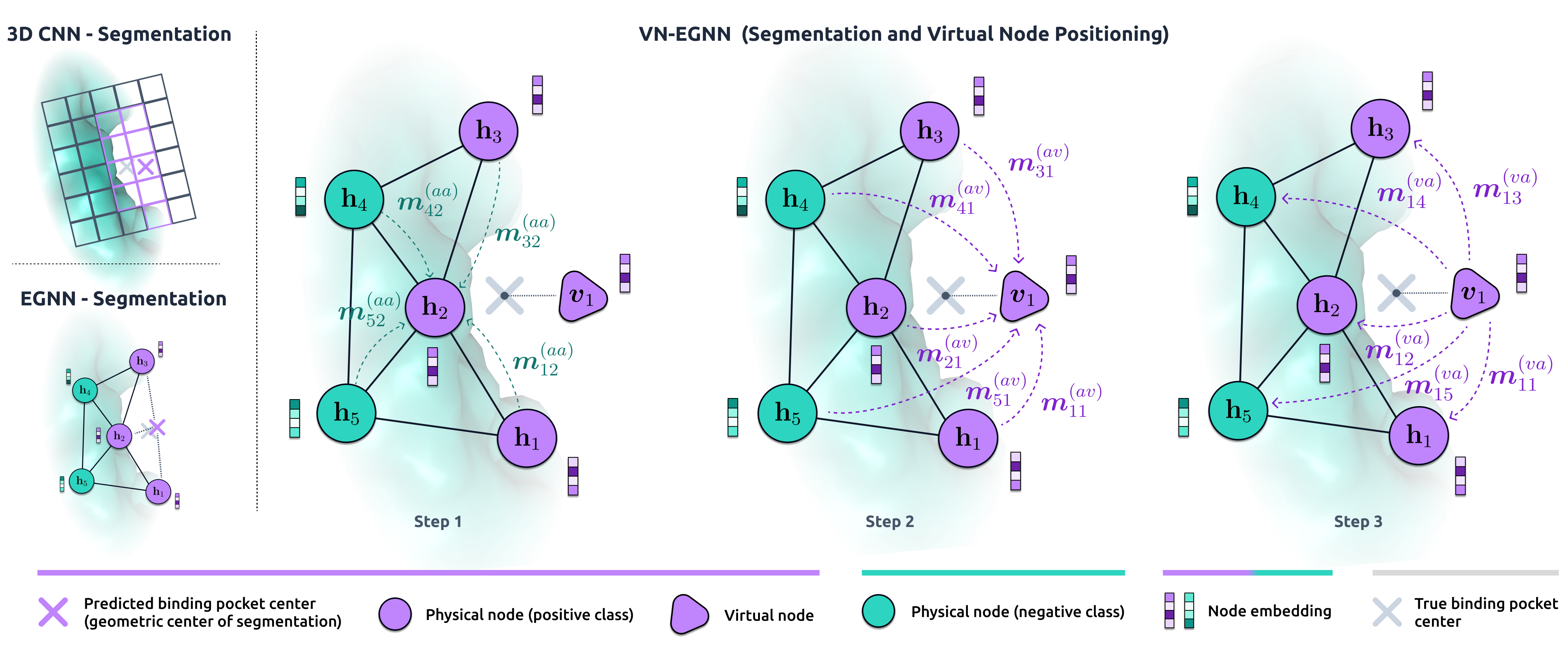
- Extend E(3)-equivariant GNNs (EGNNs) with K virtual nodes connected to all physical nodes.
- Use a three-phase message passing scheme that updates physical node features and coordinates twice per layer, while virtual nodes are updated once per layer.
- Read out the final virtual node coordinates to predict binding site centers and perform node-level binding pocket segmentation.
- Train with a multi-task objective combining binding-site center location loss and a segmentation loss (Dice or cross-entropy).
- Incorporate a self-confidence module to assign and learn confidence scores for each predicted center.
- Initialize virtual nodes on a spherical Fibonacci grid; randomize initial alignment per sample to promote approximate E(3) invariance.
Experimental results
Research questions
- RQ1Can VN-EGNN improve localization of binding site centers beyond prior equivariant GNNs?
- RQ2Do virtual nodes mitigate oversquashing and improve expressiveness for binding site identification?
- RQ3Do VN-EGNN predictions achieve state-of-the-art DCC and DCA on standard binding site benchmarks?
- RQ4How does the model perform when predicting multiple binding-site centers and ranking them by confidence?
Key findings
- VN-EGNN achieves state-of-the-art DCC on COACH420, HOLO4K, and PDBbind2020 benchmarks (as reported in Table 1).
- On COACH420 VN-EGNN attains the best DCA score among compared methods, and on PDBbind2020 it matches P2Rank's DCA performance.
- Ablation studies show the full VN-EGNN (with all components: virtual nodes, heterogeneous message passing, and residue embeddings) yields the best performance across datasets.
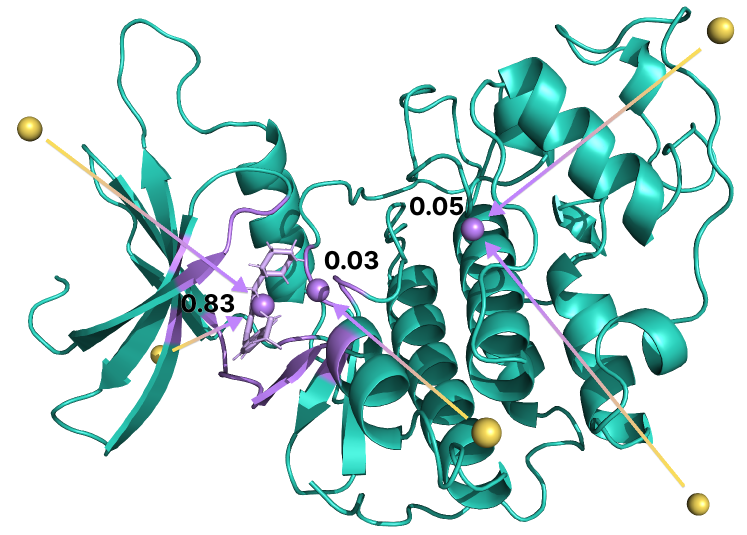
- The model's virtual nodes learn to infer binding site centers, with coordinates converging toward actual ligand-binding positions during training.
- The multi-task objective, combining center location and segmentation losses, along with a self-confidence module, improves binding site predictions and their ranking.
Read this paper
Open the full text in the Nubint reader and ask about any passage as you read.
Read this paper on NubintThis review was generated by AI from the original paper. Please check the paper before citing it.