
[Paper Review] VoiceFilter: Targeted Voice Separation by Speaker-Conditioned Spectrogram Masking
The paper introduces VoiceFilter, a two-network system that uses a target speaker embedding to perform speaker-conditioned spectrogram masking, effectively extracting the target voice from multi-speaker mixtures and improving ASR WER with minimal impact on clean speech.
In this paper, we present a novel system that separates the voice of a target speaker from multi-speaker signals, by making use of a reference signal from the target speaker. We achieve this by training two separate neural networks: (1) A speaker recognition network that produces speaker-discriminative embeddings; (2) A spectrogram masking network that takes both noisy spectrogram and speaker embedding as input, and produces a mask. Our system significantly reduces the speech recognition WER on multi-speaker signals, with minimal WER degradation on single-speaker signals.
Motivation & Objective
- Motivate targeted speech separation without knowing the number of speakers in advance.
- Develop a speaker encoder to produce robust embeddings for target speakers.
- Design a spectrogram masking network that uses the target speaker embedding to suppress interference.
- Demonstrate WER improvements on multi-speaker data while preserving single-speaker performance.
Proposed method
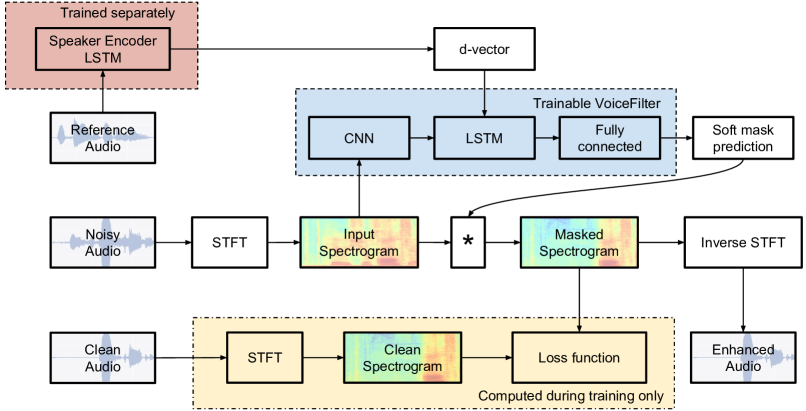
- Train a 3-layer LSTM speaker encoder to produce 256-dim d-vectors from log-mel features.
- Train a spectrogram masking network that conditions on the target speaker d-vector and the noisy magnitude spectrogram to predict a soft mask.
- Inject the d-vector into the masking network between the convolutional and LSTM layers to preserve time-frequency processing.
- Optimize the mask via a reconstruction loss between the enhanced and target clean magnitude spectrograms, then reconstruct waveform using the original phase.
- Process audio in 3-second segments at 16 kHz during training.
- Evaluate using Word Error Rate (WER) and Source to Distortion Ratio (SDR).
Experimental results
Research questions
- RQ1Can a target-speaker embedding enable end-to-end separation without knowing the number of interfering speakers?
- RQ2How does speaker conditioning affect WER and SDR compared to traditional separation methods?
- RQ3What is the impact of different temporal models (no LSTM, uni-, bi-directional LSTM) on performance?
- RQ4Does training on a larger, diverse dataset generalize across domains (LibriSpeech to VCTK, etc.)?
Key findings
- Bi-directional LSTM VoiceFilter yields best WER on noisy LibriSpeech data (23.4% vs 28.2% with uni-LSTM, 35.3% with no LSTM).
- VoiceFilter reduces Noisy WER from 55.9% to 23.4% on LibriSpeech two-speaker mixtures (LibriSpeech training).
- On LibriSpeech, Noisy WER improvement yields a relative reduction of 58.1% with the best model, while Clean WER remains close to the Clean baseline (11.1% vs 10.9%).
- On VCTK, training on LibriSpeech improves Noisy WER to 34.3% from 60.6%, with some degradation in Clean WER (5.9% vs 6.1%); training on VCTK yields higher Clean WER (21.1%)
- SDR results align with WER trends; bi-LSTM achieves the highest mean/median SDR (17.9 dB / 12.6 dB) on LibriSpeech.
- VoiceFilter with speaker embeddings outperforms a permutation-invariant loss baseline, showing the benefit of target speaker conditioning.
Read this paper
Open the full text in the Nubint reader and ask about any passage as you read.
Read this paper on NubintThis review was generated by AI from the original paper. Please check the paper before citing it.