
[Paper Review] VRSBench: A Versatile Vision-Language Benchmark Dataset for Remote Sensing Image Understanding
VRSBench provides a large-scale, human-verified vision-language benchmark for remote sensing, with 29,614 images, captions, object references, and 123,221 VQA pairs, evaluated on captioning, grounding, and VQA.
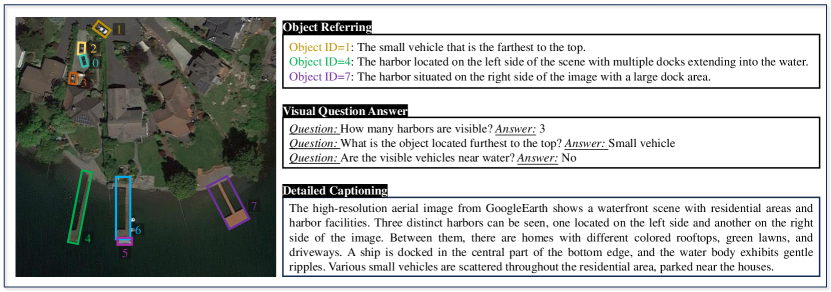
We introduce a new benchmark designed to advance the development of general-purpose, large-scale vision-language models for remote sensing images. Although several vision-language datasets in remote sensing have been proposed to pursue this goal, existing datasets are typically tailored to single tasks, lack detailed object information, or suffer from inadequate quality control. Exploring these improvement opportunities, we present a Versatile vision-language Benchmark for Remote Sensing image understanding, termed VRSBench. This benchmark comprises 29,614 images, with 29,614 human-verified detailed captions, 52,472 object references, and 123,221 question-answer pairs. It facilitates the training and evaluation of vision-language models across a broad spectrum of remote sensing image understanding tasks. We further evaluated state-of-the-art models on this benchmark for three vision-language tasks: image captioning, visual grounding, and visual question answering. Our work aims to significantly contribute to the development of advanced vision-language models in the field of remote sensing. The data and code can be accessed at https://github.com/lx709/VRSBench.
Motivation & Objective
- Address limitations of existing remote-sensing vision-language datasets (single-task focus, low object detail, quality control)
- Provide a large, unified dataset with detailed captions, object references, and open-ended VQA
- Enable training and evaluation of vision-language models across captioning, grounding, and VQA in remote sensing
- Propose a semi-automatic data collection pipeline with human verification to ensure annotation quality
- Offer three benchmarks (captioning, grounding, VQA) and baseline evaluations on state-of-the-art models
Proposed method
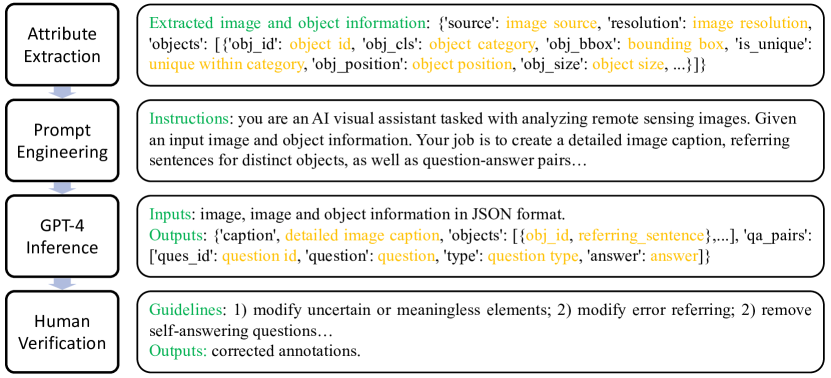
- Introduce a semi-automatic data collection pipeline with four steps: attribute extraction, prompt engineering, GPT-4 inference, and human verification
- Use DOTA-v2 and DIOR as sources for object attributes and bounding boxes to enable grounding with orientated bounding boxes (OBB)
- Design careful prompts for GPT-4V to generate captions, object referring sentences, and QA pairs, followed by human validation
- Provide annotations including detailed captions, 1–5 object referring sentences per image, and 3–10 VQA pairs per image
- Construct three benchmarks (VRSBench-Cap, VRSBench-Ref, VRSBench-VQA) and evaluate baseline models with finetuning on VRSBench
- Evaluate using standard metrics (BLEU, ROUGE_L, METEOR, CIDEr for captioning; Acc@IoU for grounding; accuracy per question type for VQA
Experimental results
Research questions
- RQ1How do current vision-language models perform on detailed captioning, grounding, and VQA tasks in remote sensing when evaluated on VRSBench?
- RQ2Does finetuning generalist vision-language models on VRSBench significantly improve performance across captioning, grounding, and VQA?
- RQ3What is the relative impact of including explicit object information (attributes, bounding boxes) during grounding and VQA tasks on remote-sensing imagery?
- RQ4How does GPT-4V perform on these tasks when provided with prompts lacking explicit object information, compared to models trained on VRSBench?
Key findings
- VRSBench enables large-scale evaluation across three tasks: captioning, grounding, and VQA for remote sensing images.
- Fine-tuned LVMs (e.g., LLaVA-1.5) achieve highest captioning metrics (BLEU-1 48.1, CIDEr 33.9) with captions averaging 52 words.
- GPT-4V yields strong captioning and VQA results (BLEU-1 37.2, CIDEr 19.1 for captioning; VQA avg 65.6) but underperforms grounding when object attributes are not provided.
- Grounding results show that finetuned models outperform baselines, with unique-object referring being easier than non-unique (e.g., GeoChat achieves 39.6% Acc@0.5 overall in some settings).
- VQA results indicate substantial gains from finetuning on VRSBench (average accuracy 60.6% for GeoChat w ft; GPT-4V achieves 65.6% average).
- The dataset comprises 29,614 images with 29,614 captions, 52,472 referring sentences, and 123,221 VQA pairs, using 512×512 RGB imagery.
Read this paper
Open the full text in the Nubint reader and ask about any passage as you read.
Read this paper on NubintThis review was generated by AI from the original paper. Please check the paper before citing it.