
[Paper Review] VSSD: Vision Mamba with Non-Causal State Space Duality
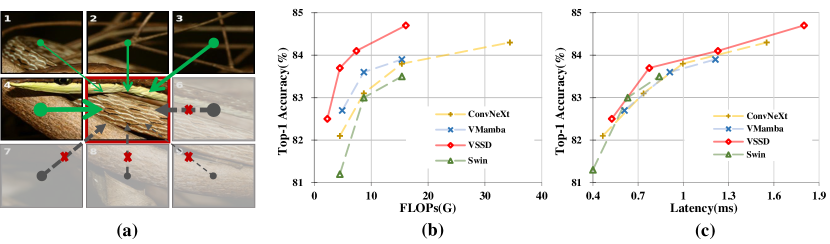
This paper proposes VSSD, a non-causal Vision Mamba model that redefines State Space Duality (SSD) by reassigning the role of the state transition matrix 𝐀 to control token contributions rather than hidden state retention, enabling full non-causal modeling without multi-scan strategies. VSSD achieves state-of-the-art performance on ImageNet-1K with 81.8% top-1 accuracy, outperforming prior SSM-based models like VMamba by 1% while improving training throughput by up to 50%.
Vision transformers have significantly advanced the field of computer vision, offering robust modeling capabilities and global receptive field. However, their high computational demands limit their applicability in processing long sequences. To tackle this issue, State Space Models (SSMs) have gained prominence in vision tasks as they offer linear computational complexity. Recently, State Space Duality (SSD), an improved variant of SSMs, was introduced in Mamba2 to enhance model performance and efficiency. However, the inherent causal nature of SSD/SSMs restricts their applications in non-causal vision tasks. To address this limitation, we introduce Visual State Space Duality (VSSD) model, which has a non-causal format of SSD. Specifically, we propose to discard the magnitude of interactions between the hidden state and tokens while preserving their relative weights, which relieves the dependencies of token contribution on previous tokens. Together with the involvement of multi-scan strategies, we show that the scanning results can be integrated to achieve non-causality, which not only improves the performance of SSD in vision tasks but also enhances its efficiency. We conduct extensive experiments on various benchmarks including image classification, detection, and segmentation, where VSSD surpasses existing state-of-the-art SSM-based models. Code and weights are available at \url{https://github.com/YuHengsss/VSSD}.
Motivation & Objective
- To address the inherent causal limitation of State Space Models (SSMs) in non-causal vision tasks such as image classification, detection, and segmentation.
- To overcome the disruption of spatial continuity caused by flattening 2D feature maps into 1D sequences during SSM processing.
- To develop a more efficient and accurate alternative to multi-scan SSM approaches that rely on bidirectional scanning for non-causal modeling.
- To enable a single global hidden state computation without causal masking, improving both training speed and model stability.
Proposed method
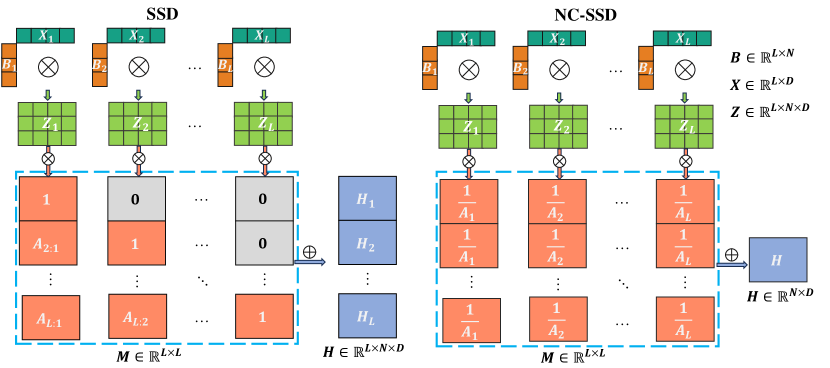
- Reformulate SSD by using the state transition matrix 𝐀 to control the contribution of each token to the hidden state, rather than determining hidden state retention.
- Eliminate the causal mask by making the contribution of each token self-referential, enabling non-causal modeling with a single forward pass.
- Introduce a learnable weight vector 𝐦 to stabilize training and prevent gradient explosion, acting as a normalization mechanism.
- Integrate multi-scan strategies implicitly through the non-causal design, avoiding the need for explicit bidirectional scanning.
- Combine NC-SSD with hybrid attention in the final stage and overlapped downsampling to enhance performance and spatial inductive bias.
- Use a single global hidden state derived from all tokens simultaneously, replacing token-wise hidden states to improve efficiency and modeling capacity.
Experimental results
Research questions
- RQ1Can the causal inductive bias of SSMs be removed to better model non-causal vision data without relying on multi-scan strategies?
- RQ2Does redefining the role of the state transition matrix 𝐀 from hidden state retention to token contribution enable stable and efficient non-causal modeling in vision tasks?
- RQ3How does the proposed non-causal SSD (NC-SSD) compare to vanilla SSD and multi-scan variants like Bi-SSD in terms of accuracy, latency, and training speed?
- RQ4What is the impact of the learnable weight vector 𝐦 on training stability and model performance in the absence of normalization in linear attention-like mechanisms?
- RQ5Can the integration of standard attention and overlapped downsampling further improve the performance of NC-SSD on vision benchmarks?
Key findings
- VSSD achieves 81.8% top-1 accuracy on ImageNet-1K, outperforming VMamba by 1% while maintaining similar FLOPs and parameter count.
- The proposed NC-SSD improves training throughput by 50% compared to Bi-SSD and by 20% compared to vanilla SSD, demonstrating significant efficiency gains.
- The inclusion of the learnable weight vector 𝐦 is critical for training stability; without it, models crash during training, especially in larger architectures.
- Replacing the patch-based downsampler with an overlapped convolutional downsampler improves accuracy by 0.7% with only a 0.2G increase in FLOPs.
- Hybridizing the last stage with standard self-attention boosts accuracy by 0.2% without increasing parameters, showing the effectiveness of attention in deep layers.
- Ablation studies confirm that NC-SSD surpasses both vanilla SSD and Bi-SSD by 0.6% and 0.2% in top-1 accuracy, respectively, with higher throughput.
Read this paper
Open the full text in the Nubint reader and ask about any passage as you read.
Read this paper on NubintThis review was generated by AI from the original paper. Please check the paper before citing it.