
[Paper Review] Watermarking Makes Language Models Radioactive
This paper demonstrates that watermarking in language models induces 'radioactivity,' where watermarked training data leaves detectable traces in models fine-tuned on such data. Even with as little as 5% watermarked data, the contamination can be detected with high confidence (p < 10⁻⁵), revealing that watermarks intended for machine-generated text detection also enable reliable detection of model fine-tuning on synthetic outputs.
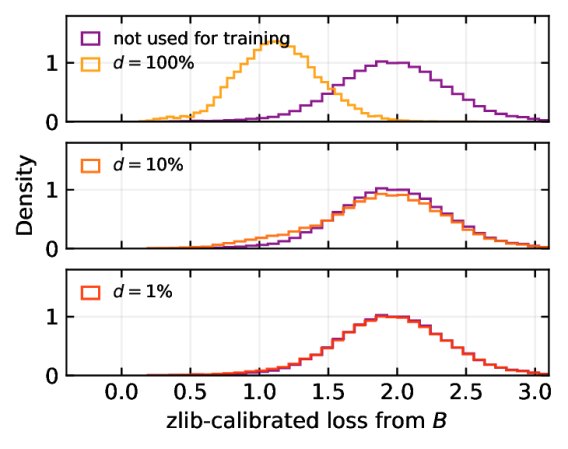
We investigate the radioactivity of text generated by large language models (LLM), i.e. whether it is possible to detect that such synthetic input was used to train a subsequent LLM. Current methods like membership inference or active IP protection either work only in settings where the suspected text is known or do not provide reliable statistical guarantees. We discover that, on the contrary, it is possible to reliably determine if a language model was trained on synthetic data if that data is output by a watermarked LLM. Our new methods, specialized for radioactivity, detects with a provable confidence weak residuals of the watermark signal in the fine-tuned LLM. We link the radioactivity contamination level to the following properties: the watermark robustness, its proportion in the training set, and the fine-tuning process. For instance, if the suspect model is open-weight, we demonstrate that training on watermarked instructions can be detected with high confidence ($p$-value $< 10^{-5}$) even when as little as $5\%$ of training text is watermarked.
Motivation & Objective
- To investigate whether watermarked language model outputs leave detectable traces when used to fine-tune other models, a phenomenon termed 'radioactivity'.
- To compare watermark-based detection with traditional membership inference attacks in identifying training data contamination.
- To evaluate the detectability of radioactivity under varying conditions: open vs. closed model access, and supervised vs. unsupervised data settings.
- To analyze how watermark robustness, watermarking window size, and training data proportion affect detectability.
- To demonstrate the real-world feasibility of detecting fine-tuning on watermarked synthetic instruction data.
Proposed method
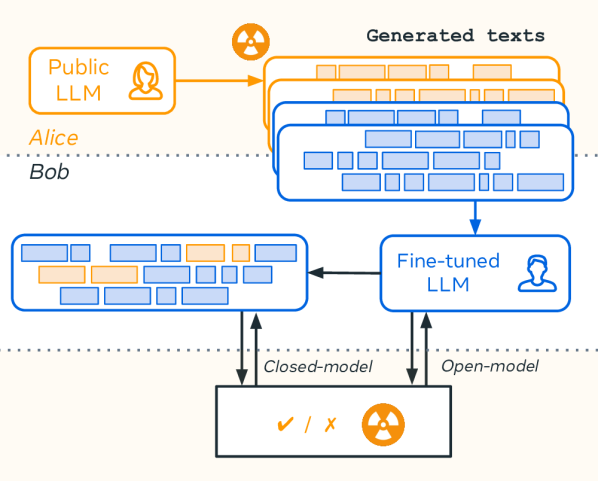
- The authors use a watermarking scheme that modifies token sampling probabilities based on a secret key, embedding a detectable signal in generated text.
- They fine-tune a target LLM (Llama-1) on synthetic instruction data generated by a source LLM (Llama-2-chat), with controlled proportions of watermarked content.
- Detection is performed using a statistical test that compares the frequency of watermark-specific token patterns in the fine-tuned model’s outputs to a baseline.
- For open-model detection, the method leverages model logits to compute a p-value for the presence of watermark signals in the fine-tuned model.
- For closed-model detection, the method uses prompt-based inference to extract and test for watermark patterns without model access.
- The contamination process is analyzed by varying watermark robustness, hashing window size, and training data ratio (ρ).
Experimental results
Research questions
- RQ1Can watermarked training data be reliably detected in a model fine-tuned on such data, even when the specific training samples are unknown?
- RQ2How does the proportion of watermarked data (ρ) affect the detectability of radioactivity in the fine-tuned model?
- RQ3How does watermark robustness and hashing window size influence the strength of the detectable signal?
- RQ4How does watermark-based detection compare to membership inference attacks in terms of detection confidence and feasibility?
- RQ5Can radioactivity be detected in a real-world setting using self-instructed synthetic data?
Key findings
- Watermarking enables detection of fine-tuning on synthetic data with a p-value < 10⁻⁵, even when only 5% of the training data is watermarked.
- Detection via watermarking is significantly more reliable than membership inference, especially in closed-model settings where logits are unavailable.
- Smaller watermarking hashing windows increase the detectability of radioactivity, indicating a stronger signal in the fine-tuned model.
- The method successfully detects radioactivity in a real-world scenario using Self-Instruct-generated instruction data, confirming practical applicability.
- The presence of watermark signals in fine-tuned models is robust across varying levels of watermarking strength and data proportions.
- The results show that watermarks not only serve for detecting machine-generated text but also reveal the use of such text in model fine-tuning, exposing potential derivative model relationships.
Read this paper
Open the full text in the Nubint reader and ask about any passage as you read.
Read this paper on NubintThis review was generated by AI from the original paper. Please check the paper before citing it.