
[Paper Review] Wave Mechanics, Interference, and Decoherence in Strong Gravitational Lensing
The paper derives the wave-optics framework for gravitational lensing from curved-spacetime scalar wave equations, explores eikonal and diffractive regimes, and discusses observational prospects for interference effects in lensing of transients.
Wave-mechanical effects in gravitational lensing have long been predicted, and with the discovery of populations of compact transients such as gravitational wave events and fast radio bursts, may soon be observed. We present an observer's review of the relevant theory underlying wave-mechanical effects in gravitational lensing. Starting from the curved-spacetime scalar wave equation, we derive the Fresnel-Kirchoff diffraction integral, and analyze it in the eikonal and wave optics regimes. We answer the question of what makes interference effects observable in some systems but not in others, and how interference effects allow for complementary information to be extracted from lensing systems as compared to traditional measurements. We end by discussing how diffraction effects affect optical depth forecasts and lensing near caustics, and how compact, low-frequency transients like gravitational waves and fast radio bursts provide promising paths to open up the frontier of interferometric gravitational lensing.
Motivation & Objective
- Motivate the study of wave-mechanical effects in gravitational lensing with upcoming transient observations (GWs, FRBs, etc.).
- Derive the Fresnel-Kirchhoff diffraction integral from the curved-spacetime scalar wave equation and connect to lensing observables.
- Characterize the eikonal and wave-optics regimes and explain when interference effects are observable and informative.
- Discuss implications for optical depth forecasts, caustics, and how low-frequency transients enable interferometric lensing.
Proposed method
- Start from the curved-spacetime scalar wave equation and derive the Fresnel-Kirchoff diffraction integral.
- Transform to the flat-sky and Fresnel framework to obtain a Schrödinger-like equation for the transverse wave profile.
- Apply stationary-phase (eikonal) and diffractive (wave optics) analyses to the Fresnel integral, yielding a sum over image-like stationary points with Morse phase.
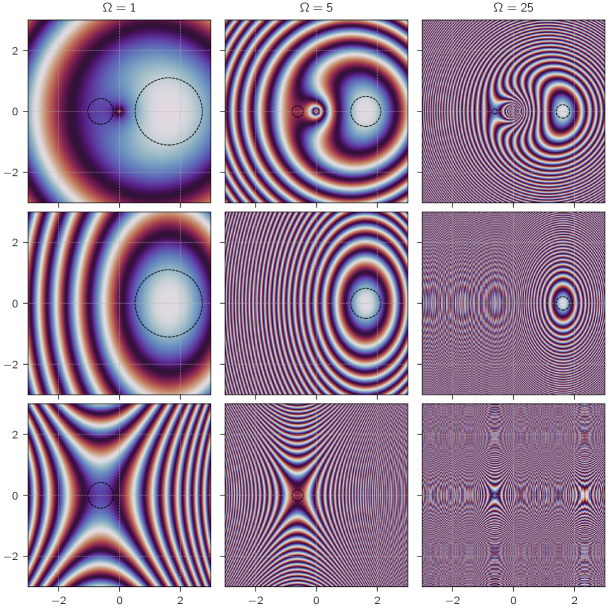
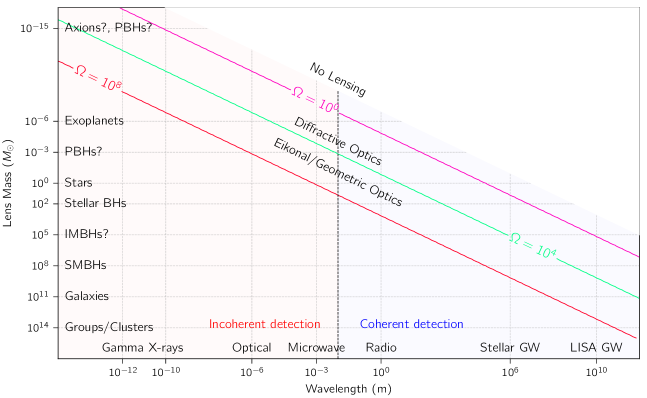
- Introduce dimensionless frequency Omega and delay tau to study regime transitions between diffractive, eikonal, and geometric optics.
- Provide analytical approximations near stationary points and discuss the role of the magnification matrix A in setting coherent patches.
- Discuss chromaticity, finite-source effects, and how diffraction alters lensing probabilities and caustic behavior.
Experimental results
Research questions
- RQ1Under what conditions do wave-interference effects become observable in gravitational lensing?
- RQ2How do the eikonal and diffraction regimes modify traditional lensing observables such as magnification and time delays?
- RQ3What is the impact of wave optics on lensing probabilities and optical depth calculations, especially near caustics?
- RQ4How can chromaticity and phase information in wave-optics lensing enhance information extraction from lens systems?
- RQ5What observational prospects exist for detecting wave-mechanical lensing effects with compact transients like GWs and FRBs?
Key findings
- A Fresnel-Kirchhoff diffraction integral is derived from first principles and reduces to an eikonal (stationary-phase) regime or a wave-optics (diffractive) regime depending on frequency and lens properties.
- Interference manifests as oscillatory fringes governed by the dimensionless frequency Omega and the magnification matrix A, with coherence scales set by coherent patches around stationary points.
- In the high-frequency limit, geometric optics is recovered as discrete images add incoherently, while at lower frequencies diffraction blurs images and introduces chromatic signatures.
- The formalism explains how chromatic lensing arises in wave optics, enabling frequency-dependent observables not present in traditional lensing.
- Finite-source and caustic regions are highlighted as important for detecting and interpreting diffractive lensing signatures.
- Coherent detection of wavefronts (e.g., via voltage data) can dramatically improve time-delay measurements and thus constrain lensing properties at low frequencies.
Read this paper
Open the full text in the Nubint reader and ask about any passage as you read.
Read this paper on NubintThis review was generated by AI from the original paper. Please check the paper before citing it.