
[Paper Review] Wavefield Networked Sensing: Principles, Algorithms and Applications
This paper introduces a physics-driven framework for networked radio sensing using diffraction tomography theory (DTT) to optimize imaging resolution and suppress grating lobes. By orchestrating multiple terminals via the wavenumber tessellation principle, it enables high-quality imaging even in limited bandwidth, leveraging coherent combination of multi-static low-resolution data across arbitrary topologies.
Networked sensing refers to the capability of properly orchestrating multiple sensing terminals to enhance specific figures of merit, e.g., positioning accuracy or imaging resolution. Regarding radio-based sensing, it is essential to understand extit{when} and extit{how} sensing terminals should be orchestrated, namely the best cooperation that trades between performance and cost (e.g., energy consumption, communication overhead, and complexity). This paper addresses networked sensing from a physics-driven perspective, aiming to provide a general theoretical benchmark to evaluate its extit{imaging} performance bounds and to guide the sensing orchestration accordingly. Diffraction tomography theory (DTT) is the method to quantify the imaging resolution of any radio sensing experiment from inspection of its spectral (or wavenumber) content. In networked sensing, the image formation is based on the back-projection integral, valid for any network topology and physical configuration of the terminals. The extit{wavefield networked sensing} is a framework in which multiple sensing terminals are orchestrated during the acquisition process to maximize the imaging quality (resolution and grating lobes suppression) by pursuing the deceptively simple extit{wavenumber tessellation principle}. We discuss all the cooperation possibilities between sensing terminals and possible killer applications. Remarkably, we show that the proposed method allows obtaining high-quality images of the environment in limited bandwidth conditions, leveraging the coherent combination of multiple multi-static low-resolution images.
Motivation & Objective
- To establish a physics-based theoretical benchmark for evaluating networked sensing imaging performance.
- To guide the orchestration of sensing terminals by balancing performance and cost (energy, complexity, communication overhead).
- To enable high-resolution imaging in limited bandwidth by coherently combining multi-static low-resolution data.
- To identify optimal cooperation strategies—coherent vs. incoherent, monostatic vs. bistatic—based on spectral coverage and wavenumber tessellation.
- To provide a general framework applicable to any network topology, terminal capabilities, and sensing configuration.
Proposed method
- The paper employs diffraction tomography theory (DTT) to quantify imaging resolution based on the spectral (wavenumber) content of the sensing acquisition.
- It derives a general back-projection integral for image formation that is valid for any network topology and physical configuration of terminals.
- The wavenumber tessellation principle is proposed as the core orchestration strategy to maximize spectral coverage and imaging quality.
- The method evaluates performance using metrics like resolution, PSLR, and ISLR, derived from the spatial spectrum of the networked system.
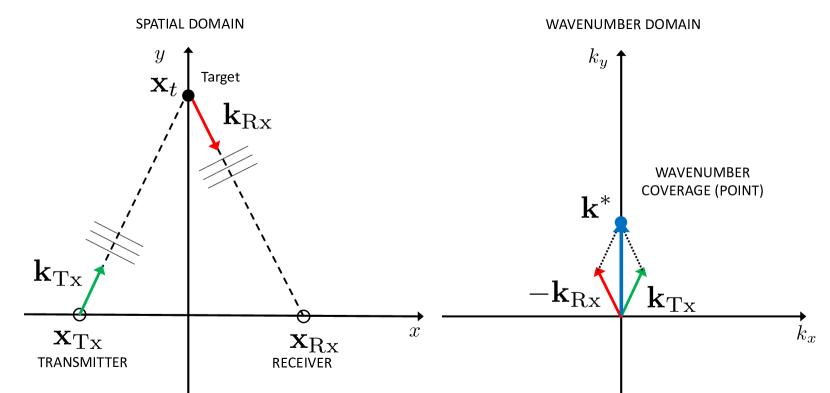
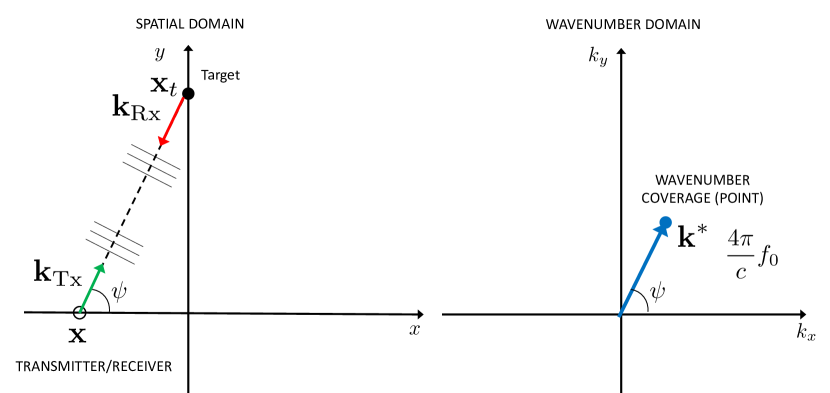
- It analyzes monostatic and bistatic configurations, showing that poor spectral coverage (e.g., opposite Tx/Rx directions) leads to resolution loss and grating lobes.
- The framework allows prediction of imaging performance using only geometric information about the network and target, without requiring specific signal or noise models.
Experimental results
Research questions
- RQ1How can networked sensing terminals be orchestrated to maximize imaging resolution while minimizing cost?
- RQ2What is the fundamental imaging performance limit of a networked sensing system, and how can it be predicted from physical principles?
- RQ3How does the spectral coverage of the wavenumber domain affect image quality, particularly in multi-static configurations?
- RQ4What are the performance trade-offs between monostatic and bistatic sensing in terms of resolution and grating lobe suppression?
- RQ5Can a unified theoretical framework be developed to evaluate imaging performance across arbitrary network topologies and terminal capabilities?
Key findings
- The wavenumber tessellation principle enables optimal spectral coverage, leading to high-resolution imaging even in limited bandwidth conditions.
- Bistatic configurations with opposing Tx and Rx terminals along the y-axis result in zero spectral coverage in that direction, causing complete loss of resolution.
- Spatial resolution in bistatic systems degrades as the cosine of half the bistatic angle, with a significant performance loss for angles >120°.
- Coherent fusion of multi-static images is ineffective when the spatial spectrum is sparse, leading to high grating lobe levels and poor target detectability.
- The monostatic configuration achieves the best resolution, while bistatic pairs with large angles offer poor performance-cost trade-offs.
- The DTT-based framework provides a noiseless, signal-agnostic benchmark for imaging performance, distinct from CRLB, enabling a new class of KPIs for sensing systems.
Better researchstarts right now
From reading papers to final review, dramatically reduce your research time.
No credit card · Free plan available
This review was created by AI and reviewed by human editors.