
[Paper Review] Weak baselines and reporting biases lead to overoptimism in machine learning for fluid-related partial differential equations
This paper investigates overoptimism in machine learning (ML) research for fluid-related partial differential equations (PDEs), revealing that 79% of studies claiming ML acceleration use weak baselines and suffer from reporting biases. The authors demonstrate that these issues—driven by researcher degrees of freedom and a preference for positive results—lead to inflated performance claims, calling for cultural and structural reforms to improve reproducibility in ML-for-PDE research.
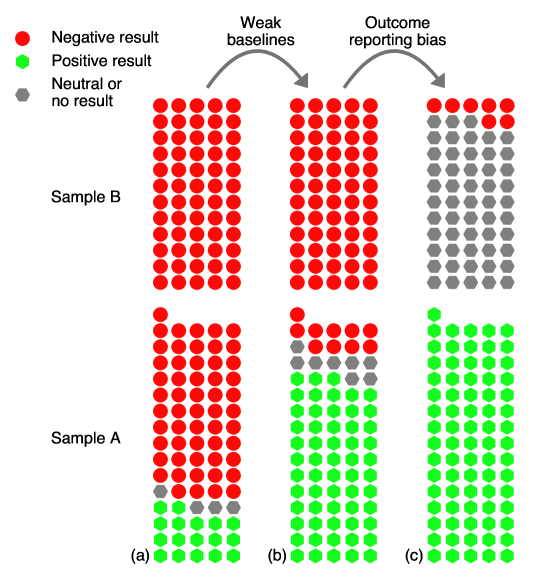
One of the most promising applications of machine learning (ML) in computational physics is to accelerate the solution of partial differential equations (PDEs). The key objective of ML-based PDE solvers is to output a sufficiently accurate solution faster than standard numerical methods, which are used as a baseline comparison. We first perform a systematic review of the ML-for-PDE solving literature. Of articles that use ML to solve a fluid-related PDE and claim to outperform a standard numerical method, we determine that 79% (60/76) compare to a weak baseline. Second, we find evidence that reporting biases, especially outcome reporting bias and publication bias, are widespread. We conclude that ML-for-PDE solving research is overoptimistic: weak baselines lead to overly positive results, while reporting biases lead to underreporting of negative results. To a large extent, these issues appear to be caused by factors similar to those of past reproducibility crises: researcher degrees of freedom and a bias towards positive results. We call for bottom-up cultural changes to minimize biased reporting as well as top-down structural reforms intended to reduce perverse incentives for doing so.
Motivation & Objective
- To investigate the extent of overoptimism in machine learning research for fluid-related partial differential equations (PDEs).
- To assess the prevalence of weak baselines in ML-for-PDE studies that claim to outperform standard numerical solvers.
- To examine the role of reporting biases—particularly outcome and publication bias—in distorting the perception of ML performance in PDE solving.
- To identify systemic factors, such as researcher degrees of freedom and incentives for positive results, that contribute to reproducibility issues in ML-for-PDE research.
- To advocate for bottom-up cultural changes and top-down structural reforms to reduce biased reporting and improve scientific rigor in the field.
Proposed method
- Conducted a systematic review of 76 ML-for-PDE articles claiming to outperform standard numerical methods in fluid-related PDEs.
- Evaluated each study’s baseline using two criteria: (1) comparison at constant degrees of freedom or iterations (proxy for runtime), and (2) use of efficient, state-of-the-art numerical methods.
- Classified comparisons as 'fair' if both criteria were met; otherwise labeled as 'weak' or 'unfair'.
- Analyzed reporting practices to detect outcome and publication bias, especially underreporting of negative results.
- Identified and cited evidence from the literature showing that methods like physics-informed neural networks (PINNs) are often slower than standard solvers.
- Used a structured evaluation framework to assess baseline strength and methodological rigor across diverse PDE types, including Poisson, Helmholtz, Burgers’, and Navier-Stokes equations.
Experimental results
Research questions
- RQ1To what extent do ML-for-PDE studies use weak baselines when claiming superior performance over standard numerical solvers?
- RQ2How prevalent are reporting biases—particularly outcome and publication bias—in ML research for fluid-related PDEs?
- RQ3What systemic factors contribute to overoptimism in ML-for-PDE research, and how do they resemble past reproducibility crises?
- RQ4Why do many ML-based PDE solvers, including PINNs, fail to outperform standard solvers despite claims of acceleration?
- RQ5What cultural and structural reforms are needed to improve reproducibility and reduce biased reporting in ML-for-PDE research?
Key findings
- 79% (60 out of 76) of ML-for-PDE studies claiming to outperform standard solvers used weak baselines, undermining the validity of their performance claims.
- Many studies compared ML models to inefficient or outdated numerical methods, such as finite element methods or conjugate gradient solvers, instead of state-of-the-art alternatives like multigrid or spectral methods.
- Physics-informed neural networks (PINNs) were found to be orders of magnitude slower than standard solvers for forward PDE problems, contradicting claims of acceleration.
- Several studies reported negative results or failed to achieve speedups, but these findings were underreported or omitted in the literature, indicating outcome reporting bias.
- The use of weak baselines and reporting biases are driven by researcher degrees of freedom and a systemic incentive to publish positive results, mirroring past reproducibility crises in other scientific fields.
- The study concludes that the field is overoptimistic due to methodological flaws and systemic incentives, and calls for cultural and structural reforms to enhance scientific integrity and reproducibility.
Read this paper
Open the full text in the Nubint reader and ask about any passage as you read.
Read this paper on NubintThis review was generated by AI from the original paper. Please check the paper before citing it.