
[Paper Review] Weakly-Supervised Anomaly Detection in the Milky Way
This paper introduces the first application of the weakly-supervised anomaly detection method CWoLa to astrophysical data, using Gaia's billion-star dataset to detect cold stellar streams without labeled training data or astrophysical assumptions. CWoLa successfully identifies both the known GD-1 stream and dozens of simulated streams with high purity, demonstrating its potential for discovering new stellar streams in the Galactic halo.
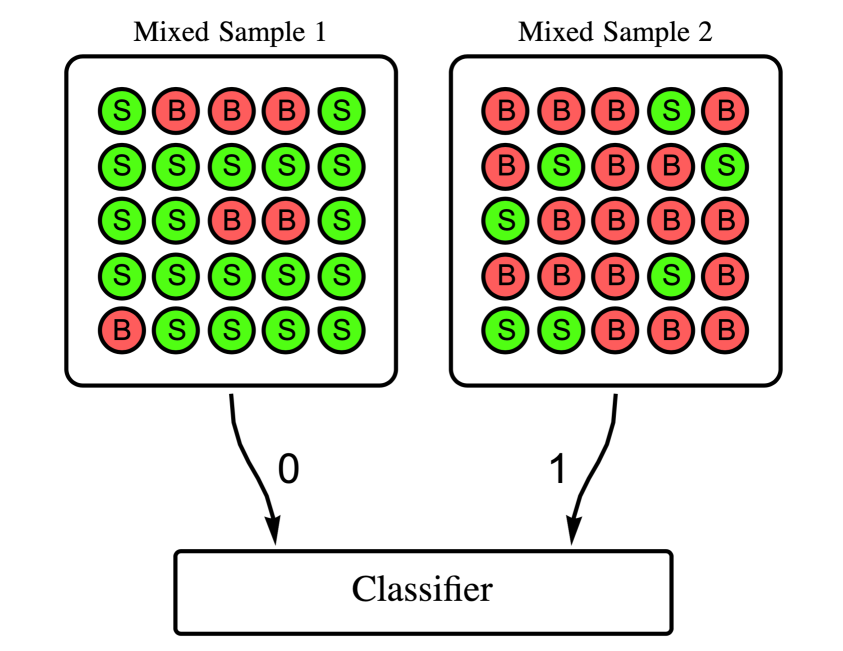
Large-scale astrophysics datasets present an opportunity for new machine learning techniques to identify regions of interest that might otherwise be overlooked by traditional searches. To this end, we use Classification Without Labels (CWoLa), a weakly-supervised anomaly detection method, to identify cold stellar streams within the more than one billion Milky Way stars observed by the Gaia satellite. CWoLa operates without the use of labeled streams or knowledge of astrophysical principles. Instead, we train a classifier to distinguish between mixed samples for which the proportions of signal and background samples are unknown. This computationally lightweight strategy is able to detect both simulated streams and the known stream GD-1 in data. Originally designed for high-energy collider physics, this technique may have broad applicability within astrophysics as well as other domains interested in identifying localized anomalies.
Motivation & Objective
- To detect cold stellar streams in the Milky Way using weakly-supervised machine learning without labeled data or astrophysical priors.
- To evaluate whether CWoLa, originally developed for high-energy physics, can effectively identify localized anomalies in large-scale astrophysical datasets.
- To demonstrate the method’s ability to detect known streams like GD-1 and simulated streams with high purity and computational efficiency.
- To explore the feasibility of using CWoLa for discovering previously undetected stellar streams in the full Gaia dataset.
Proposed method
- CWoLa is applied as a weakly-supervised classifier trained on mixed samples where signal and background proportions are unknown.
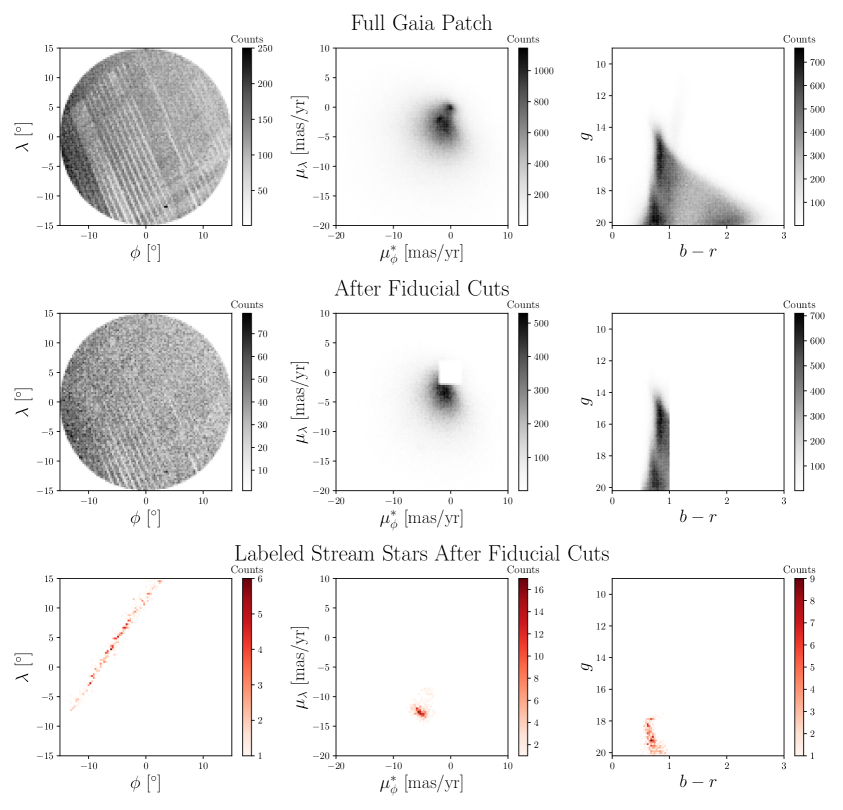
- The method uses a lightweight neural network to assign anomaly scores to stars based on five input features: two angular positions, one proper motion coordinate (not used in scanning), magnitude, and color.
- A sliding-window scan is performed across one proper motion coordinate to identify regions with high anomaly scores, indicating potential stream candidates.
- Anomaly scores are evaluated using a sideband-based selection strategy to distinguish true anomalies from background fluctuations.
- The approach is model-agnostic and does not assume specific stream orbits or isochrones, relying only on kinematic and photometric clustering.
- Post-processing may involve line-finding algorithms (e.g., modified Hough transform) to identify extended stream-like structures from detected anomalies.
Experimental results
Research questions
- RQ1Can CWoLa detect known stellar streams like GD-1 in Gaia data without labeled training data or astrophysical assumptions?
- RQ2How effective is CWoLa at identifying simulated stellar streams with varying densities and morphologies in a high-dimensional phase space?
- RQ3Can CWoLa distinguish true localized anomalies from background fluctuations using only anomaly score distributions and sideband analysis?
- RQ4What are the computational and practical challenges in scaling CWoLa to the full Gaia dataset for discovering new, previously undetected streams?
- RQ5How can performance metrics be re-evaluated in the absence of ground truth labels for new stream candidates?
Key findings
- CWoLa successfully detects the known stellar stream GD-1 with high purity, identifying the same physical features such as the 'spur', 'blob', 'cocoon', gaps, and overdense regions as found in prior studies.
- The method identifies dozens of simulated stellar streams with high purity, demonstrating its sensitivity to low-density, kinematically cold structures.
- Neural network anomaly scores from CWoLa highlight stars that were likely omitted from formal GD-1 labeling schemes, suggesting new candidate members.
- The anomaly score distribution shows a clear shape change under increasingly harsh selections when a true anomaly is present, confirming detection capability.
- The technique is computationally efficient and does not require assumptions about isochrones, stream orbits, or the Milky Way’s gravitational potential.
- The method is scalable to the full Gaia dataset and may be combined with line-finding algorithms to identify extended stream-like features from localized anomalies.
Read this paper
Open the full text in the Nubint reader and ask about any passage as you read.
Read this paper on NubintThis review was generated by AI from the original paper. Please check the paper before citing it.