
[Paper Review] Weakly Supervised Deep Recurrent Neural Networks for Basic Dance Step Generation
This paper proposes a weakly supervised deep recurrent neural network that generates basic dance steps synchronized to music using audio power spectra as input. By employing multilayered LSTMs with auto-conditioned decoding and a contrastive loss function for beat alignment, the model achieves low cross entropy (1.41) and F-measure scores comparable to human dancers, enabling real-time, end-to-end training with minimal hand-crafted data.
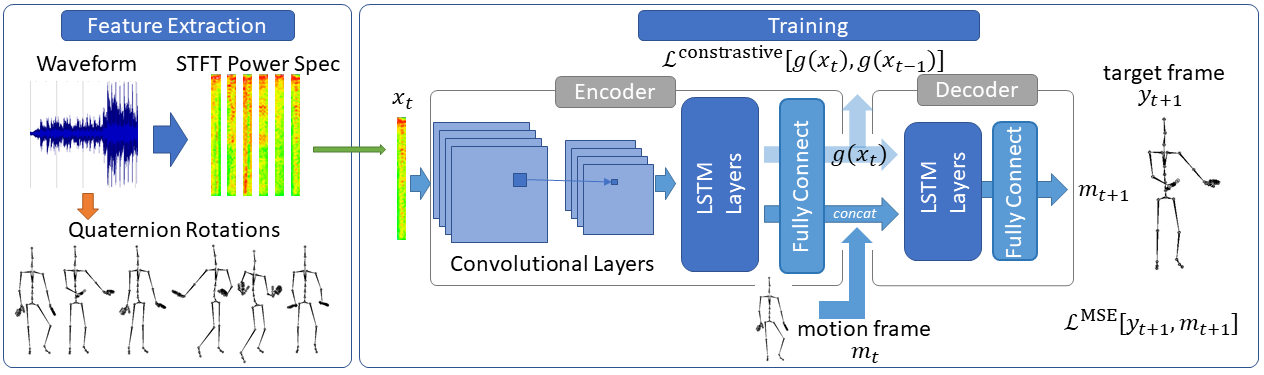
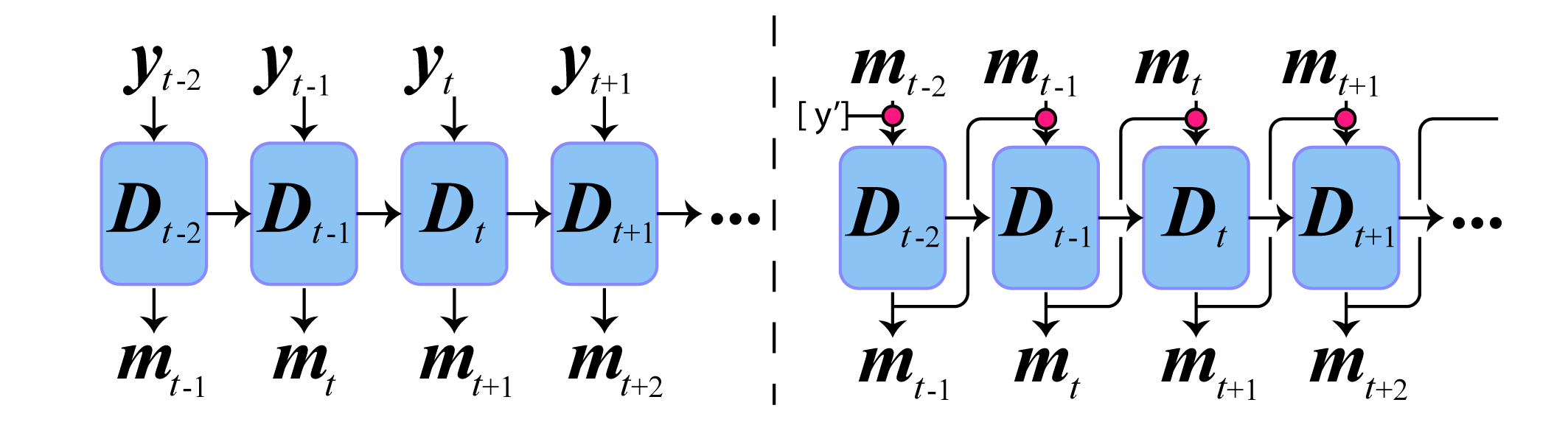
Synthesizing human's movements such as dancing is a flourishing research field which has several applications in computer graphics. Recent studies have demonstrated the advantages of deep neural networks (DNNs) for achieving remarkable performance in motion and music tasks with little effort for feature pre-processing. However, applying DNNs for generating dance to a piece of music is nevertheless challenging, because of 1) DNNs need to generate large sequences while mapping the music input, 2) the DNN needs to constraint the motion beat to the music, and 3) DNNs require a considerable amount of hand-crafted data. In this study, we propose a weakly supervised deep recurrent method for real-time basic dance generation with audio power spectrum as input. The proposed model employs convolutional layers and a multilayered Long Short-Term memory (LSTM) to process the audio input. Then, another deep LSTM layer decodes the target dance sequence. Notably, this end-to-end approach has 1) an auto-conditioned decode configuration that reduces accumulation of feedback error of large dance sequence, 2) uses a contrastive cost function to regulate the mapping between the music and motion beat, and 3) trains with weak labels generated from the motion beat, reducing the amount of hand-crafted data. We evaluate the proposed network based on i) the similarities between generated and the baseline dancer motion with a cross entropy measure for large dance sequences, and ii) accurate timing between the music and motion beat with an F-measure. Experimental results revealed that, after training using a small dataset, the model generates basic dance steps with low cross entropy and maintains an F-measure score similar to that of a baseline dancer.
Motivation & Objective
- Address the challenge of generating long, beat-synchronized dance sequences using deep learning with minimal labeled data.
- Reduce reliance on expensive, hand-crafted motion annotations by leveraging weak labels derived from motion direction.
- Improve alignment between music and motion beats through a contrastive cost function that learns beat timing from sequential audio frames.
- Enable real-time dance generation with low inference latency (≈12 ms) and end-to-end training from raw audio input.
- Demonstrate robustness to audio noise and generalization across diverse music genres with limited training data.
Proposed method
- Uses a two-branch architecture: convolutional layers to reduce frequency variation in audio power spectrum, followed by multilayered LSTMs to encode temporal audio features.
- Employs an auto-conditioned decoding LSTM that feeds its own output back to generate long-range dance sequences, minimizing error accumulation.
- Applies a contrastive loss function to regulate music-motion beat alignment by maximizing distance between non-beat frames and minimizing it between beat frames.
- Generates weak labels for training using motion direction changes, avoiding the need for explicit beat annotations.
- Trains the entire model end-to-end using only audio input and weakly labeled motion beats, enabling training from scratch without pre-training.
- Optimizes for both motion similarity (via cross entropy) and beat timing accuracy (via F-measure) during training.
Experimental results
Research questions
- RQ1Can a weakly supervised deep recurrent model generate realistic, beat-synchronized dance steps using only audio power spectrum and motion direction as weak labels?
- RQ2How effective is an auto-conditioned LSTM decoder in reducing error accumulation during long sequence generation of dance motions?
- RQ3To what extent does a contrastive loss function improve the alignment between music beats and motion beats compared to standard mean squared error?
- RQ4How does the model perform across diverse music genres and noisy audio inputs with limited training data?
- RQ5Can the model achieve real-time inference performance while maintaining high motion similarity and beat accuracy?
Key findings
- The S2S-MC model achieved an F-measure of 53.96 on the salsa dataset and 53.79 on the hip hop dataset, outperforming the baseline dancer (F-measure 52.82 and 62.31, respectively) under clean conditions.
- On the bounce dataset, the S2S-MC model achieved a cross entropy of 1.41, significantly lower than S2S (1.98), indicating higher similarity to the ground truth motion sequence.
- The model demonstrated robustness to noise, maintaining relatively stable performance on clean and noisy music inputs when trained on similar data.
- Despite strong performance on trained genres, the model’s F-measure dropped to nearly half when tested on untrained music tracks, indicating limited generalization to unseen music.
- The model achieved real-time inference with a forward pass time of approximately 12 ms, suitable for real-time applications.
- The contrastive loss function significantly improved beat alignment, with S2S-MC outperforming S2S across all test conditions, especially in noisy environments.
Read this paper
Open the full text in the Nubint reader and ask about any passage as you read.
Read this paper on NubintThis review was generated by AI from the original paper. Please check the paper before citing it.