
[Paper Review] Weakly-Supervised HOI Detection from Interaction Labels Only and Language/Vision-Language Priors
This paper proposes a weakly-supervised HOI detection framework using only image-level interaction labels (e.g., 'ride', 'eat') and free-form image captions, leveraging a vision-language model for proposal pruning, a large language model to filter implausible interactions, and a weakly-supervised preposition prediction task to enhance spatial reasoning. The method achieves state-of-the-art performance under weak supervision, improving baseline models by up to 8.12% in Agent AP on V-COCO.
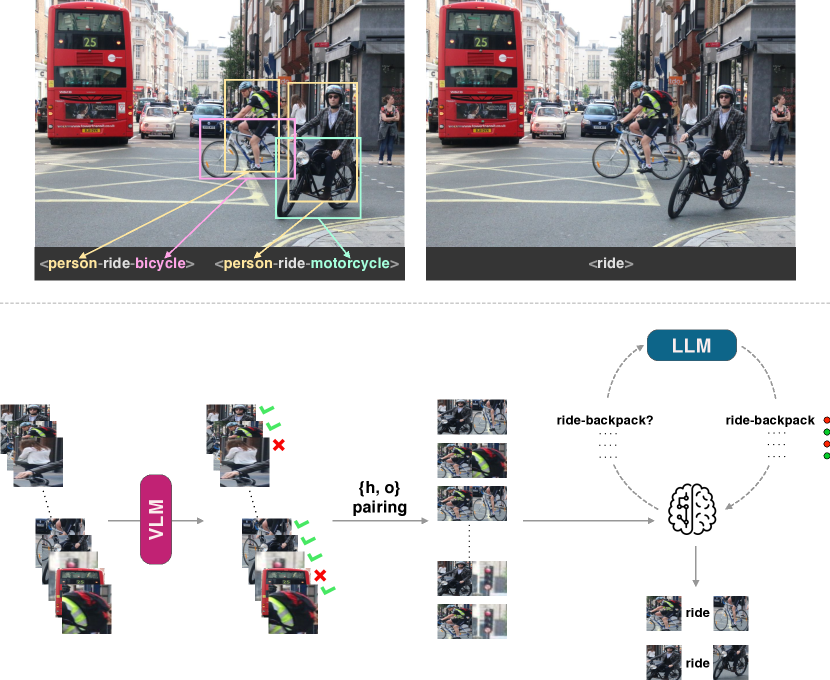
Human-object interaction (HOI) detection aims to extract interacting human-object pairs and their interaction categories from a given natural image. Even though the labeling effort required for building HOI detection datasets is inherently more extensive than for many other computer vision tasks, weakly-supervised directions in this area have not been sufficiently explored due to the difficulty of learning human-object interactions with weak supervision, rooted in the combinatorial nature of interactions over the object and predicate space. In this paper, we tackle HOI detection with the weakest supervision setting in the literature, using only image-level interaction labels, with the help of a pretrained vision-language model (VLM) and a large language model (LLM). We first propose an approach to prune non-interacting human and object proposals to increase the quality of positive pairs within the bag, exploiting the grounding capability of the vision-language model. Second, we use a large language model to query which interactions are possible between a human and a given object category, in order to force the model not to put emphasis on unlikely interactions. Lastly, we use an auxiliary weakly-supervised preposition prediction task to make our model explicitly reason about space. Extensive experiments and ablations show that all of our contributions increase HOI detection performance.
Motivation & Objective
- To address the high annotation cost of strong supervision in HOI detection by introducing a new weakly-supervised setting using only image-level interaction labels.
- To reduce the combinatorial complexity of human-object interactions by filtering out implausible interaction-object pairs using a large language model.
- To improve spatial reasoning in HOI detection through a weakly-supervised preposition prediction head.
- To train an HOI detector end-to-end using only image-caption pairs, extracting image-level labels via language parsing, enabling scalable weak supervision.
Proposed method
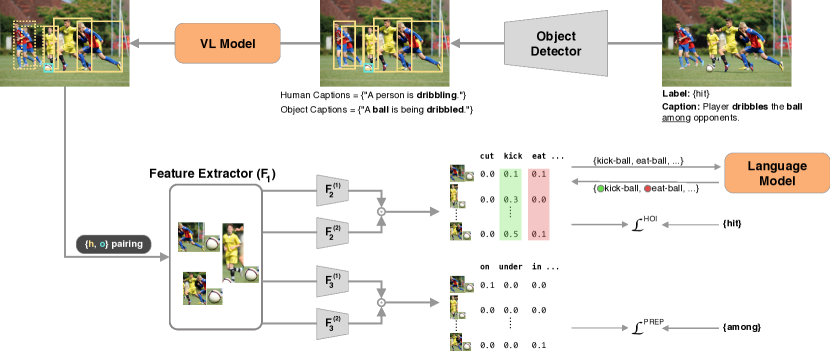
- Prune non-interacting human and object proposals using grounding signals from a vision-language model applied to image captions.
- Use a large language model to verify the plausibility of predicted $<$interaction, object$>$ pairs, suppressing implausible interactions.
- Introduce a weakly-supervised preposition prediction head to explicitly model spatial relationships between humans and objects.
- Extract image-level interaction labels from captions using a language parser, enabling fully weak supervision from image-caption pairs.
- Train an HOI detection model end-to-end on image-caption pairs, with supervision derived from image-level labels and auxiliary tasks.
- Combine all components in a unified framework that jointly optimizes for interaction classification, proposal pruning, plausibility filtering, and spatial reasoning.
Experimental results
Research questions
- RQ1Can HOI detection be effectively trained using only image-level interaction labels, without any bounding box or pair-level annotations?
- RQ2How can vision-language models be leveraged to improve proposal quality in weakly-supervised HOI detection?
- RQ3To what extent can a large language model reduce the search space of plausible interactions and improve detection accuracy?
- RQ4Can a weakly-supervised preposition prediction task enhance spatial reasoning in HOI detection?
- RQ5How robust is the proposed method to variations in caption quality and source (e.g., web-scraped vs. human-annotated)?
Key findings
- The proposed method improves baseline weakly-supervised HOI detection by 8.12% in Agent AP and 9.54% in Role AP on the V-COCO dataset.
- The ablation study confirms that each component—proposal pruning, interaction plausibility filtering, and preposition prediction—contributes significantly to performance gains.
- The method achieves a 1.33% absolute improvement over the baseline weakly-supervised SCG on HICO-DET, despite the higher combinatorial complexity of 117 interaction categories.
- The model generalizes well across caption sources: performance gains are consistent across V-COCO, HICO-DET, and Conceptual Captions, indicating robustness to caption quality.
- The preposition prediction head enhances spatial reasoning, particularly benefiting detection of interactions with clear spatial constraints (e.g., 'sit on' a horse).
- The use of language parsing to extract image-level labels from captions enables fully weak supervision, reducing dependency on costly annotations.
Read this paper
Open the full text in the Nubint reader and ask about any passage as you read.
Read this paper on NubintThis review was generated by AI from the original paper. Please check the paper before citing it.