
[论文解读] Weakly-supervised HOI Detection via Prior-guided Bi-level Representation Learning
本文提出了一种CLIP引导的双层表征学习框架,用于弱监督HOI检测,通过知识库和自教相关性分类,利用图像级和HOI实例级先验知识。该方法在HICO-DET和V-COCO数据集上实现了最先进性能,在罕见和细粒度交互任务上显著提升了准确率,同时减少了噪声的人-物关联。
Human object interaction (HOI) detection plays a crucial role in human-centric scene understanding and serves as a fundamental building-block for many vision tasks. One generalizable and scalable strategy for HOI detection is to use weak supervision, learning from image-level annotations only. This is inherently challenging due to ambiguous human-object associations, large search space of detecting HOIs and highly noisy training signal. A promising strategy to address those challenges is to exploit knowledge from large-scale pretrained models (e.g., CLIP), but a direct knowledge distillation strategy~\citep{liao2022gen} does not perform well on the weakly-supervised setting. In contrast, we develop a CLIP-guided HOI representation capable of incorporating the prior knowledge at both image level and HOI instance level, and adopt a self-taught mechanism to prune incorrect human-object associations. Experimental results on HICO-DET and V-COCO show that our method outperforms the previous works by a sizable margin, showing the efficacy of our HOI representation.
研究动机与目标
- 为解决弱监督HOI检测中的挑战,包括模糊的人-物关联、巨大的搜索空间以及噪声的图像级监督。
- 通过利用CLIP中的先验知识,改进细粒度和长尾HOI类别表征学习。
- 减少对物体检测器特征的依赖,这些特征不足以捕捉交互语义。
- 通过自教机制减少数据集偏差和噪声提议,以修剪错误关联。
- 开发一种双层知识融合策略,在图像级和成对级别增强HOI表征。
提出的方法
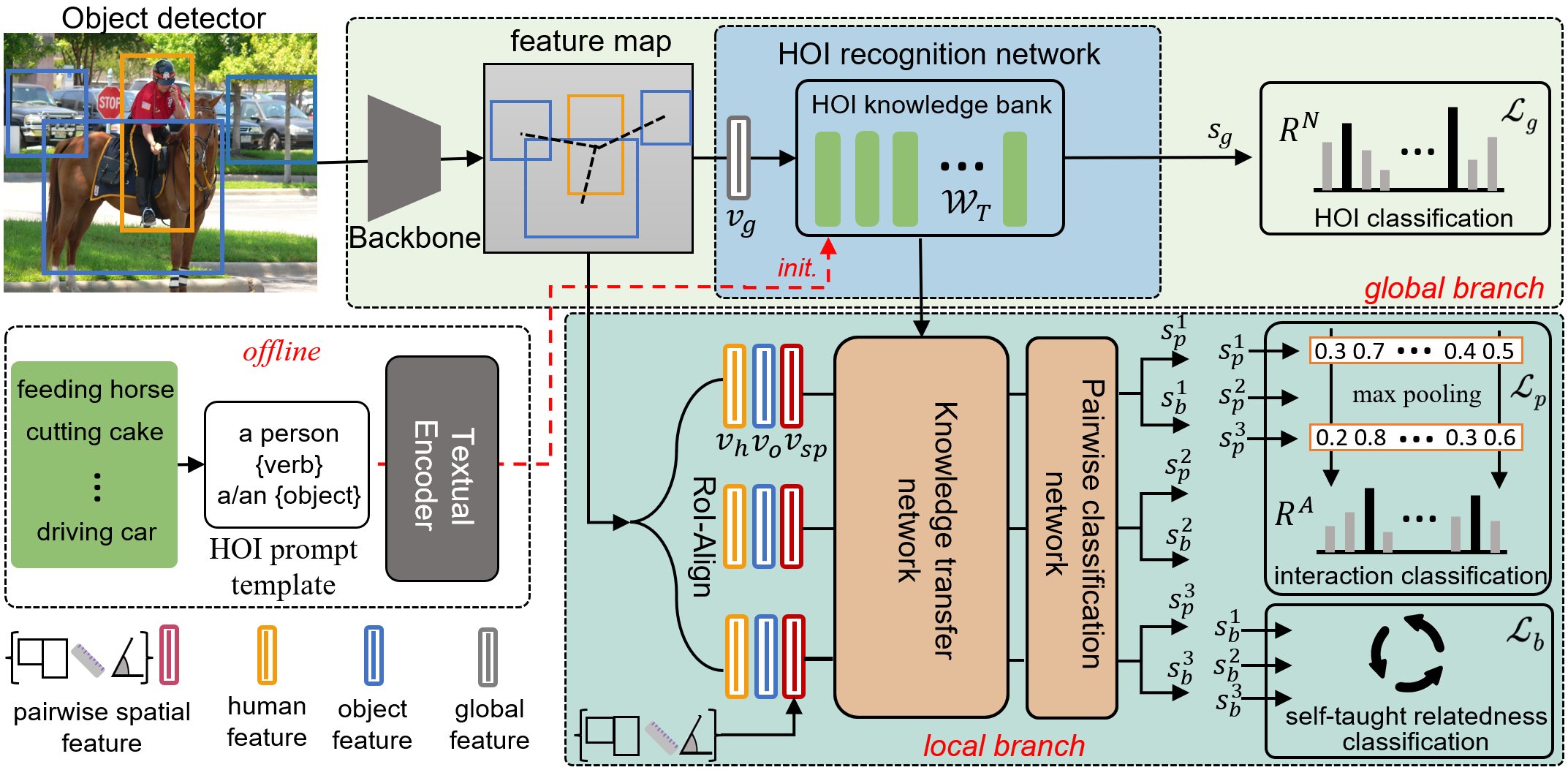
- 全局分支利用CLIP的视觉和文本嵌入生成图像级HOI预测,并构建关系知识库。
- 局部分支通过新颖的注意力机制,利用CLIP引导的知识库增强人-物提议特征。
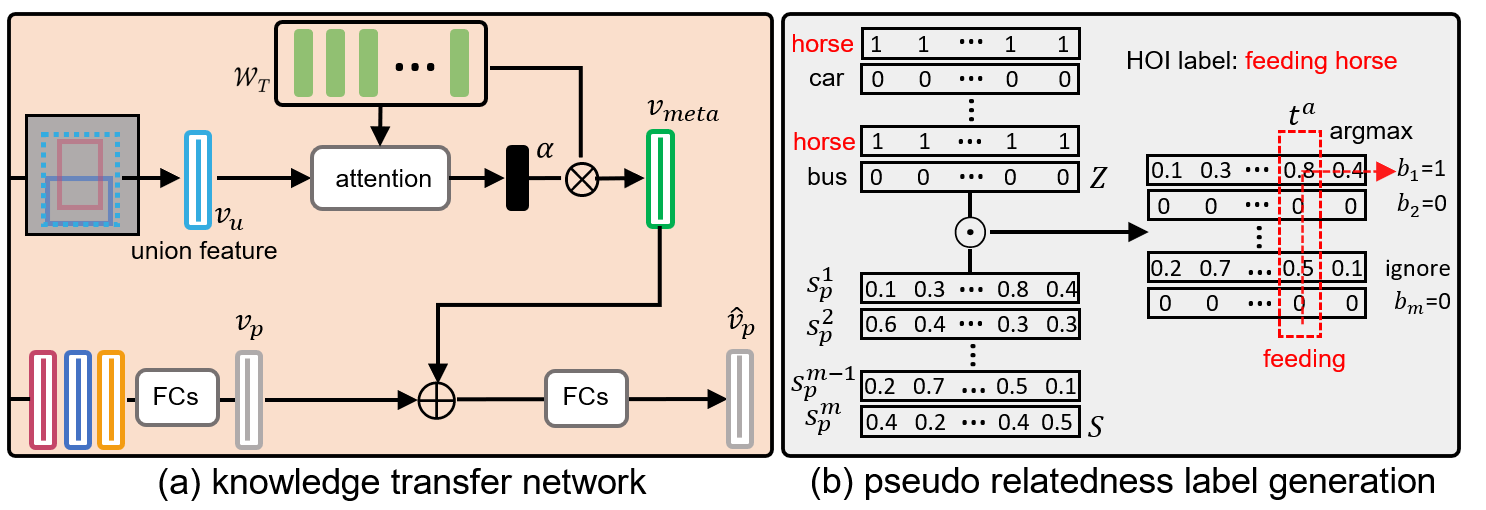
- 知识迁移网络(KTN)将知识库与基于区域的特征融合,以丰富成对交互表征。
- 自教相关性分类(SRC)头预测某个人-物对在语义上是否相关,从而抑制无关关联。
- 最终的HOI得分由全局分支和成对分支融合得到,训练仅依赖图像级标签。
- 视觉编码器和知识库从CLIP初始化,确保强泛化能力和先验知识整合。
实验结果
研究问题
- RQ1当仅有图像级标注可用时,基于CLIP的先验知识是否能提升弱监督HOI检测性能?
- RQ2如何通过图像级与实例级的双层知识融合,增强细粒度HOI识别的表征学习?
- RQ3在弱监督设置下,自教相关性分类头是否能有效抑制噪声的人-物关联?
- RQ4与随机初始化或检测预训练初始化相比,CLIP初始化在泛化能力和对长尾分布的鲁棒性方面是否表现更优?
- RQ5与先前方法相比,该方法在罕见和模糊HOI类别上的性能提升程度如何?
主要发现
- 所提方法在HICO-DET上实现了新的SOTA,Full mAP达到38.79,显著优于先前的弱监督方法。
- 在V-COCO上,该方法达到33.88 Full mAP,展现出在不同基准上的强大泛化能力。
- 当与KTN结合时,自教相关性分类(SRC)头使Full mAP提升0.49,表明能有效修剪错误关联。
- 模型在罕见HOI类别上达到16.20 mAP,比基线高出0.63 mAP,表明对长尾分布的处理能力更强。
- 知识库的随机初始化使罕见类别mAP从16.20降至15.57,证实了基于CLIP初始化的重要性。
- 定性结果表明,罕见HOI预测的置信度得到提升,且能更好地区分语义相似的交互(如repair_truck与inspect_truck)。
更好的研究,从现在开始
从阅读论文到最终审阅,大幅缩短您的研究时间。
无需绑定信用卡
本解读由 AI 生成,并经人工编辑审核。