
[Paper Review] Weakly-supervised Instance Segmentation via Class-agnostic Learning with Salient Images
This paper proposes BoxCaseg, a weakly-supervised instance segmentation method that leverages class-agnostic salient object detection as auxiliary memory to improve bounding box-supervised segmentation. By jointly training on 7,991 salient images and box-annotated images, and refining predictions via merging and dropping strategies, the method achieves performance on par with fully-supervised Mask R-CNN on PASCAL VOC and surpasses prior state-of-the-art on COCO with minimal weak supervision.
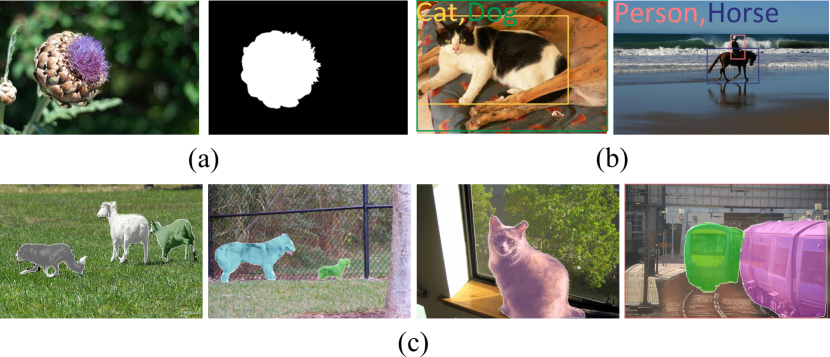
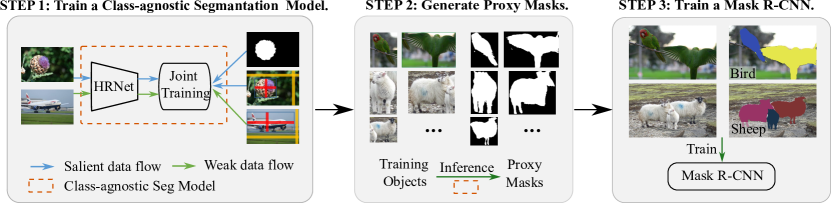
Humans have a strong class-agnostic object segmentation ability and can outline boundaries of unknown objects precisely, which motivates us to propose a box-supervised class-agnostic object segmentation (BoxCaseg) based solution for weakly-supervised instance segmentation. The BoxCaseg model is jointly trained using box-supervised images and salient images in a multi-task learning manner. The fine-annotated salient images provide class-agnostic and precise object localization guidance for box-supervised images. The object masks predicted by a pretrained BoxCaseg model are refined via a novel merged and dropped strategy as proxy ground truth to train a Mask R-CNN for weakly-supervised instance segmentation. Only using $7991$ salient images, the weakly-supervised Mask R-CNN is on par with fully-supervised Mask R-CNN on PASCAL VOC and significantly outperforms previous state-of-the-art box-supervised instance segmentation methods on COCO. The source code, pretrained models and datasets are available at \url{https://github.com/hustvl/BoxCaseg}.
Motivation & Objective
- To reduce annotation cost in instance segmentation by leveraging only bounding box and salient image annotations instead of pixel-level masks.
- To mimic human-like class-agnostic object segmentation by using salient images as auxiliary memory during training.
- To improve weakly-supervised instance segmentation performance through a novel proxy mask generation pipeline using merging and dropping strategies.
- To achieve state-of-the-art results on PASCAL VOC and COCO with minimal weak supervision, approaching fully-supervised performance.
Proposed method
- A multi-task learning framework jointly trains on box-supervised images and salient object detection images within a single deep network.
- The model uses weight transfer from multi-instance classification to pixel-level segmentation to enhance feature learning.
- A pretrained BoxCaseg model generates high-quality instance masks for box-supervised images, which are refined via a merged and dropped strategy to form proxy masks.
- The proxy masks are used to retrain a Mask R-CNN for weakly-supervised instance segmentation.
- The training strategy uses a fixed ratio of box-supervised to salient images per batch (e.g., 9:7) to balance data and improve stability.
- A weighted fusion of the salient segmentation head and transferred segmentation head is applied, with optimal performance at α=0.7.
Experimental results
Research questions
- RQ1Can salient object detection data serve as effective auxiliary memory to improve weakly-supervised instance segmentation with only bounding box annotations?
- RQ2How can proxy masks be effectively generated and refined to train a Mask R-CNN under weak supervision?
- RQ3What is the optimal balance between box-supervised and salient images during joint training to maximize performance?
- RQ4Does merging and dropping strategies for proxy masks significantly improve the quality of pseudo-labels in weakly-supervised training?
Key findings
- The method achieves 70.9 mIoU on COCO validation using only 7,991 salient images, outperforming previous state-of-the-art box-supervised methods.
- On PASCAL VOC, the approach matches the performance of fully-supervised Mask R-CNN, achieving 71.8 mIoU with a 0.7 weight on the transferred segmentation head.
- The merging strategy improves AP by 0.6 and AP75 by 0.9 on COCO, while the dropping strategy with a 0.95 IoU threshold yields the best results.
- The best performance is achieved with a 9:7 ratio of box-supervised to salient images per batch, yielding 70.9 mIoU on COCO.
- The weight transfer mechanism with α=0.7 provides a 1.3% improvement over using only one head, demonstrating robustness and effectiveness.
- The dropping strategy with a 0.95 IoU threshold achieves a 30.9 AP on COCO, with 80% of masks discarded, showing that high-quality masks are more beneficial than large volumes of medium-quality ones.
Read this paper
Open the full text in the Nubint reader and ask about any passage as you read.
Read this paper on NubintThis review was generated by AI from the original paper. Please check the paper before citing it.