
[Paper Review] What and How Well You Performed? A Multitask Learning Approach to Action Quality Assessment
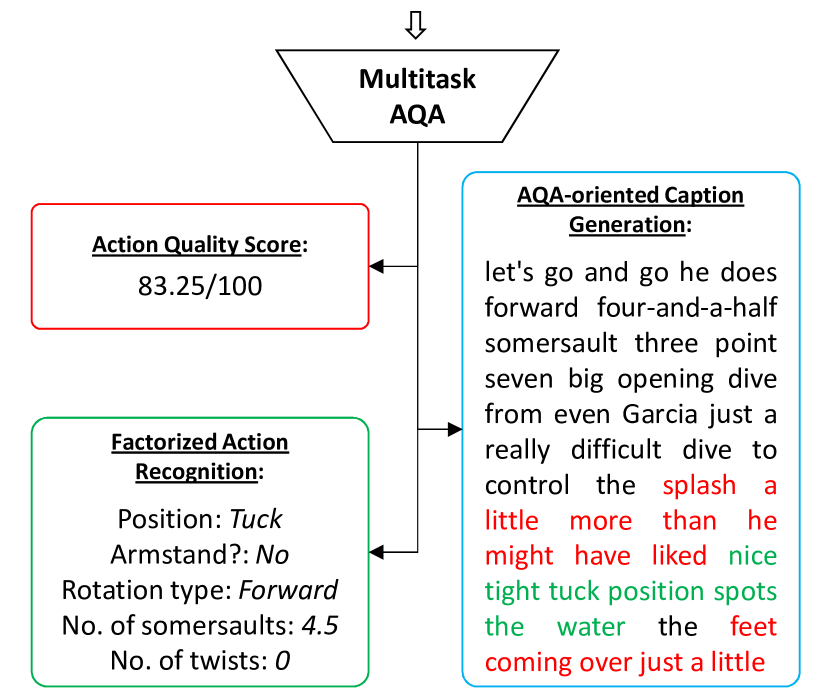
This paper proposes a multitask learning approach that jointly optimizes for action quality assessment (AQA), fine-grained action classification, and verbal commentary generation using 3D CNNs on a new, large-scale diving dataset. The method achieves state-of-the-art performance with a 90.44% rank correlation on AQA, outperforming single-task learning and demonstrating better generalization and AQA-specific feature learning than action-recognition baselines.
Can performance on the task of action quality assessment (AQA) be improved by exploiting a description of the action and its quality? Current AQA and skills assessment approaches propose to learn features that serve only one task - estimating the final score. In this paper, we propose to learn spatio-temporal features that explain three related tasks - fine-grained action recognition, commentary generation, and estimating the AQA score. A new multitask-AQA dataset, the largest to date, comprising of 1412 diving samples was collected to evaluate our approach (https://github.com/ParitoshParmar/MTL-AQA). We show that our MTL approach outperforms STL approach using two different kinds of architectures: C3D-AVG and MSCADC. The C3D-AVG-MTL approach achieves the new state-of-the-art performance with a rank correlation of 90.44%. Detailed experiments were performed to show that MTL offers better generalization than STL, and representations from action recognition models are not sufficient for the AQA task and instead should be learned.
Motivation & Objective
- To improve action quality assessment (AQA) by jointly learning representations for multiple related tasks beyond just scoring.
- To address the limitation of single-task learning in AQA, which relies only on final scores and fails to capture nuanced performance details.
- To create a large-scale, richly annotated dataset with factorized action classes and AQA-oriented commentary for training and evaluation.
- To demonstrate that multitask learning leads to better generalization and more discriminative feature representations for AQA than single-task learning.
- To validate the approach across different architectures and on unseen actions, showing transferability and robustness.
Proposed method
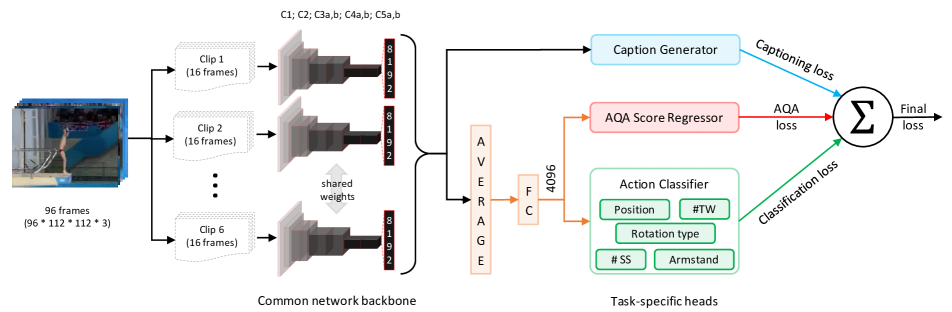
- Proposes a multitask learning framework that jointly trains a 3D CNN to predict AQA scores, fine-grained action classes, and natural language commentary from video clips.
- Uses C3D-AVG and MSCADC architectures as backbones to extract spatio-temporal features from video clips.
- Employs three distinct loss functions: one for AQA regression, one for factorized action classification, and one for sequence-to-sequence commentary generation.
- Trains the entire network end-to-end using a weighted sum of the three task-specific losses to optimize for all objectives simultaneously.
- Leverages existing broadcast footage to extract labels for action classification and commentary, minimizing additional annotation cost.
- Evaluates feature representations by training linear regressors on intermediate convolutional layer activations for zero-shot AQA on unseen actions.
Experimental results
Research questions
- RQ1Can joint learning of action description, commentary, and quality scoring improve AQA performance compared to single-task learning?
- RQ2Do multitask representations generalize better than those learned for action recognition alone, especially on unseen actions?
- RQ3Is the performance gain from multitask learning consistent across different network architectures?
- RQ4Can AQA-specific features learned through multitask training outperform action-recognition pre-trained features on zero-shot AQA evaluation?
- RQ5Does the inclusion of detailed action and commentary supervision lead to more interpretable and accurate quality assessments?
Key findings
- The C3D-AVG-MTL model achieves a rank correlation of 90.44% with human-annotated AQA scores, setting a new state-of-the-art performance.
- Multitask learning consistently outperforms single-task learning across all training set sizes, demonstrating improved generalization.
- AQA-specific features learned via multitask training generalize better to unseen actions (e.g., gymnastic vault) than features from action-recognition models.
- On out-of-dataset evaluation, the C3D-AVG-MTL model maintains superior performance compared to both action-recognition baselines, especially under domain shift.
- Linear regressors trained on intermediate layers of the MTL model achieve higher AQA correlation than those on action-recognition models, confirming better feature learning.
- The model trained on the new MTL-AQA dataset (1412 diving samples) shows strong transferability to other actions, indicating broad applicability.
Read this paper
Open the full text in the Nubint reader and ask about any passage as you read.
Read this paper on NubintThis review was generated by AI from the original paper. Please check the paper before citing it.