
[Paper Review] What Guides Our Choices? Modeling Developers' Trust and Behavioral Intentions Towards GenAI
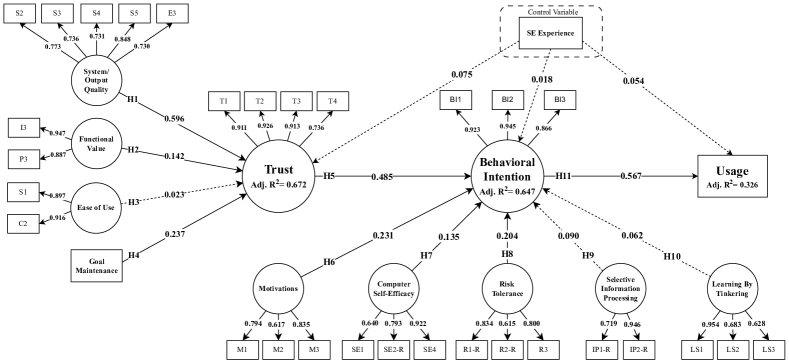
This study develops and validates a theoretical model identifying that genAI's system/output quality, functional value, and goal maintenance significantly predict developers' trust, which in turn, along with cognitive styles (motivation, self-efficacy, risk attitude), drives behavioral intentions to use these tools. The findings are based on PLS-SEM analysis of survey data from 238 developers at global tech firms.
Generative AI (genAI) tools, such as ChatGPT or Copilot, are advertised to improve developer productivity and are being integrated into software development. However, misaligned trust, skepticism, and usability concerns can impede the adoption of such tools. Research also indicates that AI can be exclusionary, failing to support diverse users adequately. One such aspect of diversity is cognitive diversity -- variations in users' cognitive styles -- that leads to divergence in perspectives and interaction styles. When an individual's cognitive style is unsupported, it creates barriers to technology adoption. Therefore, to understand how to effectively integrate genAI tools into software development, it is first important to model what factors affect developers' trust and intentions to adopt genAI tools in practice? We developed a theoretically grounded statistical model to (1) identify factors that influence developers' trust in genAI tools and (2) examine the relationship between developers' trust, cognitive styles, and their intentions to use these tools in their work. We surveyed software developers (N=238) at two major global tech organizations: GitHub Inc. and Microsoft; and employed Partial Least Squares-Structural Equation Modeling (PLS-SEM) to evaluate our model. Our findings reveal that genAI's system/output quality, functional value, and goal maintenance significantly influence developers' trust in these tools. Furthermore, developers' trust and cognitive styles influence their intentions to use these tools in their work. We offer practical suggestions for designing genAI tools for effective use and inclusive user experience.
Motivation & Objective
- To identify the key factors influencing developers’ trust in generative AI (genAI) tools within software development.
- To examine the relationship between developers’ trust, cognitive styles, and their behavioral intentions to adopt genAI tools.
- To develop an empirically grounded theoretical model for trust and behavioral intentions toward genAI in software engineering.
- To address inclusivity in AI design by considering cognitive diversity as a critical factor in technology adoption.
- To provide practical design guidelines that support equitable and effective integration of genAI tools in development workflows.
Proposed method
- Developed a theoretical model grounded in prior literature on trust (PICSE framework) and cognitive diversity.
- Collected survey data from 238 software developers across two major global tech organizations.
- Employed Partial Least Squares-Structural Equation Modeling (PLS-SEM) to test hypotheses and evaluate relationships between constructs.
- Used validated instruments to measure trust-related factors, cognitive styles, and behavioral intentions.
- Conducted psychometric validation (reliability, convergent and discriminant validity) of survey constructs.
- Applied attention checks, randomized question blocks, and pilot testing to enhance data quality and reduce response bias.
Experimental results
Research questions
- RQ1What factors predict developers’ trust in generative AI tools in software development?
- RQ2How are developers’ trust and cognitive styles associated with their intentions to use genAI tools?
- RQ3To what extent do system/output quality, functional value, and goal maintenance influence trust in genAI tools?
- RQ4How do cognitive styles—specifically intrinsic motivation, computer self-efficacy, and risk attitude—affect behavioral intentions toward genAI?
- RQ5How do trust and cognitive styles jointly predict actual usage intentions and behaviors?
Key findings
- GenAI’s system/output quality—encompassing performance, security, and output accuracy—significantly predicts developers’ trust in the tool.
- Functional value, including educational and practical benefits, is a strong predictor of developers’ trust in genAI tools.
- Goal maintenance—alignment between developers’ immediate objectives and genAI’s actions—has a significant positive influence on trust formation.
- Developers’ trust in genAI tools is a key driver of their behavioral intentions to use these tools in practice.
- Cognitive styles, particularly intrinsic motivation, computer self-efficacy within peer groups, and attitude toward risk, significantly influence behavioral intentions.
- The combination of trust and cognitive styles explains a substantial portion of the variance in developers’ reported intentions to use genAI tools in their work.
Read this paper
Open the full text in the Nubint reader and ask about any passage as you read.
Read this paper on NubintThis review was generated by AI from the original paper. Please check the paper before citing it.