
[Paper Review] What Is the Value Added by Using Causal Machine Learning Methods in a Welfare Experiment Evaluation?
This study evaluates whether causal machine learning (CML) methods add value over conventional estimators in analyzing the Jobs First welfare experiment. Using double machine learning with random forests and causal forests, it shows CML methods can support theoretical labor supply predictions when many covariates and continuous treatment effects are modeled—offering evidence conventional CATE estimators miss due to model restrictions and insufficient covariates.
Recent studies have proposed causal machine learning (CML) methods to estimate conditional average treatment effects (CATEs). In this study, I investigate whether CML methods add value compared to conventional CATE estimators by re-evaluating Connecticut's Jobs First welfare experiment. This experiment entails a mix of positive and negative work incentives. Previous studies show that it is hard to tackle the effect heterogeneity of Jobs First by means of CATEs. I report evidence that CML methods can provide support for the theoretical labor supply predictions. Furthermore, I document reasons why some conventional CATE estimators fail and discuss the limitations of CML methods.
Motivation & Objective
- To assess whether causal machine learning (CML) methods provide added value over conventional conditional average treatment effect (CATE) estimators in evaluating the Jobs First welfare experiment.
- To identify why conventional CATE estimators—particularly local constant models—fail to support established labor supply theory predictions despite data availability.
- To examine whether CATEs and quantile treatment effects (QTEs) contain nested or equivalent information in the context of the Jobs First program.
- To evaluate the importance of confounder adjustment and high-dimensional covariates in CML estimation for valid causal inference.
Proposed method
- Employs double machine learning (DML) with random forest and causal forest estimators to estimate CATEs in a randomized experiment.
- Uses a modified outcome approach with kitchen-sink covariates to include all available exogenous variables for effect heterogeneity.
- Applies data-driven subgrouping via tree-based algorithms (random forest) to avoid manual selection of strata and reduce overfitting risk.
- Compares CATE estimates from CML methods with QTEs from Bitler, Gelbach, and Hoynes (2006) to assess information overlap.
- Conducts Kolmogorov-Smirnov tests to formally test equality of potential and simulated earnings distributions, assessing whether CATEs and QTEs are nested.
- Implements confounder adjustment in the DML framework to correct for small imbalances in high-dimensional covariate spaces.
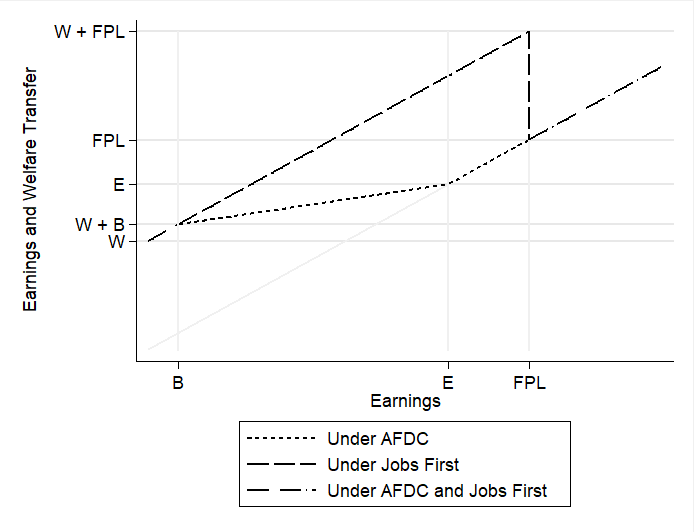
Experimental results
Research questions
- RQ1Do causal machine learning methods provide stronger empirical support for theoretical labor supply predictions than conventional CATE estimators in the Jobs First experiment?
- RQ2Why do conventional CATE estimators such as local constant models fail to detect effect heterogeneity consistent with labor supply theory?
- RQ3To what extent do CATEs estimated via CML methods contain the same information as quantile treatment effects (QTEs) in this context?
- RQ4How critical is confounder adjustment and inclusion of high-dimensional covariates for valid CATE estimation using machine learning methods?
- RQ5Can CML methods detect mass points in earnings distributions, such as the zero-earnings mass point, which QTEs can capture?
Key findings
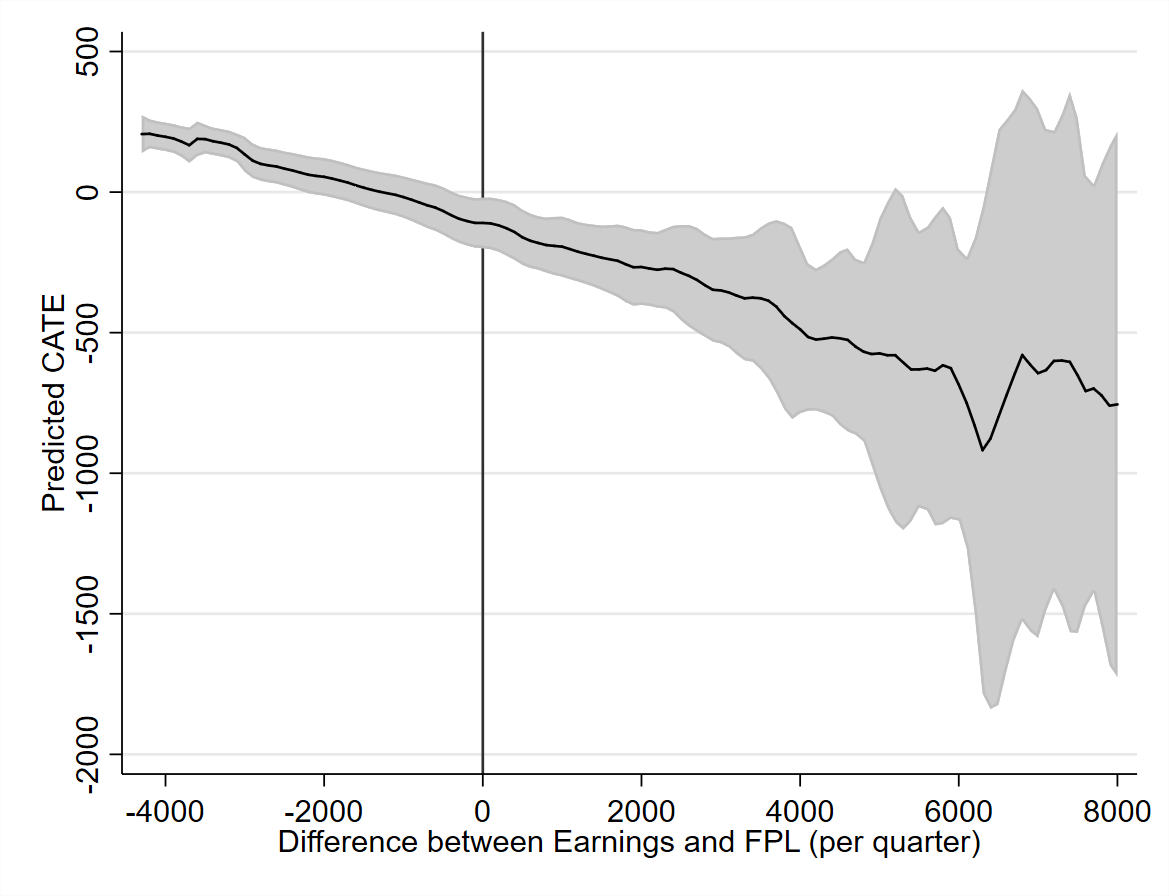
- Causal machine learning methods, particularly when using random forests and causal forests with kitchen-sink covariates, successfully provide empirical support for theoretical labor supply predictions in the Jobs First experiment.
- Conventional CATE estimators fail primarily due to suboptimal subgroup selection, constant-effect assumptions within groups, and insufficient covariate sets, even when data contain relevant heterogeneity.
- The modified outcome method without confounder adjustment fails to support theoretical predictions, even with random forest estimators, highlighting the necessity of confounder adjustment in high-dimensional settings.
- CATEs and QTEs do not contain the same information: Kolmogorov-Smirnov tests reject the equality of potential and simulated earnings distributions, indicating that CATEs cannot fully capture mass points like the zero-earnings point.
- CML methods cannot detect mass points in the outcome distribution, which limits their ability to fully represent the full distributional impact of policies.
- The value added by CML is conditional: it only emerges when many relevant covariates are included and continuous treatment effects are modeled, not when modeling assumptions are restrictive.
Read this paper
Open the full text in the Nubint reader and ask about any passage as you read.
Read this paper on NubintThis review was generated by AI from the original paper. Please check the paper before citing it.