
[Paper Review] What matters when building vision-language models?
This paper conducts controlled ablations of vision-language model design choices (architecture, backbones, data, and training) and introduces Idefics2, an 8B-parameter VLM that achieves strong performance with inference efficiency.
The growing interest in vision-language models (VLMs) has been driven by improvements in large language models and vision transformers. Despite the abundance of literature on this subject, we observe that critical decisions regarding the design of VLMs are often not justified. We argue that these unsupported decisions impede progress in the field by making it difficult to identify which choices improve model performance. To address this issue, we conduct extensive experiments around pre-trained models, architecture choice, data, and training methods. Our consolidation of findings includes the development of Idefics2, an efficient foundational VLM of 8 billion parameters. Idefics2 achieves state-of-the-art performance within its size category across various multimodal benchmarks, and is often on par with models four times its size. We release the model (base, instructed, and chat) along with the datasets created for its training.
Motivation & Objective
- Assess how backbone quality (vision and language) affects VLM performance under controlled conditions.
- Compare fully autoregressive versus cross-attention fusion architectures and assess stability with parameter-efficient fine-tuning.
Proposed method
- Systematic ablations of architecture, backbones, and data in a controlled setup.
- Use 6k-step benchmarks across VQAv2, TextVQA, OKVQA, and COCO to measure 4-shot performance.
- Develop and train Idefics2 (8B parameters) using multi-stage pre-training on OBELICS, image-text, and PDF data, followed by instruction tuning and chat-style alignment.
Experimental results
Research questions
- RQ1Which pre-trained unimodal backbones best support VLMs at a fixed parameter budget?
- RQ2How do fully autoregressive and cross-attention architectures compare when training/unfreezing backbones?
- RQ3Can efficiency be gained by reducing visual tokens and preserving aspect ratio without harming performance?
- RQ4Does image splitting and sub-image training trade compute for downstream gains, especially in OCR-heavy tasks?
Key findings
- Language-model backbone quality has a larger impact on VLM performance than vision backbone quality at a fixed parameter count.
- Fully autoregressive architecture with learned parameter-efficient fine-tuning can outperform cross-attention when backbones are trainable; cross-attention may win when backbones are frozen.
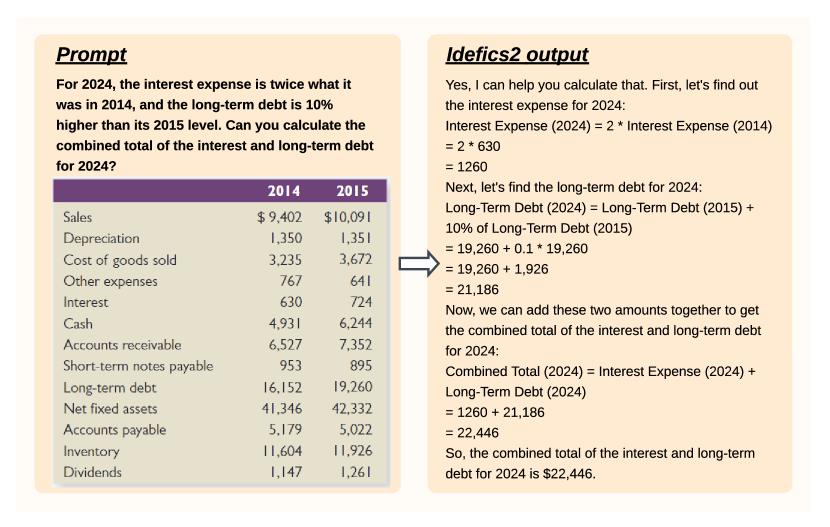
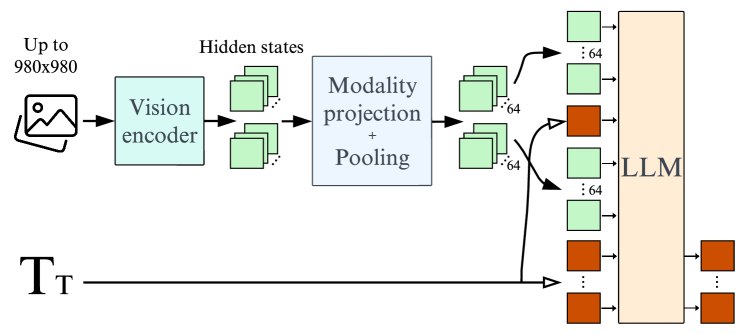
- Using a perceiver-style pooling to reduce visual tokens from hundreds to 64 tokens improves both training and inference efficiency while boosting downstream performance.
- Preserving image aspect ratio and resolution, with adaptable vision encoders, maintains performance while speeding up training and inference.
- Splitting images into sub-images during training boosts downstream performance, especially for tasks requiring reading text (OCR).
- Idefics2 achieves state-of-the-art or competitive results for its size, often matching larger models and delivering better OCR/text-reading capabilities, with open release of base, instructed, and chat variants.
Read this paper
Open the full text in the Nubint reader and ask about any passage as you read.
Read this paper on NubintThis review was generated by AI from the original paper. Please check the paper before citing it.