
[Paper Review] What Should We Engineer in Prompts? Training Humans in Requirement-Driven LLM Use
This paper introduces Requirement-Oriented Prompt Engineering (ROPE), a training paradigm that teaches novices to articulate clear, complete requirements for effective LLM prompting. Through deliberate practice with LLM-generated feedback, ROPE doubles novice prompting performance compared to conventional training, demonstrating that high-quality requirements directly enable high-quality LLM outputs.
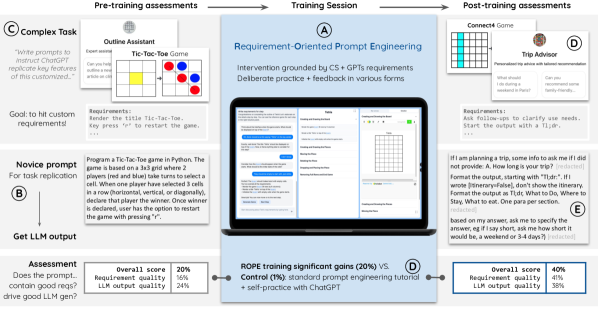
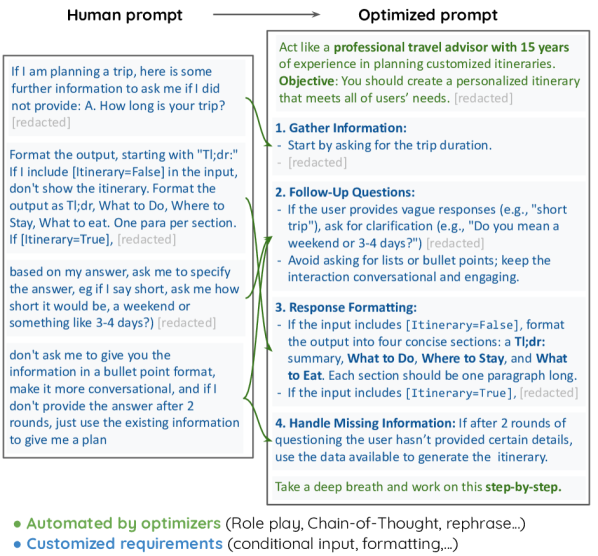
Prompting LLMs for complex tasks (e.g., building a trip advisor chatbot) needs humans to clearly articulate customized requirements (e.g., "start the response with a tl;dr"). However, existing prompt engineering instructions often lack focused training on requirement articulation and instead tend to emphasize increasingly automatable strategies (e.g., tricks like adding role-plays and "think step-by-step"). To address the gap, we introduce Requirement-Oriented Prompt Engineering (ROPE), a paradigm that focuses human attention on generating clear, complete requirements during prompting. We implement ROPE through an assessment and training suite that provides deliberate practice with LLM-generated feedback. In a randomized controlled experiment with 30 novices, ROPE significantly outperforms conventional prompt engineering training (20% vs. 1% gains), a gap that automatic prompt optimization cannot close. Furthermore, we demonstrate a direct correlation between the quality of input requirements and LLM outputs. Our work paves the way to empower more end-users to build complex LLM applications.
Motivation & Objective
- To address the challenge that novice users struggle to effectively convey customized requirements in LLM prompting, despite advances in prompt optimization.
- To shift focus from syntactic prompt refinement to requirement articulation as the core skill in prompt engineering.
- To design and evaluate a training system that improves novices' ability to write complete, specific requirements for complex LLM tasks.
- To establish a feedback loop where LLMs provide targeted, multimodal feedback on requirement quality to guide iterative improvement.
- To demonstrate that requirement quality is the primary determinant of LLM output effectiveness, even when other prompting techniques are optimized.
Proposed method
- Developed a training suite centered on deliberate practice, where users iteratively refine prompts based on LLM-generated feedback on requirement quality.
- Implemented a pre-post experimental design with 30 novices, assessing both requirement quality and final prompt effectiveness.
- Designed assessments that link requirement completeness and specificity to actual LLM output quality, using counter-balanced task replication (e.g., replicating a Trip Advisor chatbot).
- Integrated multimodal feedback from LLMs, including clarifications, suggestions, and explanations of misinterpretations, to guide users in refining requirements.
- Defined and measured requirement quality using intrinsic metrics (e.g., completeness, specificity) and extrinsic metrics (e.g., task success, output correctness).
- Used LLMs to simulate and reveal biases in requirement interpretation, prompting users to refine ambiguous or overly broad requirements.
Experimental results
Research questions
- RQ1Does training focused on requirement articulation significantly improve novice users’ ability to generate effective prompts for complex LLM tasks?
- RQ2How does ROPE training compare to conventional prompt engineering training in terms of prompting performance and requirement quality?
- RQ3To what extent is the quality of LLM output determined by the quality of input requirements, independent of other prompting techniques?
- RQ4Can LLM-generated feedback effectively guide users in refining their requirements, especially in identifying missing or ambiguous elements?
- RQ5How do users’ ability to specify requirements vary with task complexity and domain expertise, and can training adapt to these differences?
Key findings
- ROPE training doubled the prompting performance of novices compared to conventional prompt engineering training, with a statistically significant improvement in both requirement quality and final output effectiveness.
- The quality of input requirements was the strongest predictor of LLM output quality, even when other prompting techniques were held constant.
- Novices trained with ROPE demonstrated a marked improvement in specifying key behavioral requirements, such as handling diverse inputs and managing edge cases.
- LLM-generated feedback on requirements significantly improved users’ ability to identify and correct ambiguities and omissions in their prompts.
- Participants in the ROPE group were more likely to include critical requirements like 'ask follow-ups' and 'handle ambiguous inputs' compared to the control group.
- The study revealed that even experienced users often fail to articulate LLM-hard requirements, highlighting the need for structured training in requirement specification.
Better researchstarts right now
From reading papers to final review, dramatically reduce your research time.
No credit card · Free plan available
This review was created by AI and reviewed by human editors.