
[Paper Review] When do Generative Query and Document Expansions Fail? A Comprehensive Study Across Methods, Retrievers, and Datasets
This study investigates when large language model (LLM)-based query and document expansions fail in information retrieval. It finds that expansions significantly improve weaker retrievers but harm stronger models due to noise that degrades relevance ranking, suggesting expansions should be reserved for low-performing or out-of-distribution settings where they help bridge distribution gaps.
Using large language models (LMs) for query or document expansion can improve generalization in information retrieval. However, it is unknown whether these techniques are universally beneficial or only effective in specific settings, such as for particular retrieval models, dataset domains, or query types. To answer this, we conduct the first comprehensive analysis of LM-based expansion. We find that there exists a strong negative correlation between retriever performance and gains from expansion: expansion improves scores for weaker models, but generally harms stronger models. We show this trend holds across a set of eleven expansion techniques, twelve datasets with diverse distribution shifts, and twenty-four retrieval models. Through qualitative error analysis, we hypothesize that although expansions provide extra information (potentially improving recall), they add additional noise that makes it difficult to discern between the top relevant documents (thus introducing false positives). Our results suggest the following recipe: use expansions for weaker models or when the target dataset significantly differs from training corpus in format; otherwise, avoid expansions to keep the relevance signal clear.
Motivation & Objective
- To understand whether LLM-based query and document expansions universally improve retrieval or depend on model strength.
- To evaluate how expansion effectiveness varies across different retrieval models, datasets, and distribution shifts.
- To identify conditions under which expansions degrade performance despite adding information.
- To provide a principled recommendation on when to use expansions based on model capability and data distribution.
Proposed method
- The study evaluates 11 expansion techniques across 24 retrieval models and 12 datasets with diverse distribution shifts.
- It uses a standardized evaluation protocol with standard IR metrics (e.g., MRR, Recall) on BEIR and other benchmark datasets.
- Expansions are applied via instruction-tuned LLMs (e.g., GPT-3.5, Llama-2) to generate additional query or document text.
- The analysis compares performance with and without expansions across first-stage retrievers (e.g., BM25, ColBERT, bi-encoders) and rerankers (e.g., BERT, DeBERTa).
- Qualitative error analysis is conducted to examine failure modes, particularly false positives in top-ranked results.
- Statistical correlation analysis is used to quantify the relationship between retriever performance and gains from expansion.
Experimental results
Research questions
- RQ1RQ1: How does the performance of the retrieval model affect the gains from LLM-based query and document expansion?
- RQ2RQ2: How do different types of distribution shifts (e.g., domain, format, relevance, query length) influence the effectiveness of expansions?
- RQ3RQ3: Why do expansions harm stronger retrieval models despite adding potentially useful information?
- RQ4RQ4: Are there specific conditions under which expansions consistently improve performance, even for strong models?
Key findings
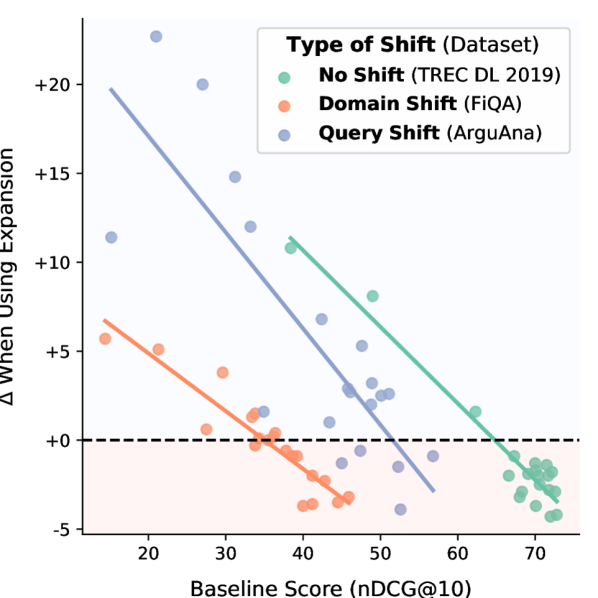
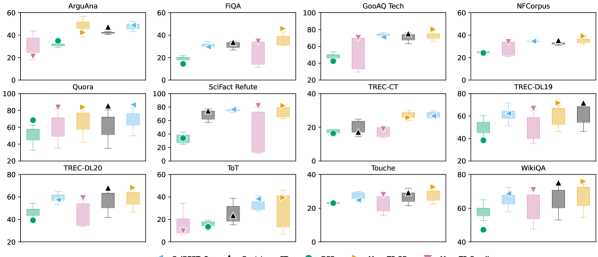
- There is a strong negative correlation between retriever performance and gains from expansion: weaker models benefit, while stronger models consistently see performance degradation.
- The negative impact of expansions on strong models holds across 11 expansion techniques, 12 datasets, and 24 retrieval models, indicating a general trend.
- Expansions increase recall by adding relevant context but introduce noise that degrades precision, leading to more false positives in top-ranked results.
- The only exception is long query shift, where expansions help all models, including strong ones, suggesting query length is a key factor in expansion utility.
- The study finds no benefit from expansions in format shift scenarios beyond what is already achieved by strong models.
- The results suggest that expansions should be avoided for strong models to preserve a clean relevance signal, and are most effective when used with weaker models or in out-of-distribution settings.
Read this paper
Open the full text in the Nubint reader and ask about any passage as you read.
Read this paper on NubintThis review was generated by AI from the original paper. Please check the paper before citing it.