
[Paper Review] When Less is More: Investigating Data Pruning for Pretraining LLMs at Scale
This paper investigates data pruning for pretraining large language models (LLMs) at scale, proposing that simple perplexity-based ranking outperforms complex metrics like EL2N and memorization. Surprisingly, models trained on just 30% of the original dataset—selected via perplexity—achieved up to 2.1% better performance than those pruned using more sophisticated methods, demonstrating that less data can yield better results when quality is prioritized over quantity.
Large volumes of text data have contributed significantly to the development of large language models (LLMs) in recent years. This data is typically acquired by scraping the internet, leading to pretraining datasets comprised of noisy web text. To date, efforts to prune these datasets down to a higher quality subset have relied on hand-crafted heuristics encoded as rule-based filters. In this work, we take a wider view and explore scalable estimates of data quality that can be used to systematically measure the quality of pretraining data. We perform a rigorous comparison at scale of the simple data quality estimator of perplexity, as well as more sophisticated and computationally intensive estimates of the Error L2-Norm and memorization. These metrics are used to rank and prune pretraining corpora, and we subsequently compare LLMs trained on these pruned datasets. Surprisingly, we find that the simple technique of perplexity outperforms our more computationally expensive scoring methods. We improve over our no-pruning baseline while training on as little as 30% of the original training dataset. Our work sets the foundation for unexplored strategies in automatically curating high quality corpora and suggests the majority of pretraining data can be removed while retaining performance.
Motivation & Objective
- To evaluate whether data pruning can improve LLM performance by selecting higher-quality training examples.
- To compare the effectiveness of simple vs. complex data quality estimators—perplexity, EL2N, and memorization—in pretraining LLMs.
- To investigate whether removing low-impact examples from massive web-scraped datasets improves model performance while reducing data volume.
- To establish a scalable, automated framework for high-quality corpus curation without reliance on human-annotated quality labels.
- To understand how pruning strategies affect model generalization across different model sizes, datasets, and training steps.
Proposed method
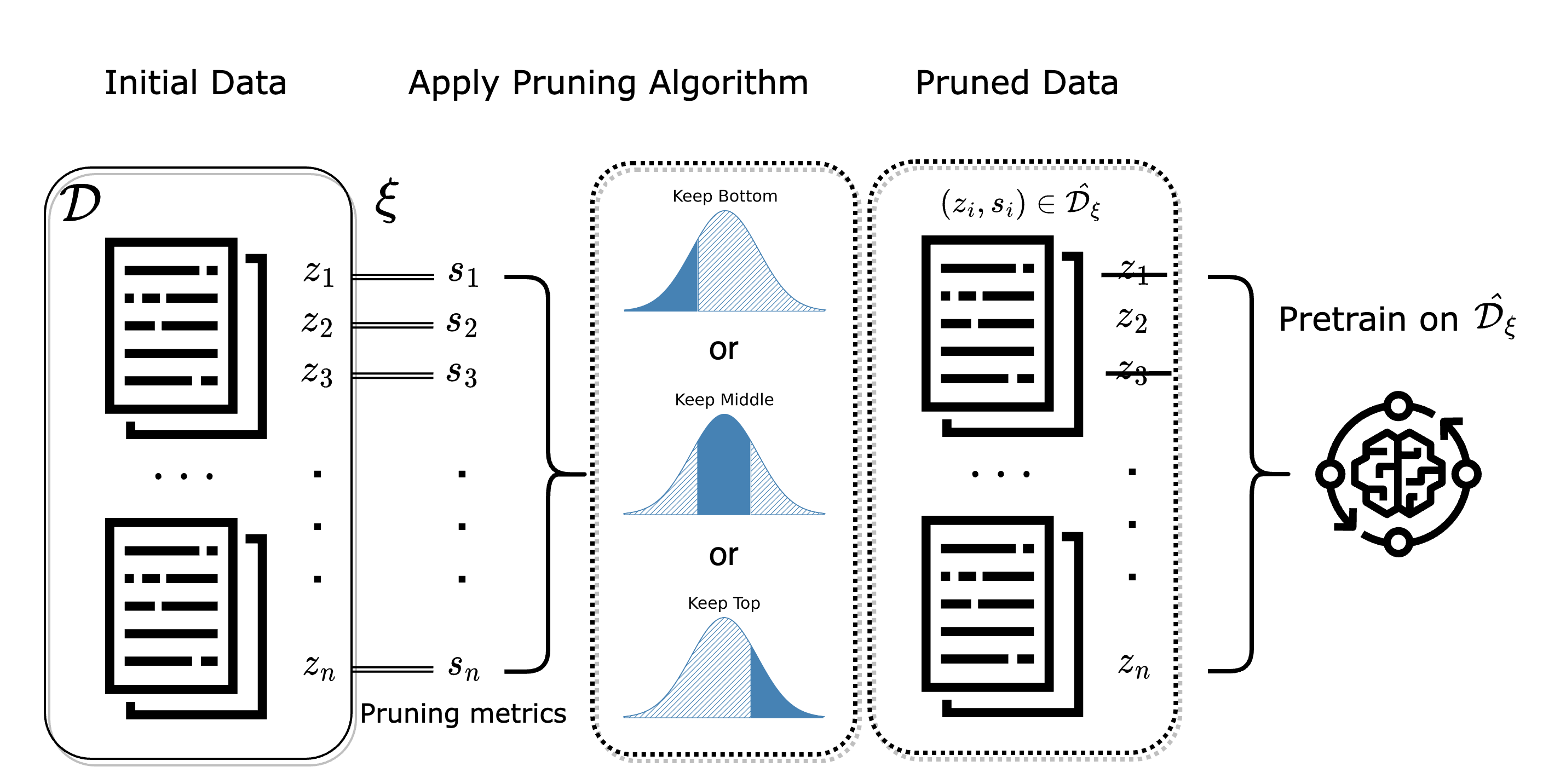
- The authors use a reference LLM to compute perplexity, EL2N, and memorization scores for each sequence in a pretraining dataset.
- They rank all training sequences based on these scores and retain only the top, middle, or bottom percentages (10%, 30%, 50%, 70%) of the distribution.
- A new LLM is fine-tuned from scratch on the pruned dataset, using the same hyperparameters as the baseline.
- The method is applied across multiple model sizes (124M to 1.5B parameters), multiple pretraining datasets, and varying total training steps.
- Performance is evaluated via test set perplexity and downstream GLUE benchmark results.
- The framework enables systematic comparison of pruning strategies across different data subsets and model configurations.
Experimental results
Research questions
- RQ1Can data pruning based on automatic quality estimators improve LLM performance compared to training on the full dataset?
- RQ2Does a simple perplexity-based pruning method outperform more complex, computationally intensive metrics like EL2N and memorization?
- RQ3How does the choice of data subset (top, middle, bottom scores) affect model performance across different model sizes and training data volumes?
- RQ4Does pruning preserve or enhance downstream generalization capabilities on benchmarks like GLUE?
- RQ5Can significant data reduction (e.g., 70% less data) maintain or improve model performance when guided by quality estimation?
Key findings
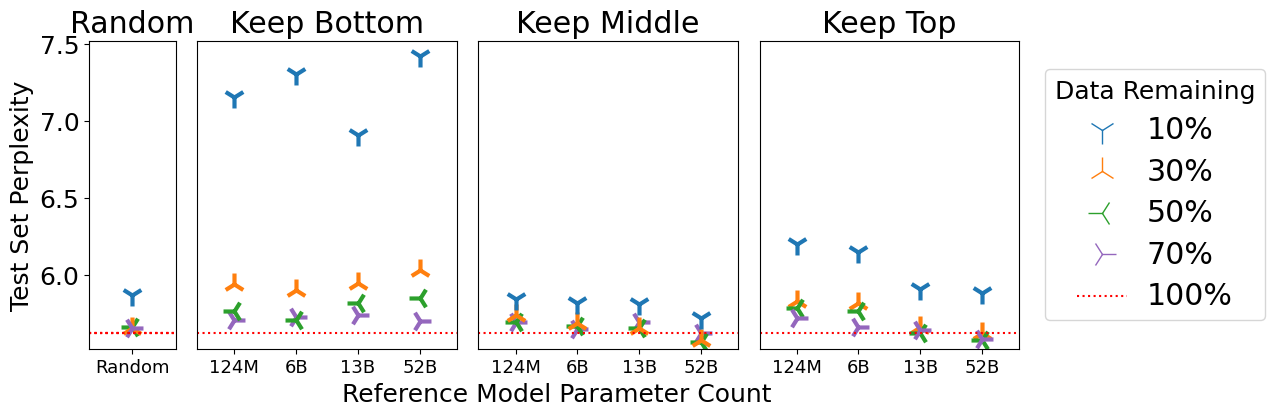
- Perplexity-based pruning outperformed both EL2N and memorization-based pruning across all model sizes and data volumes.
- A model trained on only 30% of the original dataset using perplexity pruning achieved a 2.1% improvement in test perplexity over the best EL2N-pruned model and a 1.6% improvement over the best memorization-pruned model.
- Even with 50% of the data, the perplexity-pruned model outperformed the full-baseline model by 1.33% and 1.77% over EL2N and memorization-based models respectively.
- The performance gains from pruning were consistent across different model sizes (124M to 1.5B parameters), indicating scalability of the approach.
- Pruning the lowest-perplexity (easiest) examples degraded performance, indicating that 'easiest' data is not optimal for pretraining.
- The study achieved a 1% improvement in test perplexity using only half the data when pruned via perplexity, demonstrating high data efficiency.
Read this paper
Open the full text in the Nubint reader and ask about any passage as you read.
Read this paper on NubintThis review was generated by AI from the original paper. Please check the paper before citing it.