
[Paper Review] When Services Computing Meets Blockchain: Challenges and Opportunities
This paper investigates the integration of blockchain technology with services computing to address key challenges including privacy risks, information silos, and incentive mechanisms. By leveraging blockchain’s decentralization, smart contracts, and cryptographic security, the study proposes a unified framework that enhances trust, interoperability, and automation across service lifecycle stages such as creation, discovery, composition, and arbitration, with Blockchain-as-a-Service (BaaS) emerging as a key enabler for scalable deployment.
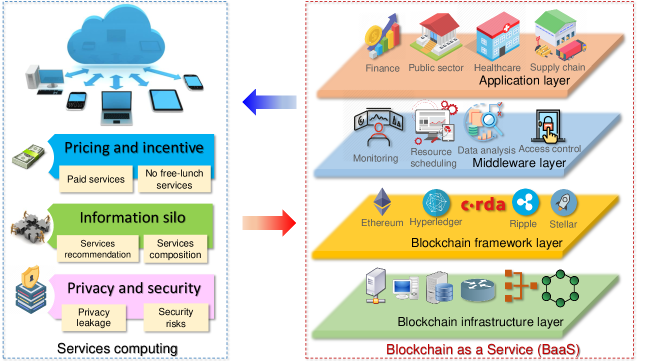
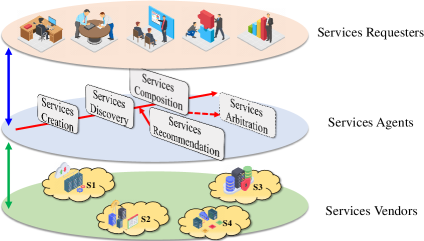
Services computing can offer a high-level abstraction to support diverse applications via encapsulating various computing infrastructures. Though services computing has greatly boosted the productivity of developers, it is faced with three main challenges: privacy and security risks, information silo, and pricing mechanisms and incentives. The recent advances of blockchain bring opportunities to address the challenges of services computing due to its build-in encryption as well as digital signature schemes, decentralization feature, and intrinsic incentive mechanisms. In this paper, we present a survey to investigate the integration of blockchain with services computing. The integration of blockchain with services computing mainly exhibits merits in two aspects: i) blockchain can potentially address key challenges of services computing and ii) services computing can also promote blockchain development. In particular, we categorize the current literature of services computing based on blockchain into five types: services creation, services discovery, services recommendation, services composition, and services arbitration. Moreover, we generalize Blockchain as a Service (BaaS) architecture and summarize the representative BaaS platforms. In addition, we also outline open issues of blockchain-based services computing and BaaS.
Motivation & Objective
- To analyze the core challenges in services computing: privacy and security risks, information silos, and pricing/incentive mechanisms.
- To investigate how blockchain technology can address these challenges through decentralization, encryption, and smart contracts.
- To categorize blockchain-based services computing into five key areas: creation, discovery, recommendation, composition, and arbitration.
- To survey and compare existing Blockchain-as-a-Service (BaaS) platforms and their architectural designs.
- To identify open technical and non-technical challenges in blockchain-based services computing and BaaS for future research.
Proposed method
- Categorizing existing literature on blockchain-integrated services computing into five service lifecycle phases: creation, discovery, recommendation, composition, and arbitration.
- Analyzing blockchain’s core features—cryptography, decentralization, smart contracts, and intrinsic incentives—as enablers for solving services computing challenges.
- Proposing a hierarchical BaaS architecture to abstract blockchain infrastructure and support diverse application workloads.
- Surveying representative BaaS platforms (e.g., Amazon QLDB, Azure Blockchain, IBM Blockchain) based on their stack, scalability, and integration capabilities.
- Identifying technical and non-technical barriers such as system complexity, high costs, regulatory risks, and lack of standardization.
- Using comparative analysis to evaluate BaaS platforms across dimensions like extensibility, security, and developer accessibility.
Experimental results
Research questions
- RQ1How can blockchain technology mitigate privacy and security risks in services computing?
- RQ2In what ways does blockchain help overcome information silos in distributed service ecosystems?
- RQ3How do smart contracts and decentralized incentives improve pricing and incentive mechanisms in services computing?
- RQ4What are the key architectural patterns and functional components of Blockchain-as-a-Service (BaaS) platforms?
- RQ5What are the major open challenges—technical and non-technical—in deploying blockchain-based services computing at scale?
Key findings
- Blockchain’s built-in encryption and digital signatures significantly reduce data misuse and privacy leakage in services computing.
- Decentralization mitigates risks from centralized attacks such as DDoS and system failures, enhancing system resilience.
- Smart contracts enable automated, trustless incentives, such as rewarding developers for contributions or bug reporting, improving ecosystem engagement.
- BaaS platforms like Amazon QLDB and IBM Blockchain provide abstraction layers that simplify blockchain deployment and management for service developers.
- Despite progress, BaaS platforms still lack flexibility, especially in supporting serverless and microservices-based service architectures.
- Security vulnerabilities such as DAO exploits and transaction deanonymization remain open challenges, even in public blockchains.
Better researchstarts right now
From reading papers to final review, dramatically reduce your research time.
No credit card · Free plan available
This review was created by AI and reviewed by human editors.