
[Paper Review] Where are NANOGrav's big black holes?
This paper investigates the discrepancy between the gravitational wave background (GWb) amplitude measured by pulsar timing arrays (PTAs) and theoretical predictions based on local supermassive black hole (SMBH) mass functions. Using the Phinney (2001) formalism, it shows that the observed GWb amplitude cannot be explained by increased merger rates or mass-dependent evolution, and instead implies that the GWb is dominated by SMBHs of mass ∼3×10¹⁰ M☉—about ten times more massive than previously inferred from local observations—requiring a previously undetected population of such massive black holes within 100 Mpc.
Multiple pulsar timing array (PTA) collaborations have recently reported the first detection of gravitational waves (GWs) of nanohertz frequencies. The signal is expected to be primarily sourced by inspiralling supermassive black hole binaries (SMBHBs) and these first results are broadly consistent with the expected GW spectrum from such a population. Curiously, the measured amplitude of the GW background in all announced results is a bit larger than theoretical predictions. In this work, we show that the amplitude of the stochastic gravitational wave background (SGWB) predicted from the present-day abundance of SMBHs derived from local scaling relations is significantly smaller than that measured by the PTAs. We demonstrate that this difference cannot be accounted for through changes in the merger history of SMBHs and that there is an upper limit to the boost to the characteristic strain from multiple merger events, due to the fact that they involve black holes of decreasing masses. If we require the current estimate of the black hole mass density -- equal to the integrated quasar luminosity function through the classic Soltan argument -- to be preserved, then the currently measured PTA result would imply that the typical total mass of SMBHs contributing to the background should be at least $\sim 3 imes 10^{10} M_\odot$, a factor of $\sim 10$ larger than previously predicted. The required space density of such massive black holes corresponds to order $10$ $3 imes 10^{10} M_\odot$ SMBHs within the volume accessible by stellar and gas dynamical SMBH measurements. By virtue of the GW signal being dominated by the massive end of the SMBH distribution, PTA measurements offer a unique window into such rare objects and complement existing electromagnetic observations.
Motivation & Objective
- To resolve the tension between the observed amplitude of the nanohertz gravitational wave background (GWb) from PTAs and theoretical predictions based on local SMBH mass functions.
- To determine whether enhanced merger rates or mass evolution in SMBHs can account for the excess GWb amplitude.
- To assess the implications of preserving the total black hole mass density (via the Sołtan argument) while matching the PTA measurement.
- To identify the required SMBH mass function peak that would reconcile GW and electromagnetic observations.
- To test whether modifications to the M–σ relation or velocity dispersion function can explain the missing high-mass population.
Proposed method
- Adapts the Phinney (2001) formalism to link the present-day SMBH population to the stochastic GW background (SGWB) via the merger history of binaries.
- Uses the Sołtan argument to preserve the total black hole mass density, constraining the required high-mass tail of the SMBH mass function.
- Applies the Hénon–Hertzsprung relation to model the characteristic strain of the SGWB as a function of the SMBH mass function.
- Quantifies the maximum possible boost to the GW strain from multiple mergers, showing it is limited to ∼1.64 due to decreasing black hole masses.
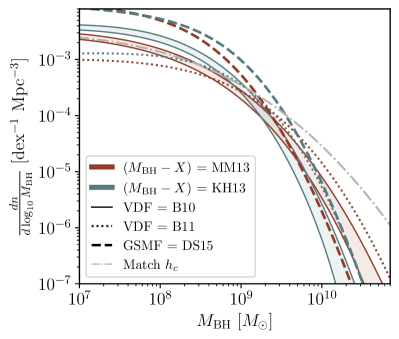
- Evaluates the impact of varying the intrinsic scatter (ε₀) and turnover scale (σ*) in the M–σ relation and velocity dispersion function (VDF).
- Tests whether a steeper M–σ relation at high velocity dispersions can account for the required high-mass population, while remaining consistent with observed residuals.
Experimental results
Research questions
- RQ1Can the excess amplitude of the PTA-measured gravitational wave background be explained by an increased merger rate of SMBHs?
- RQ2What is the maximum possible boost to the characteristic strain from multiple merger events involving progressively lighter black holes?
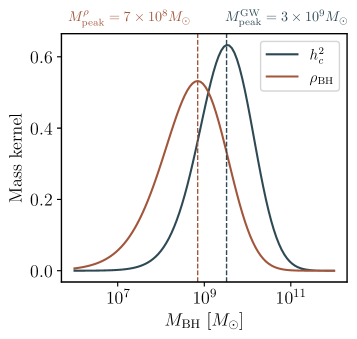
- RQ3What SMBH mass function peak is required to match the PTA GWb amplitude while preserving the total black hole mass density from the Sołtan argument?
- RQ4Are the required modifications to the M–σ relation or VDF consistent with current observational constraints on SMBH mass and velocity dispersion?
- RQ5What is the predicted local space density of ultra-massive SMBHs (M ∼ 3×10¹⁰ M☉) needed to explain the observed GWb?
Key findings
- The observed PTA GWb amplitude exceeds theoretical predictions based on local SMBH mass functions by a significant margin, even when accounting for merger history.
- The maximum theoretical boost to the characteristic strain from multiple mergers is limited to ∼1.64, which is insufficient to explain the observed excess.
- To reconcile the PTA measurement with the total black hole mass density (via the Sołtan argument), the peak mass contributing to the GWb must be ∼3×10¹⁰ M☉—about ten times higher than predicted from local observations.
- The required local space density corresponds to approximately 10 SMBHs of mass ∼3×10¹⁰ M☉ or one of mass ∼10¹¹ M☉ within 100 Mpc, a population not yet detected via stellar or gas dynamical measurements.
- Modifications to the M–σ relation's intrinsic scatter or turnover scale cannot account for the required high-mass population without violating observational constraints from residual fits.
- A steeper M–σ relation at high velocity dispersions could explain the missing high-mass tail, but even this effect falls short of fully resolving the discrepancy, implying a larger underlying population of massive SMBHs.
Read this paper
Open the full text in the Nubint reader and ask about any passage as you read.
Read this paper on NubintThis review was generated by AI from the original paper. Please check the paper before citing it.