
[Paper Review] Which is better? Exploring Prompting Strategy For LLM-based Metrics
This paper investigates prompting strategies for open-source LLMs as natural language generation (NLG) evaluation metrics, comparing human- and model-generated instruction templates, score granularity, in-context learning with exemplars, and aggregation methods. It finds that model-guided prompts with structured criteria and 0–100 scoring yield higher human correlation than traditional 1–5 scales, and that rationale generation enhances explainability.
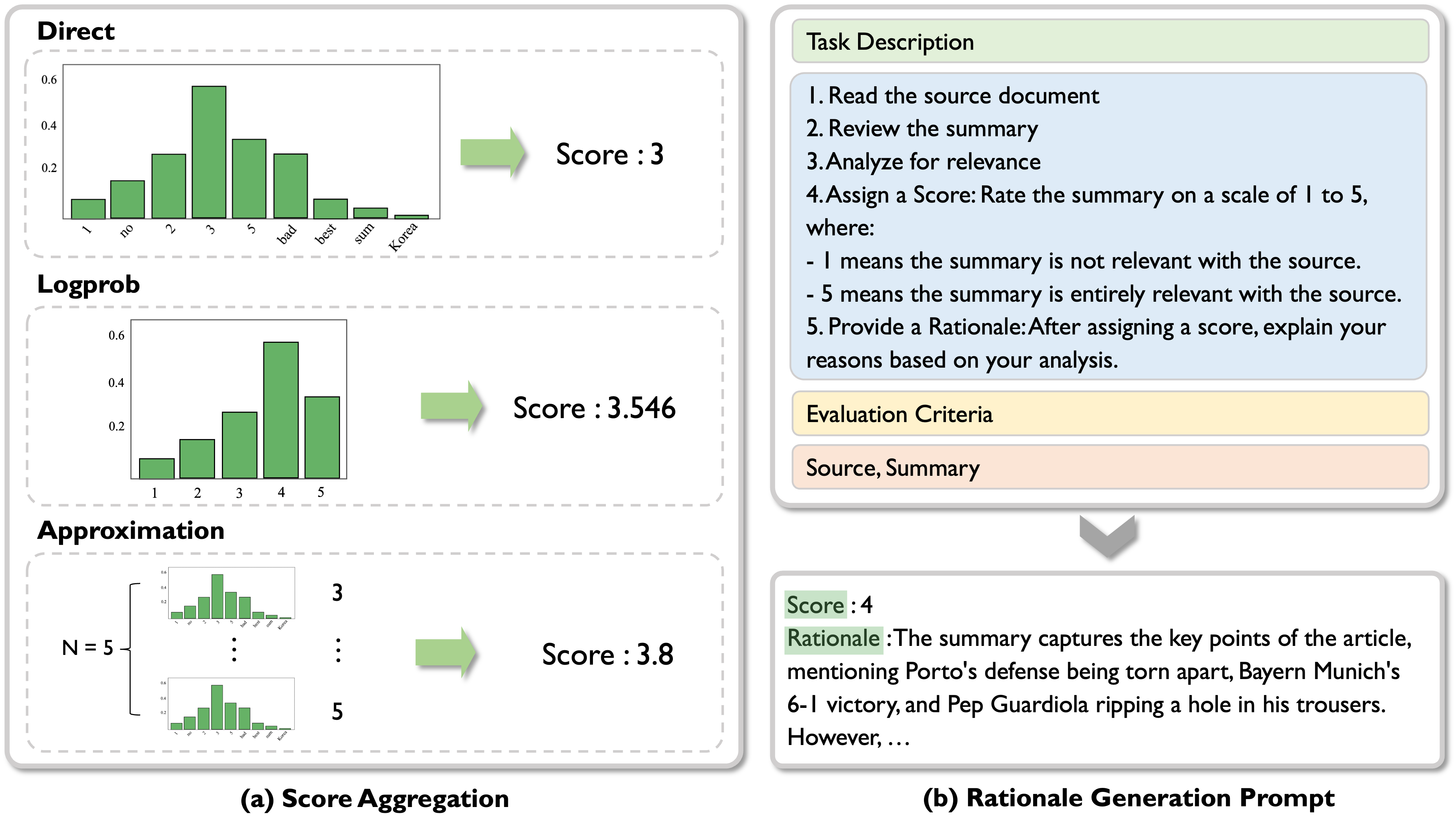
This paper describes the DSBA submissions to the Prompting Large Language Models as Explainable Metrics shared task, where systems were submitted to two tracks: small and large summarization tracks. With advanced Large Language Models (LLMs) such as GPT-4, evaluating the quality of Natural Language Generation (NLG) has become increasingly paramount. Traditional similarity-based metrics such as BLEU and ROUGE have shown to misalign with human evaluation and are ill-suited for open-ended generation tasks. To address this issue, we explore the potential capability of LLM-based metrics, especially leveraging open-source LLMs. In this study, wide range of prompts and prompting techniques are systematically analyzed with three approaches: prompting strategy, score aggregation, and explainability. Our research focuses on formulating effective prompt templates, determining the granularity of NLG quality scores and assessing the impact of in-context examples on LLM-based evaluation. Furthermore, three aggregation strategies are compared to identify the most reliable method for aggregating NLG quality scores. To examine explainability, we devise a strategy that generates rationales for the scores and analyzes the characteristics of the explanation produced by the open-source LLMs. Extensive experiments provide insights regarding evaluation capabilities of open-source LLMs and suggest effective prompting strategies.
Motivation & Objective
- Address the misalignment between traditional metrics like BLEU and ROUGE and human evaluation in open-ended NLG tasks.
- Investigate the feasibility and effectiveness of using open-source LLMs as automatic evaluation metrics.
- Systematically compare prompting strategies, score granularity, in-context learning, and aggregation techniques for LLM-based evaluation.
- Enhance explainability of LLM-based metrics by generating rationales for scores using open-source models.
- Provide actionable guidelines for deploying open-source LLMs as reliable, reproducible, and explainable NLG evaluation tools.
Proposed method
- Design and compare two prompting strategies: Human Guideline (HG) prompts (based on human-annotator instructions) and Model Guideline (MG) prompts (LLM-generated instructions).
- Evaluate score granularity using 1–5 and 0–100 scales, assessing impact on correlation with human judgments.
- Test in-context learning (ICL) by including various types of in-context examples (e.g., few-shot demonstrations) to assess their influence on LLM evaluation consistency.
- Compare three score aggregation strategies: mean, median, and weighted averaging across multiple LLM runs.
- Generate rationales for scores using the LLM to improve explainability and analyze the quality and consistency of these explanations.
- Apply the best-performing prompting configuration to the Eval4NLP 2023 shared task test set for summarization, reporting performance on small and large track benchmarks.

Experimental results
Research questions
- RQ1How do human- vs. model-generated instruction templates affect the correlation of LLM-based metrics with human judgments?
- RQ2What is the optimal score granularity (e.g., 1–5 vs. 0–100) for LLM-based NLG evaluation using open-source models?
- RQ3To what extent does in-context learning with exemplars improve the reliability and consistency of LLM-based evaluation?
- RQ4Which score aggregation strategy (mean, median, weighted) yields the most robust and human-correlated results?
- RQ5Can open-source LLMs generate meaningful, consistent rationales that enhance the explainability of their evaluation scores?
Key findings
- Model-guided prompts (MG) outperform human-guided prompts (HG) in terms of correlation with human judgments, particularly when using a 0–100 scoring scale.
- The 0–100 scoring scale significantly improves correlation with human evaluations compared to the 1–5 scale, suggesting finer-grained scoring enhances metric reliability.
- Inclusion of in-context examples (ICL) improves evaluation consistency, especially when exemplars are carefully selected to reflect key evaluation criteria.
- Aggregation via median or weighted averaging yields more stable and human-correlated results than simple mean aggregation.
- Generated rationales from open-source LLMs are coherent and consistent, providing interpretable justifications that align with human evaluation criteria.
- The best-performing prompting configuration achieved competitive performance on the Eval4NLP 2023 shared task, demonstrating the viability of open-source LLMs as effective, explainable NLG metrics.
Better researchstarts right now
From reading papers to final review, dramatically reduce your research time.
No credit card · Free plan available
This review was created by AI and reviewed by human editors.