
[Paper Review] Who Writes the Review, Human or AI?
This study proposes a transfer learning-based deep learning model to distinguish AI-generated from human-written book reviews using a custom dataset of real and Vicuna-generated reviews. The method achieves 96.86% accuracy in detecting text source, demonstrating high effectiveness in identifying synthetic text across diverse topics and writing styles.
With the increasing use of Artificial Intelligence in Natural Language Processing, concerns have been raised regarding the detection of AI-generated text in various domains. This study aims to investigate this issue by proposing a methodology to accurately distinguish AI-generated and human-written book reviews. Our approach utilizes transfer learning, enabling the model to identify generated text across different topics while improving its ability to detect variations in writing style and vocabulary. To evaluate the effectiveness of the proposed methodology, we developed a dataset consisting of real book reviews and AI-generated reviews using the recently proposed Vicuna open-source language model. The experimental results demonstrate that it is feasible to detect the original source of text, achieving an accuracy rate of 96.86%. Our efforts are oriented toward the exploration of the capabilities and limitations of Large Language Models in the context of text identification. Expanding our knowledge in these aspects will be valuable for effectively navigating similar models in the future and ensuring the integrity and authenticity of human-generated content.
Motivation & Objective
- To develop a robust methodology for detecting AI-generated text in natural language, focusing on book reviews as a representative domain.
- To investigate the effectiveness of transfer learning in improving model generalization across diverse topics and writing styles.
- To address the growing challenge of synthetic text detection amid rising concerns about misinformation and authenticity in digital content.
- To analyze the limitations and error patterns in AI text detection, particularly in cases of high lexical similarity between human and AI-generated text.
- To lay the foundation for future detection systems applicable to other text types, such as tweets, and across multiple languages and domains.
Proposed method
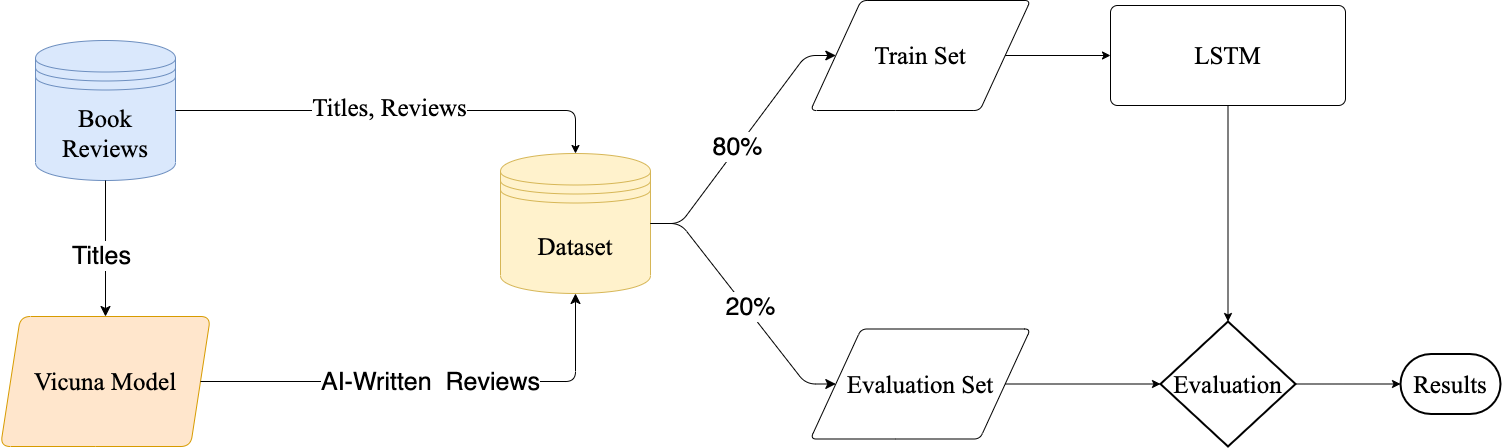
- Constructed a balanced dataset of 1,000 human-written book reviews and 1,000 AI-generated reviews using the open-source Vicuna language model.
- Employed a pre-trained transformer-based model fine-tuned via transfer learning to adapt to the specific task of text source classification.
- Utilized transfer learning to enhance feature extraction and improve detection performance across varied writing styles and vocabulary use.
- Trained the model using early stopping based on validation loss to prevent overfitting and ensure optimal generalization.
- Applied t-SNE dimensionality reduction to visualize hidden state representations and assess class separability in the embedding space.
- Conducted 100 independent training runs with statistical evaluation and 95% confidence intervals to ensure robustness and reliability of results.
Experimental results
Research questions
- RQ1Can transfer learning significantly improve the accuracy of distinguishing AI-generated from human-written book reviews?
- RQ2How does the model perform across diverse topics and writing styles in terms of generalization and robustness?
- RQ3What are the primary sources of misclassification, and how do lexical similarities between human and AI-generated text affect detection?
- RQ4To what extent can confidence intervals and statistical validation ensure the reliability of detection performance metrics?
- RQ5Can the model generalize to other text types, such as social media content, without further fine-tuning?
Key findings
- The proposed model achieved an average accuracy of 96.86% in detecting the source of book reviews, with a 95% confidence interval of [0.9647, 0.9726].
- The model demonstrated strong performance across all metrics, with F1-score at 0.9685 and AUC at 0.9687, indicating high precision and recall.
- Despite high accuracy, the model misclassified 60 human-written texts as AI-generated and 117 AI-generated texts as human-written, indicating persistent challenges in ambiguous cases.
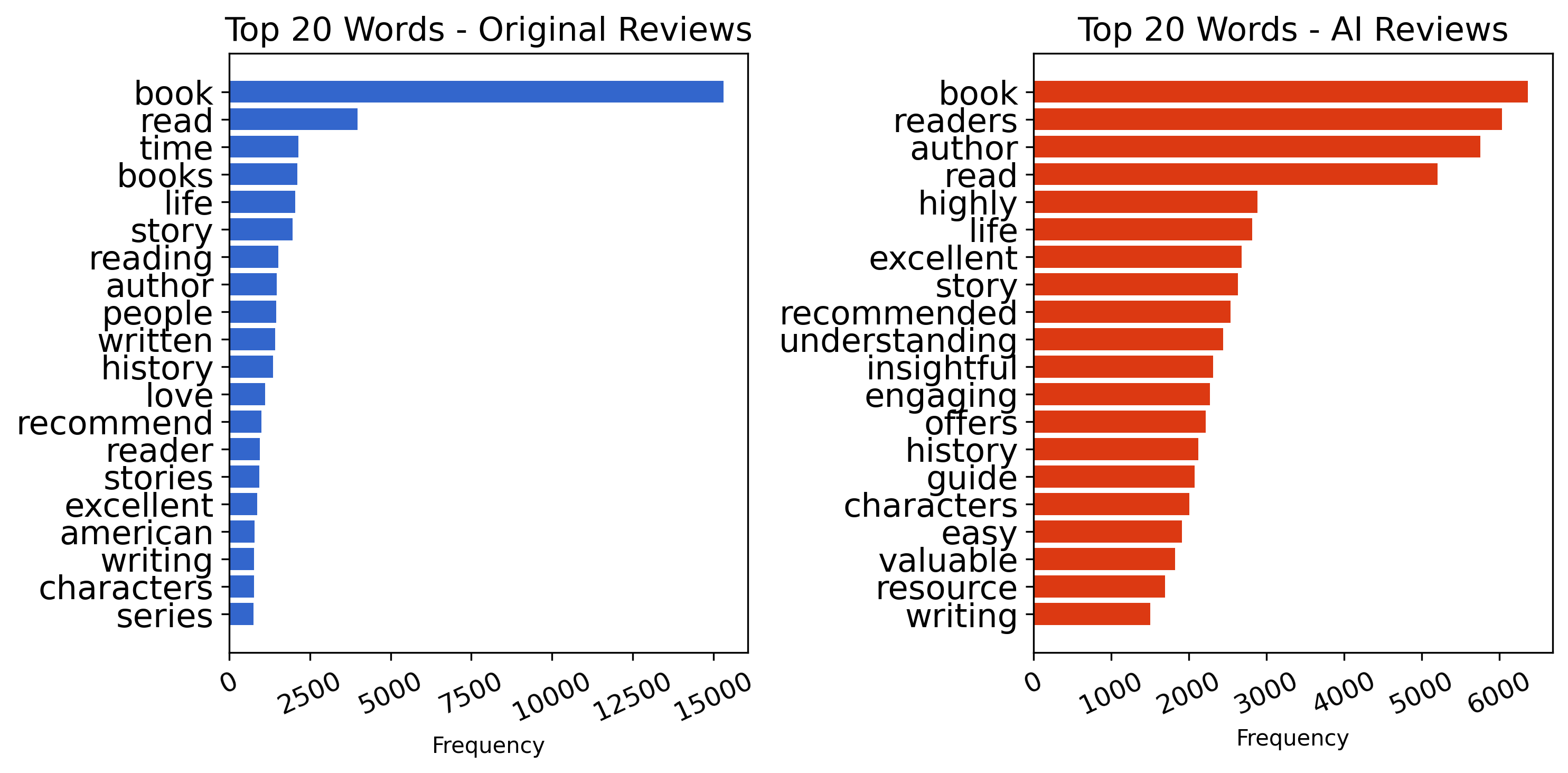
- Wordcloud and frequency analysis revealed that misclassified texts shared highly similar vocabulary, suggesting lexical overlap as a key source of confusion.
- t-SNE visualization confirmed that while most human and AI-generated sequences were well-separated, some overlap occurred in the hidden state representation, reflecting ambiguous or stylistically similar samples.
- The use of transfer learning significantly improved performance, increasing accuracy from 92.72% (without transfer learning) to 96.87% (with transfer learning), demonstrating its effectiveness in domain adaptation.
Better researchstarts right now
From reading papers to final review, dramatically reduce your research time.
No credit card · Free plan available
This review was created by AI and reviewed by human editors.