
[Paper Review] Why Charge Added Using Transition Metals To Some Insulators -- Including LK-99 -- Localizes and Does Not Yield a Metal
This study explains why transition metal doping in insulators like Cu-doped Pb10(PO4)6O (LK-99) and V-doped SrTiO3 leads to localized charge and insulating behavior rather than metallic conduction. Using ab initio DFT+U calculations, it demonstrates that electron-lattice symmetry breaking and Jahn-Teller-like distortions localize d-electrons into spin- and orbitally polarized impurity states within the band gap, precluding metallic or superconducting behavior.
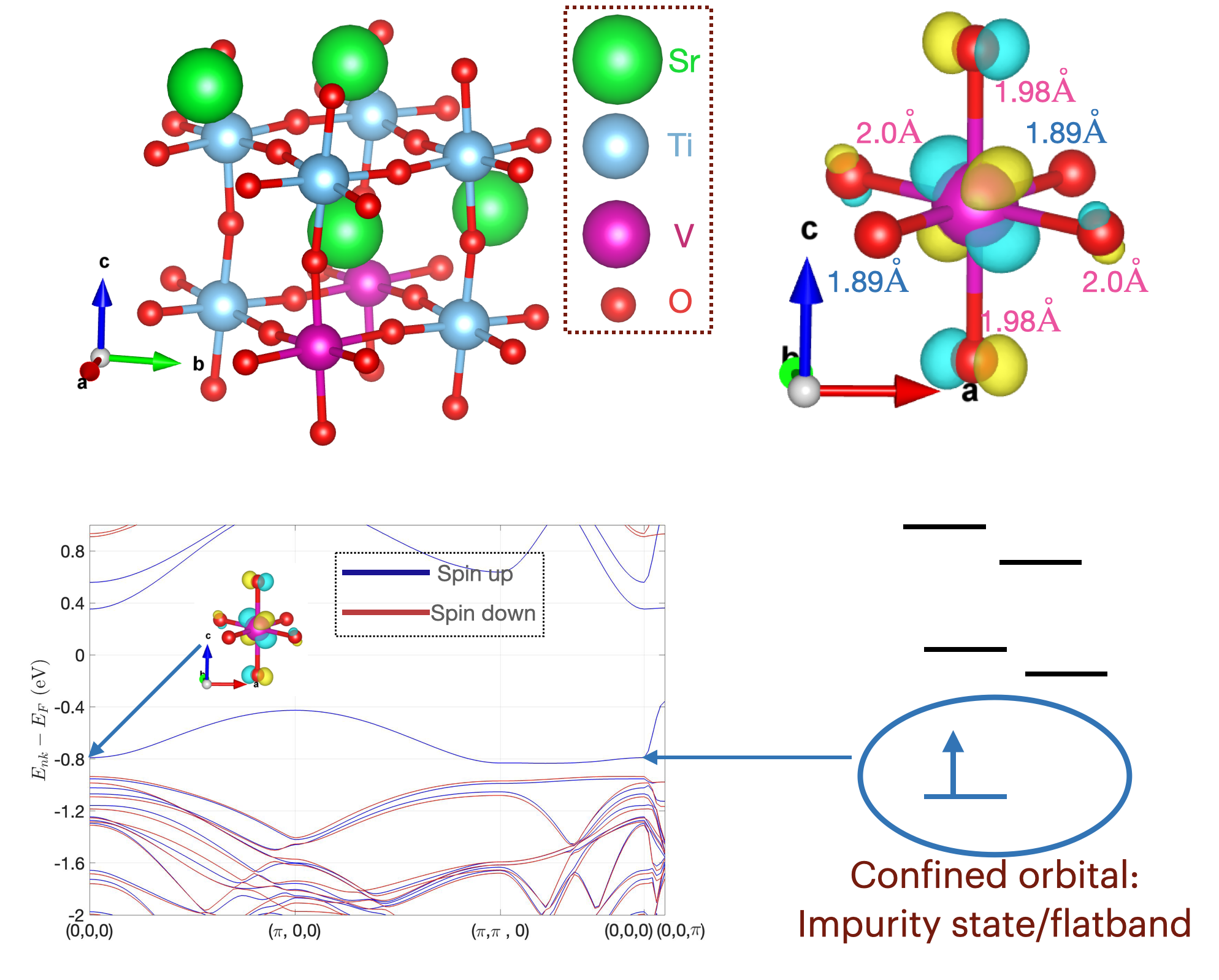
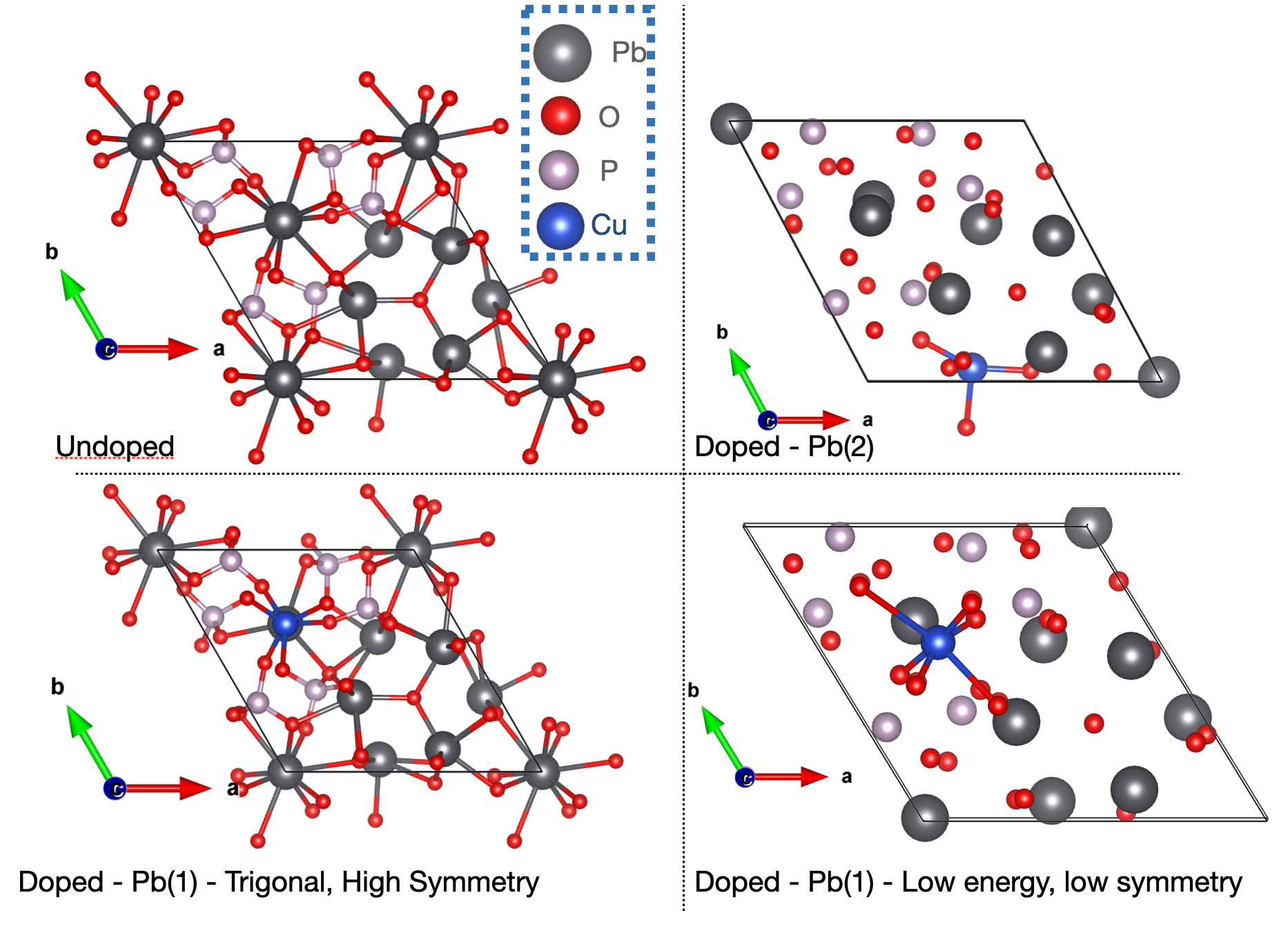
While adding charge to semiconductors via dopants is a well-established method for tuning electronic properties, we demonstrate that introducing transition metal impurities into certain insulators can lead to localized charge, assisted by a Jahn-Teller distortion. This leads to isolated charge, and an insulating material as opposed to emergent states - including superconductivity. We focus on Cu impurities added to Pb$_{10}$(PO$_4$)$_6$O ('LK-99'), replacing 10% of Cu ions, as discussed in recent literature. Our calculations show that the material remains a wide bandgap insulator with isolated, S=1/2 localized charges on the Cu ions-similar to color centers-even within standard DFT, without the need for electron correlation corrections to the Cu d-orbitals. Superconductivity is excluded by known mechanisms that require the material to be metallic. We resolve previously observed inconsistencies between density functional theory results and experimental findings related to doping site energetics, crystal structure, and transparency. We find that Cu doping either Pb site leads to CuO$_4$ coordination and a similar unit cell volume contraction. Engineering materials with dopant sites that have different local symmetries can induce non-relativistic spin splitting-often referred to as altermagnetism. However, in the case of localized charges, this may enable spins to be individually controlled.
Motivation & Objective
- To resolve inconsistencies between DFT predictions and experimental observations in Cu-doped Pb10(PO4)6O (LK-99), particularly regarding doping site energetics and transparency.
- To clarify the mechanism by which transition metal dopants in insulators lead to localized charge instead of metallic conduction.
- To investigate the role of coupled electron-crystal lattice symmetry reduction in stabilizing insulating states with localized d-orbital states.
- To assess the potential for novel quantum phenomena such as altermagnetism in these doped systems.
- To provide a framework for understanding local d-orbital symmetry and electron-lattice coupling in transition metal-doped insulators.
Proposed method
- Ab initio density functional theory (DFT) with Hubbard U correction (DFT+U) using the Dudarev approximation.
- Use of ultrasoft pseudopotentials and a 4×4×4 k-mesh for electronic structure calculations.
- Structural relaxation with force convergence threshold of 10−4 eV/Å to model lattice distortions induced by doping.
- Application of a U parameter of 4 eV, consistent with recent studies, though noted as potentially underestimated for highly localized Cu 3d states.
- Analysis of spin and orbital polarization in d-orbitals to identify symmetry breaking and charge localization.
- Investigation of two distinct Cu doping sites in the unit cell (tetrahedral vs. square planar coordination) to probe potential for altermagnetism.
Experimental results
Research questions
- RQ1Why does Cu doping in Pb10(PO4)6O (LK-99) result in localized charge and insulating behavior instead of metallic conduction?
- RQ2How do electron-lattice symmetry breaking and Jahn-Teller-like distortions stabilize localized d-electron states in transition metal-doped insulators?
- RQ3What explains the discrepancy between DFT predictions and experimental observations regarding doping site stability and transparency in LK-99?
- RQ4Can the presence of two inequivalent Cu sites in the same unit cell lead to altermagnetic behavior?
- RQ5To what extent can transition metal-doped insulators serve as platforms for color centers or quantum information applications?
Key findings
- Doping induces strong electron-lattice symmetry reduction, with an 1Å distortion in the Cu environment, breaking orbital degeneracy and localizing electrons.
- The system develops two spin-polarized, magnetically and orbitally ordered impurity states within the band gap, clearly separated from valence and conduction bands.
- The band gap is slightly reduced upon doping, suggesting potential for bandgap tuning in applications like photocatalysis.
- The material is predicted to be transparent at room temperature but may exhibit color centers at low temperatures due to localized Cu 2+ ions.
- No evidence of strong band splitting or altermagnetism is found, despite the geometric inequivalence of Cu sites, due to localized nature of the states.
- The results exclude superconductivity via conventional mechanisms, as the system remains strongly insulating with localized charge.
Read this paper
Open the full text in the Nubint reader and ask about any passage as you read.
Read this paper on NubintThis review was generated by AI from the original paper. Please check the paper before citing it.