
[Paper Review] Why is AI not a Panacea for Data Workers? An Interview Study on Human-AI Collaboration in Data Storytelling
This study interviews 18 data workers to map where, how, and why they want to collaborate with AI across the data storytelling workflow, proposing four AI roles and mixed agency-automation patterns.
Data storytelling plays an important role in data workers' daily jobs since it boosts team collaboration and public communication. However, to make an appealing data story, data workers spend tremendous efforts on various tasks, including outlining and styling the story. Recently, a growing research trend has been exploring how to assist data storytelling with advanced artificial intelligence (AI). However, existing studies may focus on individual tasks in the workflow of data storytelling and do not reveal a complete picture of humans' preference for collaborating with AI. To better understand real-world needs, we interviewed eighteen data workers from both industry and academia to learn where and how they would like to collaborate with AI. Surprisingly, though the participants showed excitement about collaborating with AI, many of them also expressed reluctance and pointed out nuanced reasons. Based on their responses, we first characterize stages and tasks in the practical data storytelling workflows and the desired roles of AI. Then the preferred collaboration patterns in different tasks are identified. Next, we summarize the interviewees' reasons why and why not they would like to collaborate with AI. Finally, we provide suggestions for human-AI collaborative data storytelling to hopefully shed light on future related research.
Motivation & Objective
- Characterize the stages and tasks in real-world data storytelling workflows.
- Identify where and how data workers want to collaborate with AI across planning, execution, and communication stages.
- Analyze preferences for AI roles using the agency-automation framework.
- Summarize reasons for and against adopting AI in data storytelling and provide design guidance.
Proposed method
- Conducted semi-structured interviews with 18 data workers from academia and industry.
- Used mind maps to elicit each participant's data storytelling workflow.
- Applied iterative coding to derive collaboration patterns and AI roles from interview transcripts.
Experimental results
Research questions
- RQ1Where would humans like to collaborate with AI in the data storytelling workflow?
- RQ2How would humans like to collaborate with AI across different storytelling tasks?
- RQ3Why do data workers prefer or resist collaborating with AI in data storytelling?
- RQ4What AI roles and collaboration patterns best fit the data storytelling workflow?
Key findings
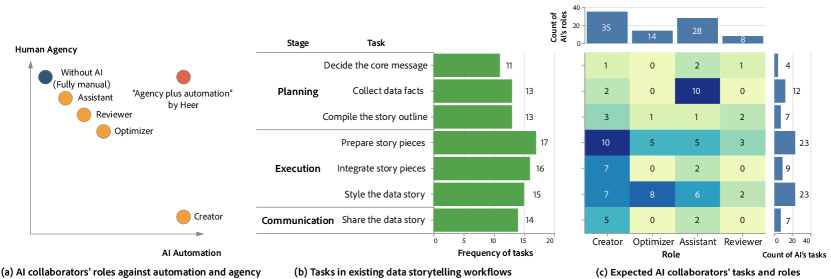
- The data storytelling workflow comprises three stages (planning, execution, communication) and eight tasks.
- Participants prefer four AI roles—creator, optimizer, reviewer, and assistant—mapped along an agency-automation spectrum.
- Collaboration patterns concentrate in planning and execution, with AI often acting as assistants for collecting data facts and as creators or optimizers for story pieces and styling.
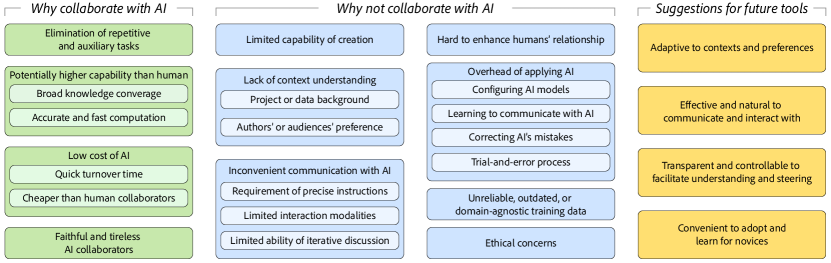
- Access to AI is valued for reducing workload on repetitive tasks, but concerns arise about AI understanding context and maintaining human control.
- People favor mixed patterns across stages, aiming for high human agency with AI automation (agency plus automation).
- Most participants are reluctant to replace human storytelling entirely, preferring AI support that preserves audience understanding and contextual nuance.
Read this paper
Open the full text in the Nubint reader and ask about any passage as you read.
Read this paper on NubintThis review was generated by AI from the original paper. Please check the paper before citing it.