
[Paper Review] Why think step by step? Reasoning emerges from the locality of experience
The paper shows that chain-of-thought reasoning helps language models when training data has local structure, enabling efficient inference by chaining local dependencies; under fully observed or non-local data, reasoning offers little or no advantage.
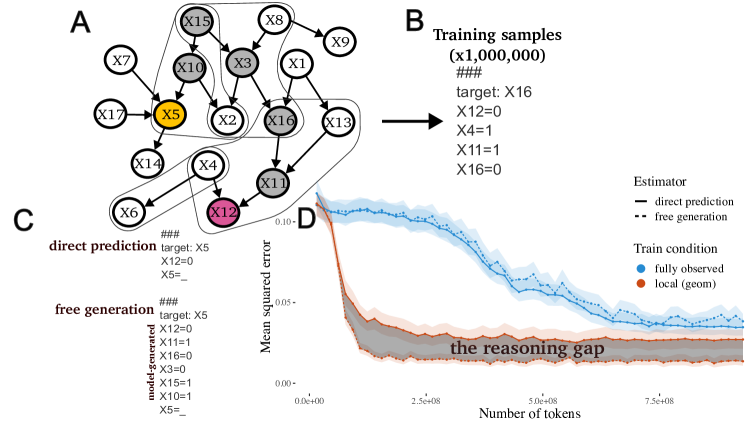
Humans have a powerful and mysterious capacity to reason. Working through a set of mental steps enables us to make inferences we would not be capable of making directly even though we get no additional data from the world. Similarly, when large language models generate intermediate steps (a chain of thought) before answering a question, they often produce better answers than they would directly. We investigate why and how chain-of-thought reasoning is useful in language models, testing the hypothesis that reasoning is effective when training data consists of overlapping local clusters of variables that influence each other strongly. These training conditions enable the chaining of accurate local inferences to estimate relationships between variables that were not seen together in training. We prove that there will exist a "reasoning gap", where reasoning through intermediate variables reduces bias, for the simple case of an autoregressive density estimator trained on local samples from a chain-structured probabilistic model. We then test our hypothesis experimentally in more complex models, training an autoregressive language model on samples from Bayes nets but only including a subset of variables in each sample. We test language models' ability to match conditional probabilities with and without intermediate reasoning steps, finding that intermediate steps are only helpful when the training data is locally structured with respect to dependencies between variables. The combination of locally structured observations and reasoning is much more data-efficient than training on all variables. Our results illustrate how the effectiveness of reasoning step by step is rooted in the local statistical structure of the training data.
Motivation & Objective
- Motivate and formalize why reasoning through intermediate variables can improve inference in language models.
- Formalize a Bayes-net-based framework for conditional inference with locally structured observations.
- Prove a theoretical bias-reduction gap for reasoning in chain-structured models.
- Empirically test when intermediate reasoning helps using autoregressive transformers trained on synthetic Bayes nets.
Proposed method
- Formalize observation distributions that create local neighborhoods of variables.
- Derive three estimators: direct prediction, scaffolded generation, and free generation for conditional probabilities.
- Prove a “reasoning gap” where reasoning through intermediates reduces bias for non-adjacent variable pairs in a chain structure.
- Train autoregressive transformers on synthetic Bayes-net data with local structure and evaluate conditional probabilities for held-out pairs.
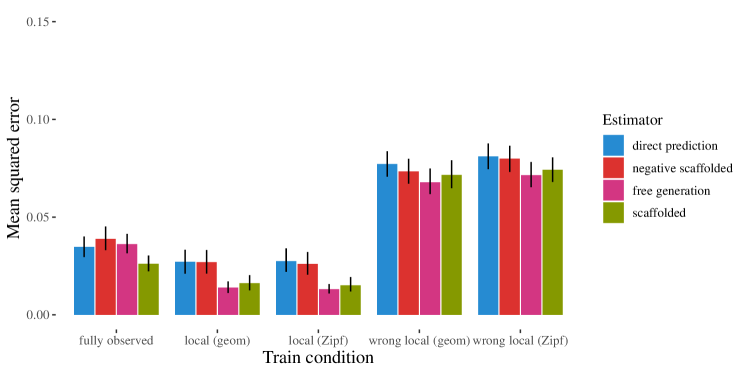
- Compare estimators across locally structured, fully observed, and mis-specified locality settings using mean squared error (MSE).
- Analyze data efficiency and when reasoning is unnecessary or detrimental.
Experimental results
Research questions
- RQ1Under what training-data locality conditions do intermediate reasoning steps reduce bias in conditional inference?
- RQ2Does self-generated intermediate reasoning help autoregressive models match true conditional probabilities better than direct prediction under local structure?
- RQ3How data-efficient is reasoning-based inference compared to learning on fully observed data?
- RQ4When does reasoning fail to help or hurt performance?
- RQ5What factors (e.g., locality strength, distance between variables) modulate the usefulness of chain-of-thought reasoning?
Key findings
- Reasoning through intermediate variables reduces bias for non-adjacent variable pairs when training data has strong local structure.
- Both free generation and scaffolded generation outperform direct prediction under locally structured training data.
- Reasoning offers little to no advantage when data is fully observed or locality structure is incorrect.
- Locally structured data plus chain-of-thought reasoning yields greater data efficiency, achieving close-to-true conditional probabilities with less training.
- Direct prediction can already match true probabilities when observed variables co-occur frequently, diminishing the need for reasoning in such cases.
- Re-sampling the reasoning chain (multiple Monte Carlo samples) helps reduce estimation variance.
Read this paper
Open the full text in the Nubint reader and ask about any passage as you read.
Read this paper on NubintThis review was generated by AI from the original paper. Please check the paper before citing it.