
[Paper Review] Why Warmup the Learning Rate? Underlying Mechanisms and Improvements
The paper shows that the main benefit of learning rate warmup is enabling larger target learning rates by pushing the optimizer into better-conditioned regions; it analyzes SGD and Adam, identifies regimes, and proposes initialization strategies to reduce or remove warmup.
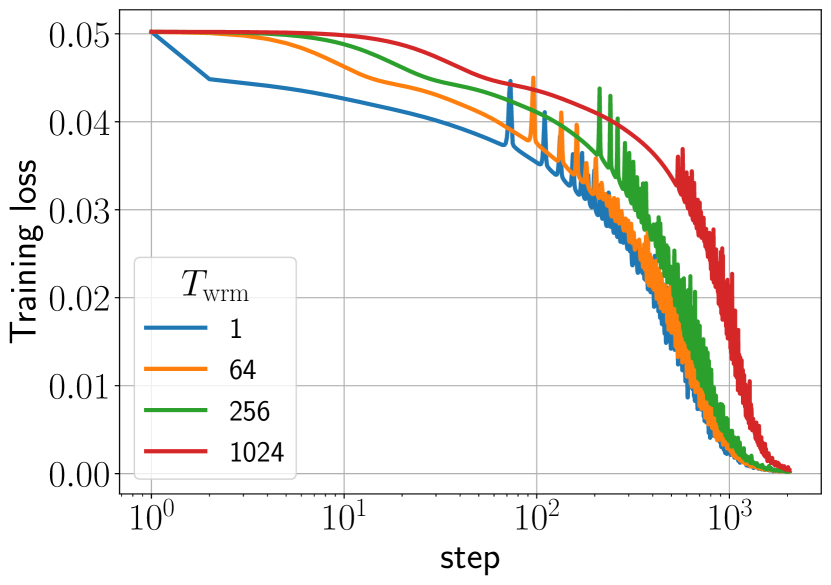
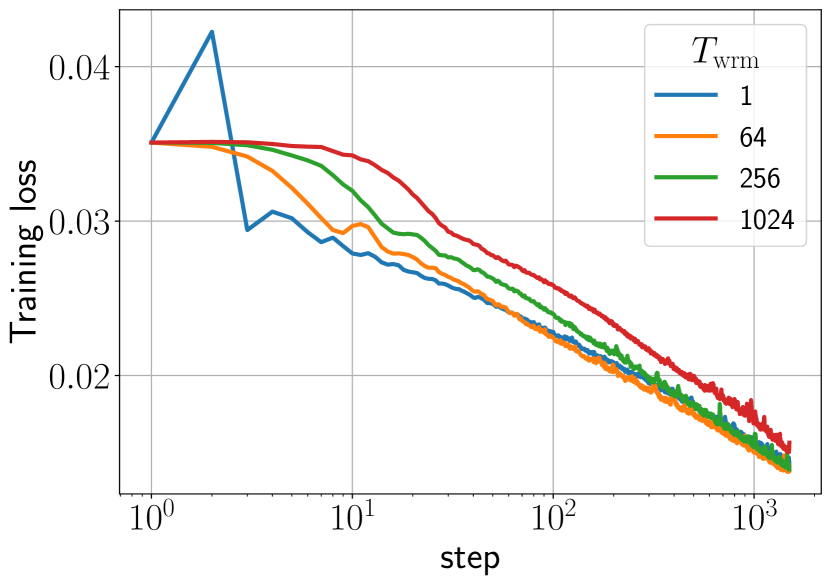
It is common in deep learning to warm up the learning rate $η$, often by a linear schedule between $η_{ ext{init}} = 0$ and a predetermined target $η_{ ext{trgt}}$. In this paper, we show through systematic experiments using SGD and Adam that the overwhelming benefit of warmup arises from allowing the network to tolerate larger $η_{ ext{trgt}}$ {by forcing the network to more well-conditioned areas of the loss landscape}. The ability to handle larger $η_{ ext{trgt}}$ makes hyperparameter tuning more robust while improving the final performance. We uncover different regimes of operation during the warmup period, depending on whether training starts off in a progressive sharpening or sharpness reduction phase, which in turn depends on the initialization and parameterization. Using these insights, we show how $η_{ ext{init}}$ can be properly chosen by utilizing the loss catapult mechanism, which saves on the number of warmup steps, in some cases completely eliminating the need for warmup. We also suggest an initialization for the variance in Adam which provides benefits similar to warmup.
Motivation & Objective
- Investigate why learning rate warmup helps training across architectures, initializations, and optimizers.
- Characterize the interaction between warmup dynamics and loss landscape sharpness.
- Quantify how warmup affects the ability to use larger target learning rates and generalization.
- Propose initialization strategies to reduce or eliminate the need for warmup.
- Offer practical methods to initialize Adam to reduce preconditioned sharpness.
Proposed method
- Systematic empirical study across FCNs, ResNets, and Transformers on CIFAR-10/100, TinyImageNet, and WikiText-2.
- Analysis of SGD, SGD with momentum, and Adam with linear warmup and various parameterizations (SP, μP).
- Definition and use of sharpness (λ^H) and pre-conditioned sharpness (λ^{P^{-1}H}) to assess stability thresholds.
- Catapult/self-stabilization framework to explain training instabilities and warmup effects.
- Introduction of GI-Adam, an initialization for the second moment g0^2 to reduce preconditioned sharpness.
- Proposal of an η_init search method to estimate η_c via forward passes and binary/exponential searches.
Experimental results
Research questions
- RQ1What is the primary mechanism by which learning rate warmup improves training performance?
- RQ2How do warmup dynamics interact with sharpness evolution under SGD, SGD with momentum, and Adam?
- RQ3Can warmup allow larger target learning rates by moving to flatter regions of the loss landscape?
- RQ4How do initialization and parameterization (SP vs μP) affect warmup regimes and effectiveness?
- RQ5Can we reduce or remove warmup through principled initialization strategies (e.g., GI-Adam, η_init ≈ η_c)?
Key findings
- Warmup primarily enables larger target learning rates by allowing the network to tolerate increased η_trgt through moving to better-conditioned loss regions.
- Two main regimes observed: natural progressive sharpening and natural sharpness reduction, which determine how warmup interacts with the loss landscape.
- For Adam, the key instability is tied to pre-conditioned sharpness; warmup mitigates large catapults by reducing λ^{P^{-1}H}.
- GI-Adam reduces initial preconditioned sharpness by initializing the second moment with gradient squares, improving stability similarly to warmup.
- An η_init selection method estimating η_c via forward passes can significantly reduce warmup time or remove it in some cases.
- Longer warmup generally allows higher η_trgt by delaying instability thresholds and smoothing catapults, improving robustness and generalization.
- Final performance is mainly determined by η_trgt, while warmup duration fine-tunes robustness and the range of usable learning rates.
Read this paper
Open the full text in the Nubint reader and ask about any passage as you read.
Read this paper on NubintThis review was generated by AI from the original paper. Please check the paper before citing it.