
[Paper Review] WildBench: Benchmarking LLMs with Challenging Tasks from Real Users in the Wild
WildBench introduces a dynamic, automated benchmark for evaluating large language models (LLMs) using 1,024 real-world user queries collected from live chat interactions. It employs LLM-as-judge with task-specific checklists and structured reasoning to generate interpretable, reliable scores via WB-Reward (pairwise comparison) and WB-Score (individual scoring), achieving 0.98 and 0.95 Pearson correlation with human judgments, respectively, outperforming existing benchmarks.
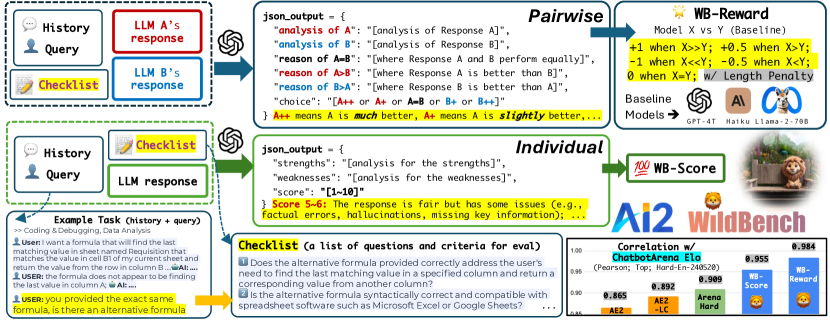
We introduce WildBench, an automated evaluation framework designed to benchmark large language models (LLMs) using challenging, real-world user queries. WildBench consists of 1,024 tasks carefully selected from over one million human-chatbot conversation logs. For automated evaluation with WildBench, we have developed two metrics, WB-Reward and WB-Score, which are computable using advanced LLMs such as GPT-4-turbo. WildBench evaluation uses task-specific checklists to evaluate model outputs systematically and provides structured explanations that justify the scores and comparisons, resulting in more reliable and interpretable automatic judgments. WB-Reward employs fine-grained pairwise comparisons between model responses, generating five potential outcomes: much better, slightly better, slightly worse, much worse, or a tie. Unlike previous evaluations that employed a single baseline model, we selected three baseline models at varying performance levels to ensure a comprehensive pairwise evaluation. Additionally, we propose a simple method to mitigate length bias, by converting outcomes of ``slightly better/worse'' to ``tie'' if the winner response exceeds the loser one by more than $K$ characters. WB-Score evaluates the quality of model outputs individually, making it a fast and cost-efficient evaluation metric. WildBench results demonstrate a strong correlation with the human-voted Elo ratings from Chatbot Arena on hard tasks. Specifically, WB-Reward achieves a Pearson correlation of 0.98 with top-ranking models. Additionally, WB-Score reaches 0.95, surpassing both ArenaHard's 0.91 and AlpacaEval2.0's 0.89 for length-controlled win rates, as well as the 0.87 for regular win rates.
Motivation & Objective
- To address the limitations of existing LLM benchmarks that rely on synthetic or narrow task distributions by using real, diverse, and challenging user queries from live chat interactions.
- To develop an automated, scalable, and interpretable evaluation framework that reduces human labor while maintaining high alignment with human preferences.
- To mitigate common biases in LLM-as-judge evaluations, especially length bias, through a dynamic length-penalty mechanism.
- To ensure data freshness and reduce leakage risk by continuously updating the benchmark with new, unseen user data from the WildChat project.
- To provide a transparent, contamination-resistant evaluation platform with public validation data and detailed construction procedures.
Proposed method
- WildBench curates 1,024 challenging tasks from over one million real user-chatbot dialog logs in the WildChat dataset, filtering out easy tasks using multi-LLM analysis and manual review.
- It employs a Chain-of-Thought (CoT)-inspired prompting strategy where LLM judges generate structured, step-by-step justifications using task-specific checklists to evaluate response quality.
- WB-Reward performs pairwise comparisons between model outputs using five outcomes: much better, slightly better, tie, slightly worse, or much worse, with three baseline models used instead of one for comprehensive evaluation.
- WB-Score evaluates model outputs individually, enabling fast and cost-efficient assessment of model quality without pairwise comparisons.
- A length-penalty mechanism converts 'slightly better' or 'slightly worse' outcomes to 'tie' if the winning response exceeds the losing one by more than K characters, mitigating length bias.
- The benchmark uses a private holdout set to prevent data leakage and ensures transparency by publicly releasing the validation set and construction pipeline.
Experimental results
Research questions
- RQ1Can an automated LLM-as-judge framework achieve high correlation with human preference judgments when evaluated on real-world, open-ended user queries?
- RQ2How does using multiple baseline models in pairwise comparisons improve the robustness and comprehensiveness of LLM evaluation compared to single-baseline approaches?
- RQ3To what extent can structured checklists and step-by-step reasoning in LLM judges reduce ambiguity and improve interpretability in automated evaluation?
- RQ4How effective is a dynamic length-penalty mechanism in mitigating the well-known length bias in LLM-as-judge evaluations?
- RQ5Can a continuously updated benchmark using real user data maintain relevance and resist model contamination while outperforming static, closed benchmarks?
Key findings
- WB-Reward achieves a Pearson correlation of 0.98 with human-voted Elo ratings from Chatbot Arena on hard tasks, indicating near-perfect alignment with human preferences.
- WB-Score achieves a correlation of 0.95 with human judgments, surpassing ArenaHard’s 0.91 and AlpacaEval2.0’s 0.89 for length-controlled win rates.
- The benchmark demonstrates strong performance across diverse task categories, with detailed score breakdowns revealing model strengths and weaknesses in areas like coding, mathematics, and reasoning.
- The use of three baseline models in pairwise evaluation provides a more nuanced and comprehensive assessment than single-baseline approaches, capturing performance differences across model tiers.
- The length-penalty mechanism effectively reduces the impact of output length on judgment, improving fairness and reliability in automated evaluation.
- The WildBench leaderboard has been accessed over 20,000 times since launch, indicating strong adoption and utility in the research community.
Read this paper
Open the full text in the Nubint reader and ask about any passage as you read.
Read this paper on NubintThis review was generated by AI from the original paper. Please check the paper before citing it.