
[Paper Review] WildFake: A Large-scale Challenging Dataset for AI-Generated Images Detection
This paper introduces WildFake, a large-scale, diverse dataset for detecting AI-generated images, encompassing high-quality fakes from GANs, diffusion models, and other generators across varied styles and real-world applications. The dataset enables robust evaluation of detectors across cross-weight, cross-version, and degradation scenarios, revealing that ViT-based models outperform ResNet-50 in robustness, especially under geometric and color transformations.
The extraordinary ability of generative models enabled the generation of images with such high quality that human beings cannot distinguish Artificial Intelligence (AI) generated images from real-life photographs. The development of generation techniques opened up new opportunities but concurrently introduced potential risks to privacy, authenticity, and security. Therefore, the task of detecting AI-generated imagery is of paramount importance to prevent illegal activities. To assess the generalizability and robustness of AI-generated image detection, we present a large-scale dataset, referred to as WildFake, comprising state-of-the-art generators, diverse object categories, and real-world applications. WildFake dataset has the following advantages: 1) Rich Content with Wild collection: WildFake collects fake images from the open-source community, enriching its diversity with a broad range of image classes and image styles. 2) Hierarchical structure: WildFake contains fake images synthesized by different types of generators from GANs, diffusion models, to other generative models. These key strengths enhance the generalization and robustness of detectors trained on WildFake, thereby demonstrating WildFake's considerable relevance and effectiveness for AI-generated detectors in real-world scenarios. Moreover, our extensive evaluation experiments are tailored to yield profound insights into the capabilities of different levels of generative models, a distinctive advantage afforded by WildFake's unique hierarchical structure.
Motivation & Objective
- Address the lack of comprehensive, large-scale datasets that cover diverse generative models and real-world image distributions for AI-generated image detection.
- Improve detector generalization across different model architectures, weights, and versions, especially in unseen or evolving generative models.
- Evaluate detector robustness under common image degradation types such as compression, downscaling, watermarking, and color transformations.
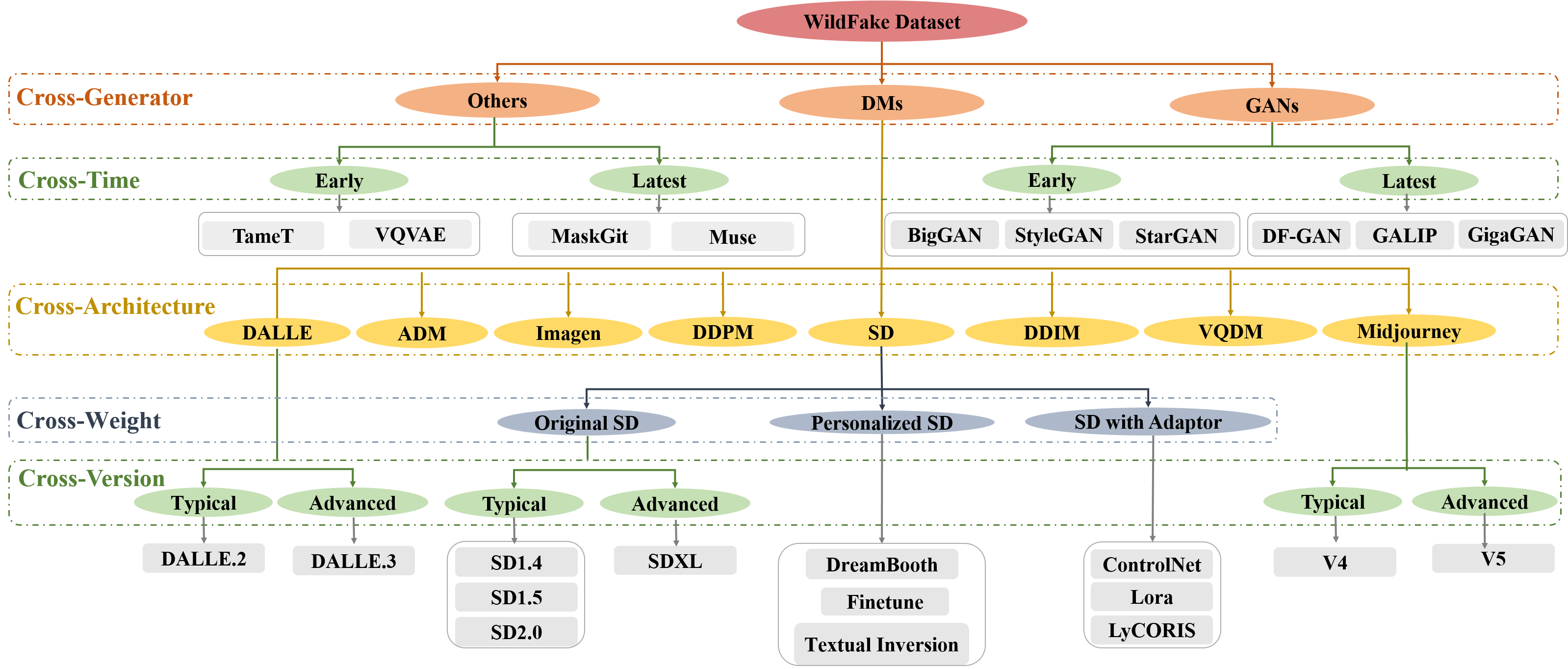
- Provide a hierarchical, multi-level categorization of fake images based on generator type, architecture, weights, and model versions to enable fine-grained analysis of detection performance.
- Support the academic community by publicly releasing a diverse, high-quality dataset to advance research in synthetic image detection.
Proposed method
- Collect fake images from open-source communities and generate them via a comprehensive pipeline using state-of-the-art GANs, diffusion models (DMs), and other generative models.
- Gather real images from diverse open datasets used in image captioning, generation, and classification tasks to ensure broad stylistic and content diversity.
- Structure the dataset into four hierarchical levels: generator type (GANs, DMs, Others), model architecture, model weights, and model versions, enabling cross-comparative evaluation.
- Apply degradation techniques—downsampling, JPEG compression, geometric transformations (flipping, cropping), watermarking (textual and visual), and color adjustments (brightness, contrast, saturation, hue)—to test detector robustness.
- Train and evaluate multiple detectors (e.g., ViT-based and ResNet-50-based) on WildFake, focusing on cross-weight, cross-version, and cross-time generalization across Stable Diffusion, Midjourney, and GAN models.
- Conduct ablation studies and comparative experiments to analyze detector performance across different degradation types and model evolution stages.
Experimental results
Research questions
- RQ1How well do AI-generated image detectors generalize across different weights of the same generative model architecture, such as Stable Diffusion?
- RQ2What is the generalization performance of detectors when evaluated on newer or advanced versions of generative models compared to earlier ones?
- RQ3How robust are detectors to common image degradation types such as compression, downscaling, and watermarking in real-world deployment scenarios?
- RQ4How does detector performance vary across different types of generative models (GANs, diffusion models, others) under cross-version and cross-weight evaluations?
- RQ5To what extent do architectural choices (e.g., ViT vs. ResNet-50) influence detector robustness under image degradation?
Key findings
- Detectors trained on WildFake demonstrate strong generalization across different weights of the same model family, such as Stable Diffusion, with performance on par with in-weight evaluations.
- Cross-version evaluations show that detectors maintain stable performance across evolving versions of diffusion models (e.g., Stable Diffusion and Midjourney), indicating that core architectural stability preserves detectable patterns.
- The ViT-based detector outperforms the ResNet-50-based detector in handling geometric and color transformations, showing greater robustness under such degradations.
- Both detector types suffer significant performance drops when processing images with image-based or text-based watermarks, indicating a critical vulnerability in watermark-affected samples.
- Lower image resolution and quality (e.g., 64×64 or low JPEG quality) have a substantial negative impact on detection accuracy, highlighting the importance of input quality for reliable detection.
- Detectors trained on the latest GANs exhibit superior generalization compared to those trained on earlier GAN versions, suggesting that newer models may leave more consistent or detectable artifacts.
Read this paper
Open the full text in the Nubint reader and ask about any passage as you read.
Read this paper on NubintThis review was generated by AI from the original paper. Please check the paper before citing it.