
[Paper Review] Wireless Edge-Empowered Metaverse: A Learning-Based Incentive Mechanism for Virtual Reality
This paper proposes a deep reinforcement learning (DRL)-based double Dutch auction mechanism to optimize VR service allocation and pricing in a wireless edge-empowered Metaverse. By modeling user experience via perception quality (SSIM/VMAF), the framework enables efficient, low-cost trading between VR users and service providers, achieving near-optimal social welfare while reducing auction information exchange cost by at least 50% compared to baselines.
The Metaverse is regarded as the next-generation Internet paradigm that allows humans to play, work, and socialize in an alternative virtual world with immersive experience, for instance, via head-mounted display for Virtual Reality (VR) rendering. With the help of ubiquitous wireless connections and powerful edge computing technologies, VR users in wireless edge-empowered Metaverse can immerse in the virtual through the access of VR services offered by different providers. However, VR applications are computation- and communication-intensive. The VR service providers (SPs) have to optimize the VR service delivery efficiently and economically given their limited communication and computation resources. An incentive mechanism can be thus applied as an effective tool for managing VR services between providers and users. Therefore, in this paper, we propose a learning-based Incentive Mechanism framework for VR services in the Metaverse. First, we propose the quality of perception as the metric for VR users immersing in the virtual world. Second, for quick trading of VR services between VR users (i.e., buyers) and VR SPs (i.e., sellers), we design a double Dutch auction mechanism to determine optimal pricing and allocation rules in this market. Third, for auction communication reduction, we design a deep reinforcement learning-based auctioneer to accelerate this auction process. Experimental results demonstrate that the proposed framework can achieve near-optimal social welfare while reducing at least half of the auction information exchange cost than baseline methods.
Motivation & Objective
- To design an incentive mechanism that efficiently manages VR service trading between users and providers in the wireless edge-empowered Metaverse.
- To redefine utility in VR by focusing on quality of perception, using SSIM and VMAF as joint metrics.
- To enable fast, asynchronous trading between VR users (buyers) and service providers (sellers) via a call market mechanism.
- To reduce auction information exchange cost through a DRL-based auctioneer that learns optimal clock update strategies without prior knowledge.
- To balance social welfare and auction efficiency in dynamic, large-scale VR service markets.
Proposed method
- Proposes a perception-based utility metric using Structural Similarity (SSIM) and Video Multimethod Assessment Fusion (VMAF) to quantify VR user experience.
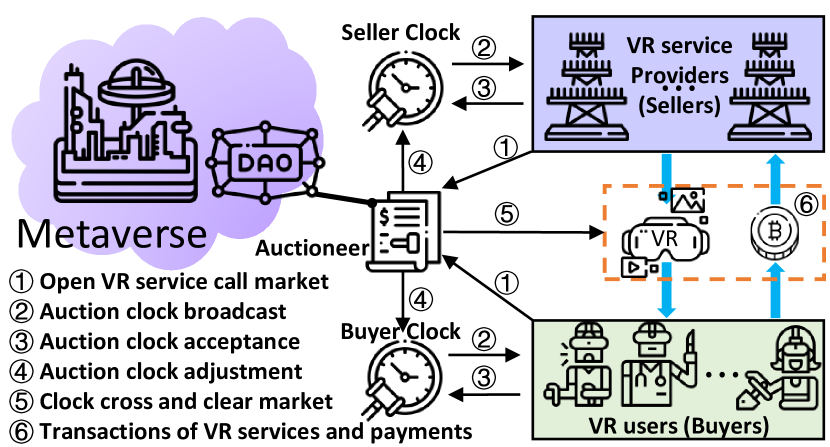
- Designs a double Dutch auction (DDA) mechanism with descending buyer clock and ascending seller clock for asynchronous, finite-time trading.
- Introduces a deep reinforcement learning (DRL) agent as the auctioneer to dynamically adjust clock stepsize based on market feedback.
- Trains the DRL agent using a reward function that maximizes social welfare while minimizing information exchange cost.
- Employs a Markov Decision Process (MDP) framework where the auctioneer learns optimal policies through interaction with VR service market participants.
- Sets auction parameters: price range [1, 100], minimum interval 1, weight w₁ = w₂ = 0.5, and exchange cost c = 0.1.
Experimental results
Research questions
- RQ1How can perception quality in non-panoramic VR be effectively modeled to reflect user experience in the Metaverse?
- RQ2What auction mechanism enables efficient, asynchronous matching and pricing between VR users and service providers in a call market setting?
- RQ3Can a DRL-based auctioneer reduce information exchange cost without significantly compromising social welfare in dynamic VR service markets?
- RQ4How does the performance of the DRL-based auctioneer scale with increasing market size and VR service bitrate requirements?
- RQ5What trade-offs exist between social welfare and auction efficiency in incentive mechanisms for wireless edge-empowered Metaverse applications?
Key findings
- The DRL-based DDA achieves near-optimal social welfare, with only about 5% loss compared to the maximum achievable social welfare.
- The proposed framework reduces auction information exchange cost by at least 50% compared to the state-of-the-art method and by two-thirds compared to the vanilla DDA baseline.
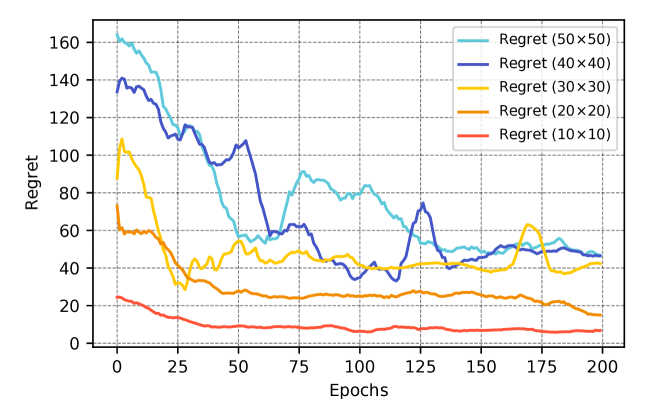
- In large markets (e.g., 50×50), the DRL-based DDA converges in approximately 160 epochs, though convergence is slower and less stable than in small markets.
- Social welfare increases with higher VR service bitrates due to improved perception quality, and the DRL-based DDA adapts dynamically to this change.
- The DRL-based auctioneer outperforms the random method by achieving 20% higher social welfare, demonstrating the value of learning over random or fixed strategies.
- The DRL-based DDA maintains high efficiency even in large-scale markets, with significantly lower information exchange cost than both SOTA and vanilla DDA methods.
Read this paper
Open the full text in the Nubint reader and ask about any passage as you read.
Read this paper on NubintThis review was generated by AI from the original paper. Please check the paper before citing it.