
[Paper Review] Wireless Multi-Agent Generative AI: From Connected Intelligence to Collective Intelligence
The paper proposes a foundation for on-device, multi-agent generative AI in wireless networks, analyzes planning, game-theoretic interactions, and semantic communication to enable collective intelligence at the edge, and demonstrates a case study on network energy savings using on-device LLMs.
The convergence of generative large language models (LLMs), edge networks, and multi-agent systems represents a groundbreaking synergy that holds immense promise for future wireless generations, harnessing the power of collective intelligence and paving the way for self-governed networks where intelligent decision-making happens right at the edge. This article puts the stepping-stone for incorporating multi-agent generative artificial intelligence (AI) in wireless networks, and sets the scene for realizing on-device LLMs, where multi-agent LLMs are collaboratively planning and solving tasks to achieve a number of network goals. We further investigate the profound limitations of cloud-based LLMs, and explore multi-agent LLMs from a game theoretic perspective, where agents collaboratively solve tasks in competitive environments. Moreover, we establish the underpinnings for the architecture design of wireless multi-agent generative AI systems at the network level and the agent level, and we identify the wireless technologies that are envisioned to play a key role in enabling on-device LLM. To demonstrate the promising potentials of wireless multi-agent generative AI networks, we highlight the benefits that can be achieved when implementing wireless generative agents in intent-based networking, and we provide a case study to showcase how on-device LLMs can contribute to solving network intents in a collaborative fashion. We finally shed lights on potential challenges and sketch a research roadmap towards realizing the vision of wireless collective intelligence.
Motivation & Objective
- Motivate the integration of generative agents into wireless networks to achieve edge-based collective intelligence.
- Identify enabling technologies and architectures for on-device LLMs in 6G wireless systems.
- Explore planning, reasoning, and game-theoretic interactions among multiple LLM agents.
- Highlight semantic communication as a means to efficiently share knowledge and tasks among agents.
- Demonstrate a case study illustrating energy-saving intents guided by multi-agent LLMs and discuss challenges and roadmaps.
Proposed method
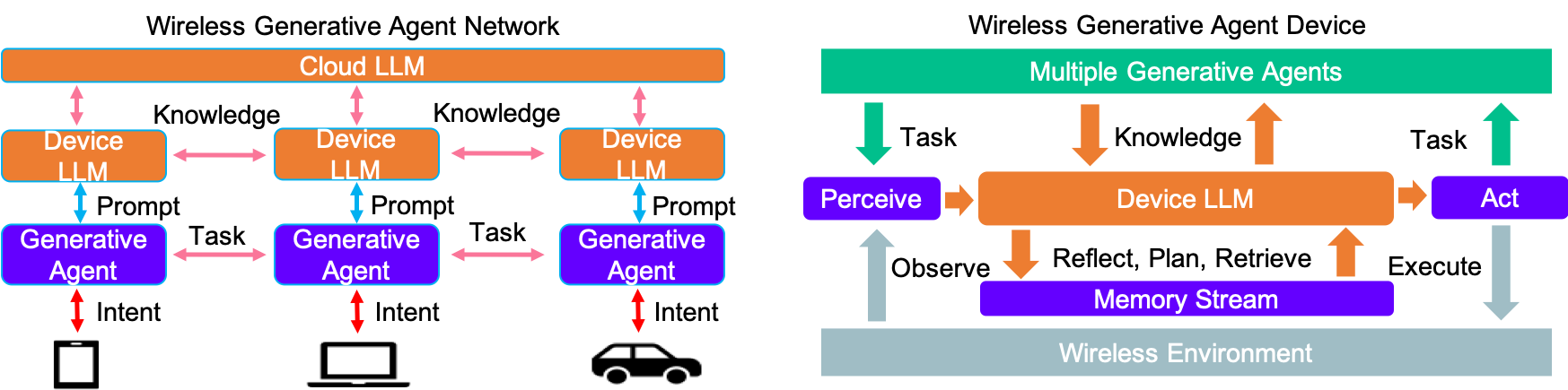
- Describe an architecture where multiple on-device LLMs interact to decompose intents into sequences of tasks for edge execution.
- Discuss planning and reasoning techniques to enable system-2 level cognition (chain-of-thought, self-consistency, and tree of thoughts).
- Introduce multi-agent LLM games and reinforcement learning to derive cooperative behaviors and reduce inter-agent communication costs.
- Advocate semantic information and communication to transfer task-relevant knowledge rather than raw data.
- Present a case study using GPT-4 to solve a wireless energy-saving game among users for network-wide optimization.

Experimental results
Research questions
- RQ1How can on-device LLMs collaboratively plan, reason, and act to achieve network-level goals without relying on cloud-based LLMs?
- RQ2What architectures and interactions among wireless generative agents enable efficient collective intelligence at the network edge?
- RQ3What role do planning, reasoning, and MARL play in achieving cooperative yet competitive multi-agent behavior in wireless settings?
- RQ4How can semantic communication reduce information exchange while preserving task-relevant knowledge for LLMs in a multi-agent wireless network?
- RQ5What are the key challenges (e.g., hallucination, resource constraints, convergence) and future directions for Telecom-domain LLMs in edge networks?
Key findings
- On-device, multi-agent LLMs can collaboratively plan and solve telecom tasks to achieve network objectives in a closed-loop loop (planning, execution, optimization).
- Game theory and MARL provide a framework to model interactions among agents and learn cooperative policies while considering individual KPIs.
- Semantic communication can transfer task-specific knowledge to reduce data exchange and improve cross-agent collaboration.
- A case study with a four-user energy-saving scenario demonstrates that on-device LLMs can achieve power-saving goals while maintaining rate constraints, though multi-agent coordination becomes harder as the number of agents increases.
- The paper identifies necessary components for Telecom domain-specific LLMs and highlights challenges such as hallucination, self-replication concepts, and resource management for on-device LLMs.
Read this paper
Open the full text in the Nubint reader and ask about any passage as you read.
Read this paper on NubintThis review was generated by AI from the original paper. Please check the paper before citing it.