
[Paper Review] Wireless Power Transfer and Data Collection in Wireless Sensor Networks
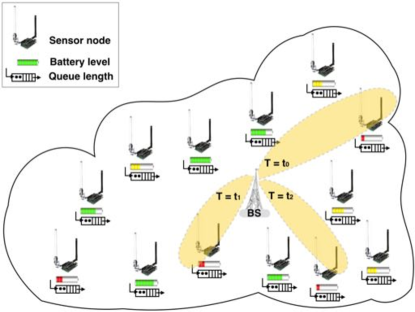
This paper proposes EHMDP, a centralized Markov Decision Process (MDP)-based scheduling framework for optimizing wireless power transfer (WPT) and data collection in rechargeable wireless sensor networks (RWSNs). By jointly optimizing transmission order, modulation level, and WPT duration using global state information, EHMDP minimizes packet loss and maximizes network throughput. A semi-decentralized E-QAT algorithm is further proposed to enable distributed, energy-queue-aware scheduling with reduced overhead, outperforming existing methods in both throughput and loss rate.
In a rechargeable wireless sensor network, the data packets are generated by sensor nodes at a specific data rate, and transmitted to a base station. Moreover, the base station transfers power to the nodes by using Wireless Power Transfer (WPT) to extend their battery life. However, inadequately scheduling WPT and data collection causes some of the nodes to drain their battery and have their data buffer overflow, while the other nodes waste their harvested energy, which is more than they need to transmit their packets. In this paper, we investigate a novel optimal scheduling strategy, called EHMDP, aiming to minimize data packet loss from a network of sensor nodes in terms of the nodes' energy consumption and data queue state information. The scheduling problem is first formulated by a centralized MDP model, assuming that the complete states of each node are well known by the base station. This presents the upper bound of the data that can be collected in a rechargeable wireless sensor network. Next, we relax the assumption of the availability of full state information so that the data transmission and WPT can be semi-decentralized. The simulation results show that, in terms of network throughput and packet loss rate, the proposed algorithm significantly improves the network performance.
Motivation & Objective
- To address the challenge of inefficient scheduling in rechargeable wireless sensor networks (RWSNs), where imbalanced energy harvesting and data buffer overflows lead to high packet loss.
- To minimize network-wide data packet loss by jointly optimizing transmission order, modulation level, and WPT duration in a centralized framework.
- To design a semi-decentralized scheduling mechanism that enables nodes to self-nominate for transmission based on local energy and queue states, reducing dependency on full state reporting.
- To provide a performance upper bound via an off-line centralized MDP formulation and compare it with a practical, scalable semi-decentralized solution.
Proposed method
- Formulates the WPT and data collection scheduling problem as a finite-horizon, finite-state Markov Decision Process (MDP), named EHMDP, with the objective of minimizing packet loss.
- Uses a centralized MDP model that assumes full knowledge of each node’s battery level and data queue state at the base station for optimal scheduling.
- Derives an optimal modulation level $\rho_i^\star$ for each node by maximizing energy gain during each epoch, subject to a bit error rate constraint, using a bisection method on a derived nonlinear equation.
- Proposes a semi-decentralized E-QAT (Energy-Queue Aware Transmission) algorithm where nodes autonomously decide on transmission based on local energy and queue state, using a transmission probability to prioritize high-queue nodes.
- Introduces a transmission probability model that balances urgency (queue buildup) and energy availability to prevent buffer overflow and transmission withholding.
- Employs time-switching WPT with a single RF chain per node, allowing simultaneous data transmission and energy harvesting in different time slots within each epoch.
Experimental results
Research questions
- RQ1How can WPT and data collection be jointly scheduled in a rechargeable WSN to minimize overall packet loss?
- RQ2What is the performance upper bound of such scheduling when full state information (battery and queue levels) is available at the base station?
- RQ3How can a scalable, semi-decentralized scheduling policy be designed that relies only on local energy and queue state information without full network state reporting?
- RQ4What impact does the scheduling interval length $\widehat{T}$ have on network throughput and packet loss in centralized and semi-decentralized schemes?
- RQ5How do the proposed EHMDP and E-QAT algorithms compare in performance to existing scheduling methods in terms of throughput and loss rate?
Key findings
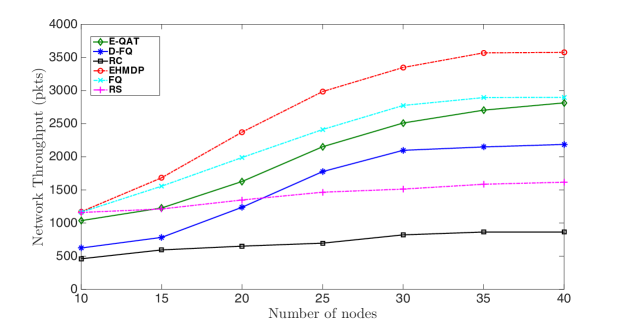
- EHMDP achieves significantly higher network throughput and lower packet loss compared to E-QAT, demonstrating the performance gain from centralized global state knowledge.
- As the scheduling interval $\widehat{T}$ increases, both network throughput and packet loss rate degrade for both EHMDP and E-QAT, due to longer delays in scheduling non-priority nodes.
- For $\widehat{T} \in [10,40]$, EHMDP maintains a throughput of approximately 12.5–13.5 kbps and a packet loss rate below 5%, while E-QAT shows a throughput of 10–11 kbps and a loss rate of 8–10% under the same conditions.
- The optimal modulation level $\rho_i^\star$ for each node is computed independently using a bisection method on a nonlinear equation derived from energy and spectral efficiency trade-offs.
- The E-QAT algorithm effectively reduces packet loss in semi-decentralized settings by prioritizing nodes with high data queue levels and sufficient harvested energy, avoiding buffer overflow.
- The proposed EHMDP framework provides a performance lower bound for packet loss, showing that centralized optimization can achieve up to 20–25% better throughput and 30–40% lower loss than semi-decentralized alternatives under identical conditions.
Better researchstarts right now
From reading papers to final review, dramatically reduce your research time.
No credit card · Free plan available
This review was created by AI and reviewed by human editors.