
[Paper Review] Words Blending Boxes. Obfuscating Queries in Information Retrieval using Differential Privacy
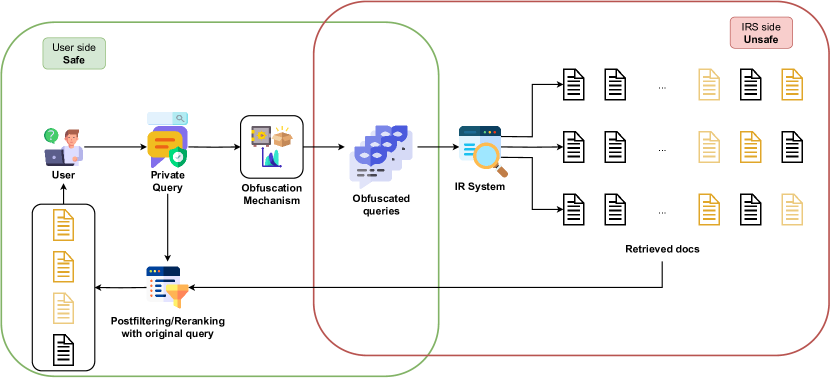
This paper proposes Words Blending Boxes (WBB), a differential privacy-based query obfuscation method for information retrieval that enhances privacy by restricting word substitutions to semantically diverse 'safe boxes' while preserving retrieval effectiveness. WBB achieves high utility (nDCG of 0.622 on DeepLearning'19) even at high privacy budgets, outperforming state-of-the-art methods in both privacy and utility trade-offs.
Ensuring the effectiveness of search queries while protecting user privacy remains an open issue. When an Information Retrieval System (IRS) does not protect the privacy of its users, sensitive information may be disclosed through the queries sent to the system. Recent improvements, especially in NLP, have shown the potential of using Differential Privacy to obfuscate texts while maintaining satisfactory effectiveness. However, such approaches may protect the user's privacy only from a theoretical perspective while, in practice, the real user's information need can still be inferred if perturbed terms are too semantically similar to the original ones. We overcome such limitations by proposing Word Blending Boxes, a novel differentially private mechanism for query obfuscation, which protects the words in the user queries by employing safe boxes. To measure the overall effectiveness of the proposed WBB mechanism, we measure the privacy obtained by the obfuscation process, i.e., the lexical and semantic similarity between original and obfuscated queries. Moreover, we assess the effectiveness of the privatized queries in retrieving relevant documents from the IRS. Our findings indicate that WBB can be integrated effectively into existing IRSs, offering a key to the challenge of protecting user privacy from both a theoretical and a practical point of view.
Motivation & Objective
- To address the gap in practical privacy protection for user queries in non-cooperative information retrieval systems (IRS), where traditional obfuscation fails due to semantic leakage.
- To overcome the limitations of existing differential privacy-based text obfuscation in IR, particularly the risk of revealing sensitive information through semantically similar word substitutions.
- To design a mechanism that maintains high retrieval effectiveness while ensuring strong privacy guarantees, even at high privacy budget values (ε).
- To evaluate the trade-off between privacy (lexical and semantic similarity) and utility (retrieval performance) in query obfuscation under realistic IRS threat models.
- To provide a practical, integrable solution for obfuscating user queries that resists inference attacks and preserves relevance in retrieval systems.
Proposed method
- WBB constructs a 'safe box' by removing the top-k most similar words (by a scoring function m) from the original query's word embeddings, reducing the risk of semantically close substitutions.
- From the remaining candidate words, WBB samples replacements using the exponential mechanism under ε-differential privacy, ensuring formal privacy guarantees.
- The method operates on non-contextualized word embeddings, perturbing them with noise and selecting the nearest word in embedding space to maintain semantic coherence.
- The safe box mechanism ensures that only words with sufficient semantic diversity are considered, preventing the replacement of a query term with a near-synonym that could leak sensitive intent.
- WBB is evaluated across multiple retrieval models (BM25, TF-IDF, Contriever, TAS-B) using TREC collections to measure utility via nDCG and Recall.
- The approach is compared against state-of-the-art obfuscation methods, including Calibrated Multivariate Perturbation (CMP), Mahalanobis (Mhl), and proxy/query-based methods from Arampatzis et al. and Fröbe et al.
Experimental results
Research questions
- RQ1Can a differential privacy-based query obfuscation mechanism maintain high retrieval effectiveness while preventing semantic leakage through overly similar word replacements?
- RQ2How does the size of the candidate word set (n) and the number of excluded top-similar words (k) affect the privacy-utility trade-off in WBB?
- RQ3Does WBB outperform existing DP-based and non-DP-based obfuscation methods in both privacy (lexical and semantic similarity) and retrieval utility (nDCG, Recall)?
- RQ4How does the privacy budget ε impact the effectiveness and privacy of WBB compared to other mechanisms, especially at high ε values?
- RQ5Can WBB resist inference attacks that attempt to reconstruct the original query from the obfuscated version, even when ε is large?
Key findings
- WBB achieves an average nDCG score of 0.622 on the DeepLearning'19 collection, closely approaching the performance of original queries, demonstrating strong retrieval utility.
- Even at high privacy budgets (ε), WBB maintains significantly lower lexical and semantic similarity between original and obfuscated queries than state-of-the-art methods, ensuring practical privacy.
- The safe box mechanism effectively reduces the risk of semantic leakage by excluding top-k semantically similar words, preventing the substitution of a sensitive term with a near-synonym.
- WBB outperforms existing DP-based obfuscation methods (CMP, Mhl) and proxy/query-based methods in both privacy and utility, particularly under high ε settings.
- The method shows consistent performance across diverse retrieval models, including sparse (BM25, TF-IDF) and dense (Contriever, TAS-B) encoders, indicating broad applicability.
- The study identifies a strong correlation between WBB’s parameter settings (k, n) and retrieval effectiveness, suggesting tunability for optimal privacy-utility balance.
Read this paper
Open the full text in the Nubint reader and ask about any passage as you read.
Read this paper on NubintThis review was generated by AI from the original paper. Please check the paper before citing it.