
[Paper Review] Workflow Techniques for the Robust Use of Bayes Factors
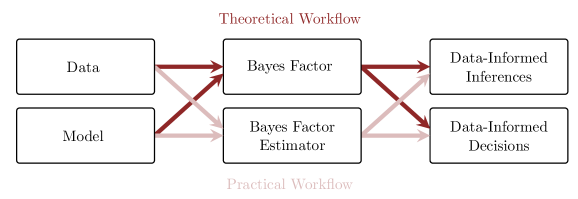
This paper proposes a systematic workflow to assess the robustness of Bayes factors in cognitive science research by addressing sensitivity to priors, estimation instability, data variability, and decision-making under uncertainty. Using simulation-based calibration and sensitivity analyses, the authors demonstrate that Bayes factors can be unreliable due to poor prior specification, insufficient effective sample sizes, and model mis-specification, and they advocate for utility-based decision-making and reproducible calibration to ensure valid inferences in practice.
Inferences about hypotheses are ubiquitous in the cognitive sciences. Bayes factors provide one general way to compare different hypotheses by their compatibility with the observed data. Those quantifications can then also be used to choose between hypotheses. While Bayes factors provide an immediate approach to hypothesis testing, they are highly sensitive to details of the data/model assumptions. Moreover it's not clear how straightforwardly this approach can be implemented in practice, and in particular how sensitive it is to the details of the computational implementation. Here, we investigate these questions for Bayes factor analyses in the cognitive sciences. We explain the statistics underlying Bayes factors as a tool for Bayesian inferences and discuss that utility functions are needed for principled decisions on hypotheses. Next, we study how Bayes factors misbehave under different conditions. This includes a study of errors in the estimation of Bayes factors. Importantly, it is unknown whether Bayes factor estimates based on bridge sampling are unbiased for complex analyses. We are the first to use simulation-based calibration as a tool to test the accuracy of Bayes factor estimates. Moreover, we study how stable Bayes factors are against different MCMC draws. We moreover study how Bayes factors depend on variation in the data. We also look at variability of decisions based on Bayes factors and how to optimize decisions using a utility function. We outline a Bayes factor workflow that researchers can use to study whether Bayes factors are robust for their individual analysis, and we illustrate this workflow using an example from the cognitive sciences. We hope that this study will provide a workflow to test the strengths and limitations of Bayes factors as a way to quantify evidence in support of scientific hypotheses. Reproducible code is available from https://osf.io/y354c/.
Motivation & Objective
- To investigate the robustness of Bayes factors in cognitive science applications under varying data, model, and prior assumptions.
- To identify sources of instability in Bayes factor estimation, including poor prior specification and insufficient MCMC effective sample size.
- To evaluate the accuracy of bridge sampling and Savage-Dickey method estimates using simulation-based calibration (SBC).
- To examine variability in Bayes factor results across repeated data draws and replication attempts.
- To develop a practical workflow for researchers to assess the reliability of Bayes factor inferences and decisions using utility functions and simulation-based calibration.
Proposed method
- Employing simulation-based calibration (SBC) to test the accuracy of Bayes factor estimates by recovering the prior from simulated data under known true models.
- Using the R package brms to fit hierarchical Bayesian models and estimate Bayes factors via bridge sampling for complex cognitive science data.
- Conducting prior sensitivity analyses by varying prior distributions to assess their impact on Bayes factor stability and conclusions.
- Performing prior predictive and posterior predictive checks to evaluate model assumptions and data compatibility.
- Applying utility functions to formalize decision-making and assess the robustness of conclusions under uncertainty.
- Using SBC simulations to calibrate decisions and evaluate whether posterior model probabilities align with true model frequencies.
Experimental results
Research questions
- RQ1How accurate are Bayes factor estimates obtained via bridge sampling, and under what conditions do they fail to recover the true Bayes factor?
- RQ2How sensitive are Bayes factors to variations in prior distributions, especially in small-to-moderate sample settings?
- RQ3To what extent do Bayes factor results vary across repeated sampling due to data variability (e.g., subject and item effects)?
- RQ4How stable are Bayes factor estimates across different MCMC draws, and what effective sample size is required for reliable estimation?
- RQ5Can simulation-based calibration detect biases in Bayes factor estimates due to model mis-specification or improper prior choices?
Key findings
- Bayes factor estimates via bridge sampling can be inaccurate and unstable, even with large MCMC sample sizes, particularly when models are mis-specified.
- SBC revealed that average posterior model probabilities were invalid under the Savage-Dickey method in certain model configurations, indicating unreliable inference.
- Bayes factors showed high sensitivity to prior assumptions, with results changing substantially when effect size priors were altered, even within weakly informative ranges.
- Replication studies demonstrated that Bayes factors can vary widely across repeated sampling, indicating low reproducibility for small-to-moderate effect sizes.
- Studies with small effect sizes or low power—common in cognitive science—often yield inconclusive Bayes factors, even with large samples, unless effect sizes are substantially larger.
- Utility-based decision-making significantly improved robustness, showing that decisions can be optimized only when calibrated using simulation-based methods.
Read this paper
Open the full text in the Nubint reader and ask about any passage as you read.
Read this paper on NubintThis review was generated by AI from the original paper. Please check the paper before citing it.