
[Paper Review] Worldsheet: Wrapping the World in a 3D Sheet for View Synthesis from a Single Image
Worldsheet proposes a category-agnostic, end-to-end differentiable method for novel view synthesis from a single RGB image by shrink-wrapping a deformable 3D mesh sheet onto scene geometry predicted from depth supervision. The approach uses differentiable texture sampling and rendering to train via 2D image reconstruction losses, achieving state-of-the-art performance on Matterport, Replica, and RealEstate10K datasets with high-resolution in-the-wild images and large viewpoint changes.
We present Worldsheet, a method for novel view synthesis using just a single RGB image as input. The main insight is that simply shrink-wrapping a planar mesh sheet onto the input image, consistent with the learned intermediate depth, captures underlying geometry sufficient to generate photorealistic unseen views with large viewpoint changes. To operationalize this, we propose a novel differentiable texture sampler that allows our wrapped mesh sheet to be textured and rendered differentiably into an image from a target viewpoint. Our approach is category-agnostic, end-to-end trainable without using any 3D supervision, and requires a single image at test time. We also explore a simple extension by stacking multiple layers of Worldsheets to better handle occlusions. Worldsheet consistently outperforms prior state-of-the-art methods on single-image view synthesis across several datasets. Furthermore, this simple idea captures novel views surprisingly well on a wide range of high-resolution in-the-wild images, converting them into navigable 3D pop-ups. Video results and code are available at https://worldsheet.github.io.
Motivation & Objective
- To enable novel view synthesis from a single RGB image without requiring 3D supervision or multiple views at test time.
- To develop a category-agnostic, end-to-end trainable method that learns 3D geometry and texture jointly from multi-view supervision.
- To explore the use of a deformable mesh sheet as a sparse, differentiable 3D representation for scene reconstruction and view synthesis.
- To evaluate the effectiveness of mesh wrapping for handling complex scenes, occlusions, and large viewpoint changes.
- To investigate the impact of mesh resolution and multi-layered sheets on view synthesis quality.
Proposed method
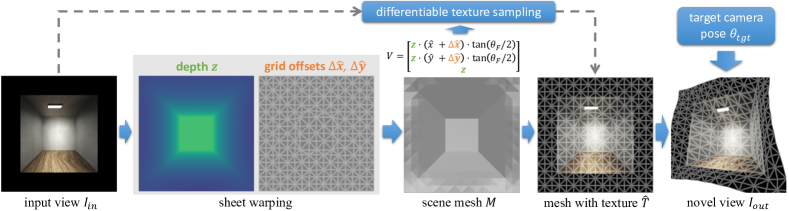
- The method constructs a Worldsheet by warping a planar mesh grid onto the scene using predicted depth and 2D grid offsets, forming a 3D mesh representation.
- A novel differentiable texture sampler projects the input image onto the 3D mesh geometry, enabling gradient computation through the texture mapping process.
- The mesh is rendered from novel viewpoints using a differentiable renderer, with training supervised solely by 2D image reconstruction losses.
- Geometric regularization via mesh Laplacian loss stabilizes deformation and prevents unrealistic mesh distortions during optimization.
- A multi-layer extension stacks separate mesh sheets to model depth discontinuities and improve occlusion handling.
- The model is trained end-to-end using only two views per scene, with no explicit 3D supervision or ground-truth depth at test time.
Experimental results
Research questions
- RQ1Can a single, deformable 3D mesh sheet be effectively used to reconstruct scene geometry and synthesize novel views from a single input image?
- RQ2How well does differentiable texture sampling and rendering enable end-to-end training without 3D supervision?
- RQ3Does mesh wrapping generalize across diverse scene categories, including outdoor scenes, indoor environments, and artistic paintings?
- RQ4Can multi-layered Worldsheets improve occlusion modeling and parallax effects in large viewpoint changes?
- RQ5How does mesh resolution and geometric regularization affect the quality of synthesized views?
Key findings
- Worldsheet achieves state-of-the-art performance on Matterport3D, Replica, and RealEstate10K datasets, outperforming prior methods by a significant margin in PSNR and LPIPS metrics.
- On RealEstate10K, the method achieves a PSNR of 26.74 with a 65×65 mesh, significantly outperforming SynSin and other SOTA baselines.
- The model generates high-quality, photorealistic novel views from 960×960 resolution in-the-wild images, even with large viewpoint changes.
- Abllation studies show that mesh Laplacian regularization is crucial for stable deformation, with performance degrading when regularization is too high.
- Higher mesh resolution (e.g., 65×65) improves detail capture and performance, though the grid offset component is less critical at high resolution.
- Multi-layer Worldsheets improve qualitative handling of occlusions and parallax effects, though quantitative gains on standard metrics are modest.
Read this paper
Open the full text in the Nubint reader and ask about any passage as you read.
Read this paper on NubintThis review was generated by AI from the original paper. Please check the paper before citing it.