
[Paper Review] XENONnT WIMP Search: Signal & Background Modeling and Statistical Inference
This paper presents the XENONnT experiment's first WIMP search using a blinded statistical analysis with a comprehensive signal and background model in cS1, cS2, and R space. The analysis yields new upper limits on the spin-independent WIMP-nucleon cross section, reaching a minimum of $2.58 \times 10^{-47}\ \text{cm}^2$ at $28\ \text{GeV}/c^2$, with no significant excess observed.
The XENONnT experiment searches for weakly-interacting massive particle (WIMP) dark matter scattering off a xenon nucleus. In particular, XENONnT uses a dual-phase time projection chamber with a 5.9-tonne liquid xenon target, detecting both scintillation and ionization signals to reconstruct the energy, position, and type of recoil. A blind search for nuclear recoil WIMPs with an exposure of 1.1 tonne-years (4.18 t fiducial mass) yielded no signal excess over background expectations, from which competitive exclusion limits were derived on WIMP-nucleon elastic scatter cross sections, for WIMP masses ranging from 6 GeV/$c^2$ up to the TeV/$c^2$ scale. This work details the modeling and statistical methods employed in this search. By means of calibration data, we model the detector response, which is then used to derive background and signal models. The construction and validation of these models is discussed, alongside additional purely data-driven backgrounds. We also describe the statistical inference framework, including the definition of the likelihood function and the construction of confidence intervals.
Motivation & Objective
- To search for weakly interacting massive particles (WIMPs) using the XENONnT liquid xenon time projection chamber.
- To develop a precise detector response model for electronic and nuclear recoils, including S2 multiplicity and waveform-level reconstruction.
- To model backgrounds—especially radiogenic neutrons, accidental coincidences, and surface backgrounds—using simulation and data-driven methods.
- To perform a blinded analysis to prevent bias, ensuring statistical rigor in setting exclusion limits.
- To derive new upper limits on the spin-independent WIMP-nucleon scattering cross section across WIMP masses from 6 to 500 GeV/$c^2$
Proposed method
- A full detector response model was fitted to calibration data, incorporating xenon scintillation, charge collection, and waveform reconstruction for both electronic (ER) and nuclear (NR) recoils.
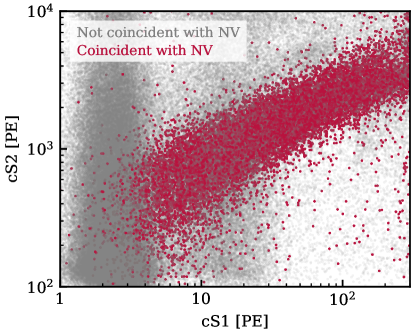
- The S2 multiplicity model was validated using calibration data to correctly describe events with multiple, potentially unresolved energy deposits.
- Background rates were constrained using ancillary measurements: neutron background via multiple-vs-single scatter ratios and veto tagging efficiency in NR calibration data.
- The non-vetoed single-scatter neutron background was predicted by combining simulated and measured neutron interaction characteristics.
- Two shape parameters were introduced to account for uncertainties in the ER model within the cS1–cS2 analysis space.
- Accidental coincidences and surface backgrounds were modeled using data-driven techniques, validated in calibration and science data outside the signal region.
Experimental results
Research questions
- RQ1What is the sensitivity of the XENONnT experiment to spin-independent WIMP-nucleon scattering across a broad mass range?
- RQ2How accurately can the detector response model describe ER and NR events, including complex S2 multiplicity patterns?
- RQ3What is the contribution of radiogenic neutrons to the background, and how well can it be constrained using calibration data?
- RQ4How do data-driven background models compare to simulation in predicting background levels in the signal region?
- RQ5What are the resulting upper limits on the WIMP-nucleon cross section after a blinded analysis with rigorous statistical inference?
Key findings
- No significant signal excess was observed in the unblinded WIMP search data, with local discovery p-values ≥ 0.2 for all tested WIMP masses.
- The analysis achieved a minimum upper limit of $2.58 \times 10^{-47}\ \text{cm}^2$ on the spin-independent WIMP-nucleon cross section at a WIMP mass of $28\ \text{GeV}/c^2$.
- The background model for radiogenic neutrons was successfully constrained using the ratio of multiple-to-single scatter interactions and neutron veto tagging efficiency from NR calibration data.
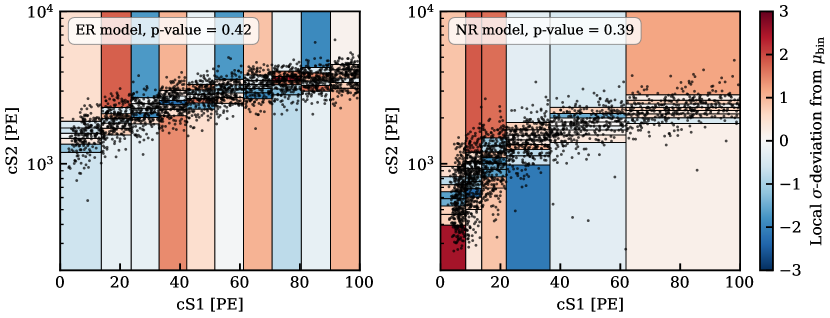
- The statistical model was validated using goodness-of-fit tests with high mismodeling rejection power, defined before unblinding.
- The power-constrained limit (PCL) threshold was raised from 0.15 to 0.5, ensuring limits were set only at or above the median unconstrained upper limit.
- The final best-fit model and calibration fits were assessed as acceptable, confirming the robustness of the signal and background modeling.
Better researchstarts right now
From reading papers to final review, dramatically reduce your research time.
No credit card · Free plan available
This review was created by AI and reviewed by human editors.