
[Paper Review] Yi: Open Foundation Models by 01.AI
Yi presents 6B and 34B language models extended to chat, long-context (200K), depth-upscaled, and vision-language variants, emphasizing data quality and scalable infrastructure to reach GPT-3.5–level performance at lower costs.
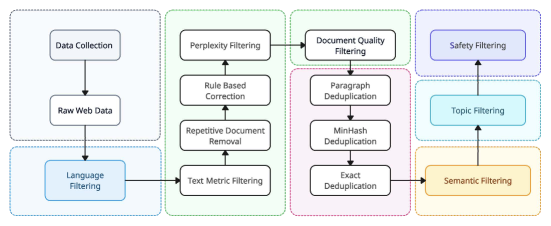
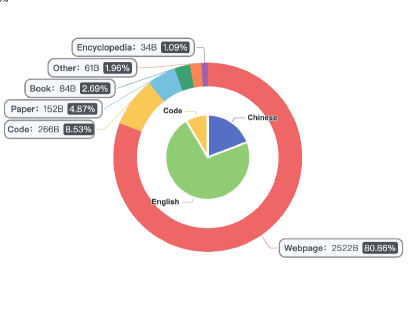
We introduce the Yi model family, a series of language and multimodal models that demonstrate strong multi-dimensional capabilities. The Yi model family is based on 6B and 34B pretrained language models, then we extend them to chat models, 200K long context models, depth-upscaled models, and vision-language models. Our base models achieve strong performance on a wide range of benchmarks like MMLU, and our finetuned chat models deliver strong human preference rate on major evaluation platforms like AlpacaEval and Chatbot Arena. Building upon our scalable super-computing infrastructure and the classical transformer architecture, we attribute the performance of Yi models primarily to its data quality resulting from our data-engineering efforts. For pretraining, we construct 3.1 trillion tokens of English and Chinese corpora using a cascaded data deduplication and quality filtering pipeline. For finetuning, we polish a small scale (less than 10K) instruction dataset over multiple iterations such that every single instance has been verified directly by our machine learning engineers. For vision-language, we combine the chat language model with a vision transformer encoder and train the model to align visual representations to the semantic space of the language model. We further extend the context length to 200K through lightweight continual pretraining and demonstrate strong needle-in-a-haystack retrieval performance. We show that extending the depth of the pretrained checkpoint through continual pretraining further improves performance. We believe that given our current results, continuing to scale up model parameters using thoroughly optimized data will lead to even stronger frontier models.
Motivation & Objective
- Demonstrate high-performance 6B and 34B language models trained on a large, carefully filtered bilingual corpus.
- Showcase extensions to chat, long-context (200K), depth-upscaled, and vision-language variants.
- Investigate data quality, preprocessing, and alignment strategies that enable strong benchmarks and human preferences.
- Provide scalable infrastructure and optimization techniques to support pretraining, finetuning, and efficient serving.
Proposed method
- Pretrain 6B and 34B decoder-only transformers on 3.1T bilingual English/Chinese tokens with cascaded deduplication and quality filtering.
- Incorporate Grouped-Query Attention (GQA), SwiGLU activations, and Rotary/ RoPE-based positional embeddings with RoPE ABF for long-context extension.
- Finetune with a small, high-quality instruction dataset (<10K) using ChatML-format prompts and a tiered data-mixing grid search.
- Extend capabilities via 200K context length through long-sequence pretraining, vision-language alignment with a vision encoder, and depth-upscaling via continual pretraining.
- Build a full-stack infrastructure for cross-cloud scheduling, resilient training, and efficient inference using 4-bit/8-bit quantization, dynamic batching, and PagedAttention.
Experimental results
Research questions
- RQ1Can small-to-medium scale models (6B/34B) match GPT-3.5-level performance on standard benchmarks given heavy data curation?
- RQ2Does increasing context length to 200K and adding vision-language alignment significantly improve retrieval and multimodal capabilities?
- RQ3What is the impact of depth-upscaling via continual pretraining on model performance?
- RQ4How do data quality and targeted finetuning influence human preferences and automated evaluation across tasks?
- RQ5What infrastructure and optimization techniques enable cost-efficient pretraining, finetuning, and serving for large language models?
Key findings
- Yi-34B achieves performance on par with GPT-3.5 on many benchmarks and delivers strong human preference signals in evaluations.
- Yi-34B attains 200K context length with minimal performance loss after long-context training and quantization.
- 4-bit quantization with 8-bit KV cache yields significant memory savings with negligible accuracy loss on benchmarks like MMLU/CMMLU.
- In-context learning experiments indicate emergent abilities at larger scales, with Yi-34B showing strong performance on multi-parameter inference tasks.
- Vision-language extension aligns visual representations to language semantic space, enabling multimodal capabilities.
- Yi-34B-Chat demonstrates strong results on automatic and human evaluations, notably in math-related and code-like tasks relative to smaller baselines.
Read this paper
Open the full text in the Nubint reader and ask about any passage as you read.
Read this paper on NubintThis review was generated by AI from the original paper. Please check the paper before citing it.