
[Paper Review] YOLOv11: An Overview of the Key Architectural Enhancements
The paper analyzes YOLOv11’s architectural innovations (C3k2, SPPF, C2PSA) and its multi-task capabilities, benchmarking its speed and accuracy against predecessors across Nano to XLarge variants.
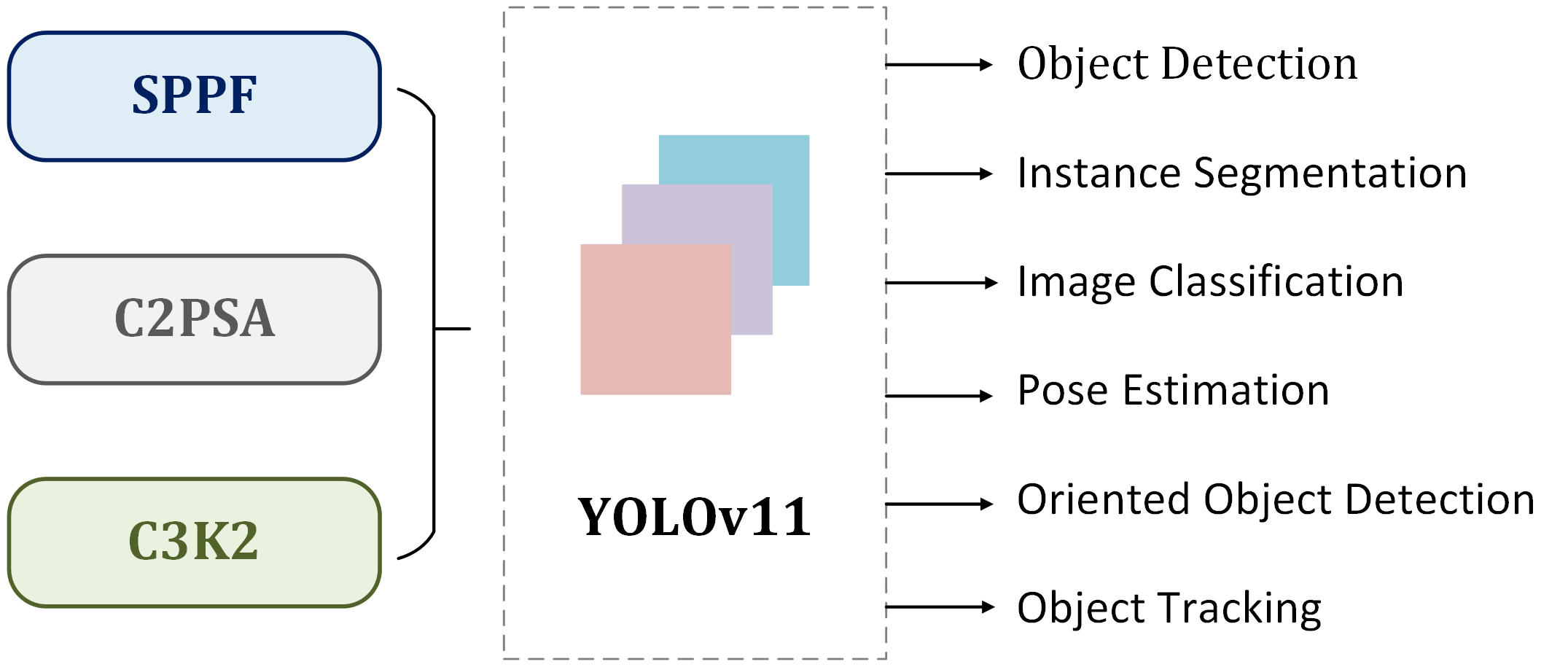
This study presents an architectural analysis of YOLOv11, the latest iteration in the YOLO (You Only Look Once) series of object detection models. We examine the models architectural innovations, including the introduction of the C3k2 (Cross Stage Partial with kernel size 2) block, SPPF (Spatial Pyramid Pooling - Fast), and C2PSA (Convolutional block with Parallel Spatial Attention) components, which contribute in improving the models performance in several ways such as enhanced feature extraction. The paper explores YOLOv11's expanded capabilities across various computer vision tasks, including object detection, instance segmentation, pose estimation, and oriented object detection (OBB). We review the model's performance improvements in terms of mean Average Precision (mAP) and computational efficiency compared to its predecessors, with a focus on the trade-off between parameter count and accuracy. Additionally, the study discusses YOLOv11's versatility across different model sizes, from nano to extra-large, catering to diverse application needs from edge devices to high-performance computing environments. Our research provides insights into YOLOv11's position within the broader landscape of object detection and its potential impact on real-time computer vision applications.
Motivation & Objective
- Assess the architectural improvements introduced in YOLOv11 (C3k2, SPPF, C2PSA) and their impact on feature extraction and efficiency.
- Evaluate YOLOv11 across multiple CV tasks (object detection, instance segmentation, pose estimation, OBB) and its scalability from nano to extra-large models.
- Compare YOLOv11 performance (mAP and speed) with prior YOLO versions and discuss deployment implications.
Proposed method
- Describe the YOLOv11 architecture and the role of the backbone, neck, and head in detail.
- Introduce and explain the C3k2 block as a faster CSP bottleneck replacement.
- Incorporate SPPF with the new C2PSA attention block to enhance spatial focus.
- Explain the head’s use of C3k2 blocks and CBS layers with SiLU activations (CBS blocks).
- Present the model variants (nano to xlarge) and their supported tasks (detection, seg, pose, obb, cls).
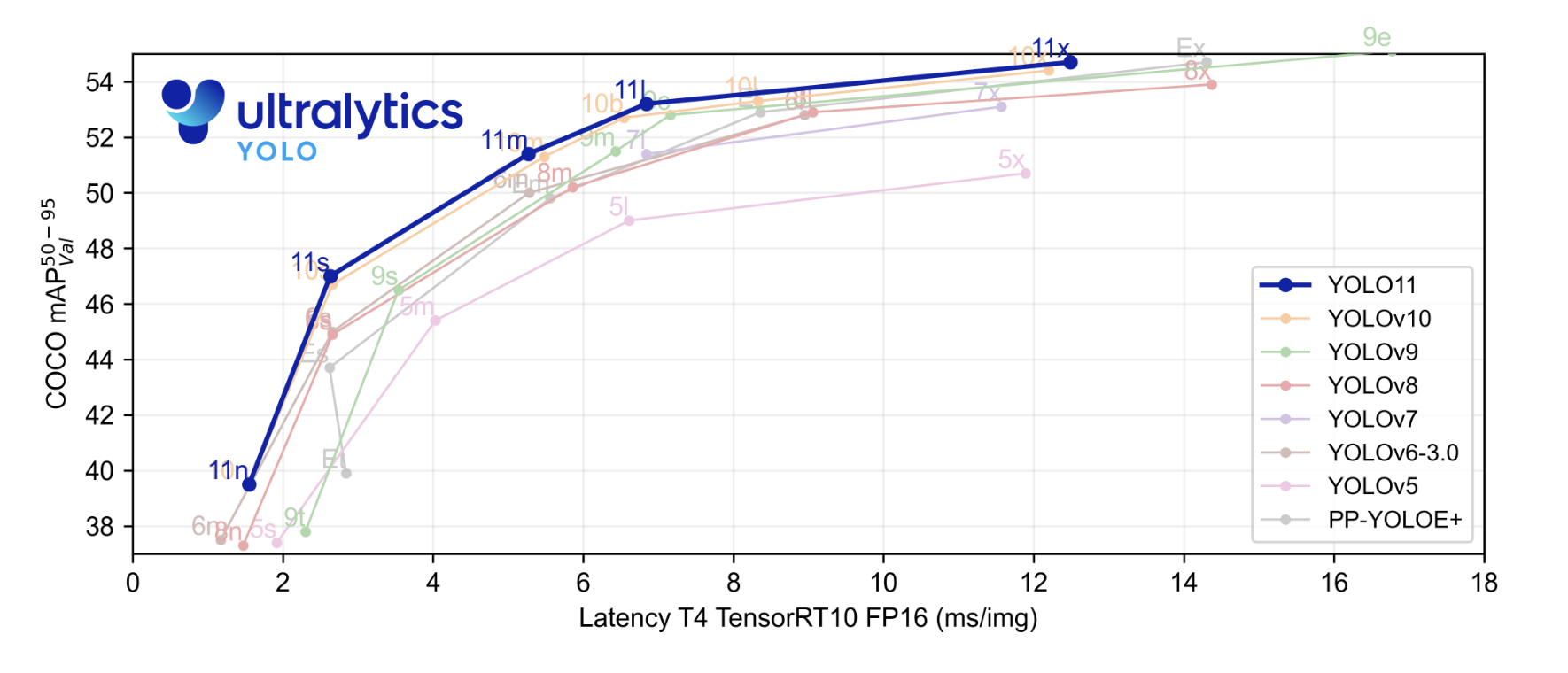
- Provide benchmark-style comparisons to prior YOLO versions, highlighting mAP and inference speed across variants.
Experimental results
Research questions
- RQ1What architectural innovations in YOLOv11 improve feature extraction and detection accuracy?
- RQ2How do the new blocks (C3k2, SPPF, C2PSA) affect computational efficiency and parameter count?
- RQ3What is YOLOv11’s performance across different CV tasks (detection, instance segmentation, pose estimation, oriented object detection) and model sizes?
- RQ4How does YOLOv11 compare to its predecessors in terms of mAP and inference speed on COCO and other benchmarks?
Key findings
- YOLOv11 introduces the C3k2 block replacing C2f in the backbone and neck for faster processing.
- A new C2PSA spatial attention module enhances focus on important regions in feature maps.
- The head uses multiple C3k2 blocks and CBS layers with SiLU activation for refined predictions.
- YOLOv11 offers model variants from nano to xlarge to cover edge to cloud deployments.
- Compared to predecessors, YOLOv11 achieves higher mAP with reduced or competitive parameter counts, and faster inference in several variants (e.g., 11x at ~13 ms) across COCO benchmarks.
- YOLOv11 demonstrates versatility across object detection, instance segmentation, pose estimation, and oriented object detection.
Read this paper
Open the full text in the Nubint reader and ask about any passage as you read.
Read this paper on NubintThis review was generated by AI from the original paper. Please check the paper before citing it.