
[Paper Review] YOLOv11 Optimization for Efficient Resource Utilization
The paper develops six size-specific YOLOv11 variants optimized for efficiency, plus an object-size classifier to select the best model per dataset, and compares them to YOLOv11 and YOLOv8 showing reduced size and inference time with comparable or improved accuracy.
The objective of this research is to optimize the eleventh iteration of You Only Look Once (YOLOv11) by developing size-specific modified versions of the architecture. These modifications involve pruning unnecessary layers and reconfiguring the main architecture of YOLOv11. Each proposed version is tailored to detect objects of specific size ranges, from small to large. To ensure proper model selection based on dataset characteristics, we introduced an object classifier program. This program identifies the most suitable modified version for a given dataset. The proposed models were evaluated on various datasets and compared with the original YOLOv11 and YOLOv8 models. The experimental results highlight significant improvements in computational resource efficiency, with the proposed models maintaining the accuracy of the original YOLOv11. In some cases, the modified versions outperformed the original model regarding detection performance. Furthermore, the proposed models demonstrated reduced model sizes and faster inference times. Models weights and the object size classifier can be found in this repository
Motivation & Objective
- Motivate efficient object detection by tailoring YOLOv11 to object size ranges.
- Develop six modified YOLOv11 variants specialized for small, medium, large, and mixed-size objects.
- Provide an object-size classifier to automatically choose the appropriate model based on dataset characteristics.
- Evaluate the modified models against YOLOv11 and YOLOv8 across diverse datasets.
- Demonstrate reductions in model size and inference time with maintained or improved accuracy.
Proposed method
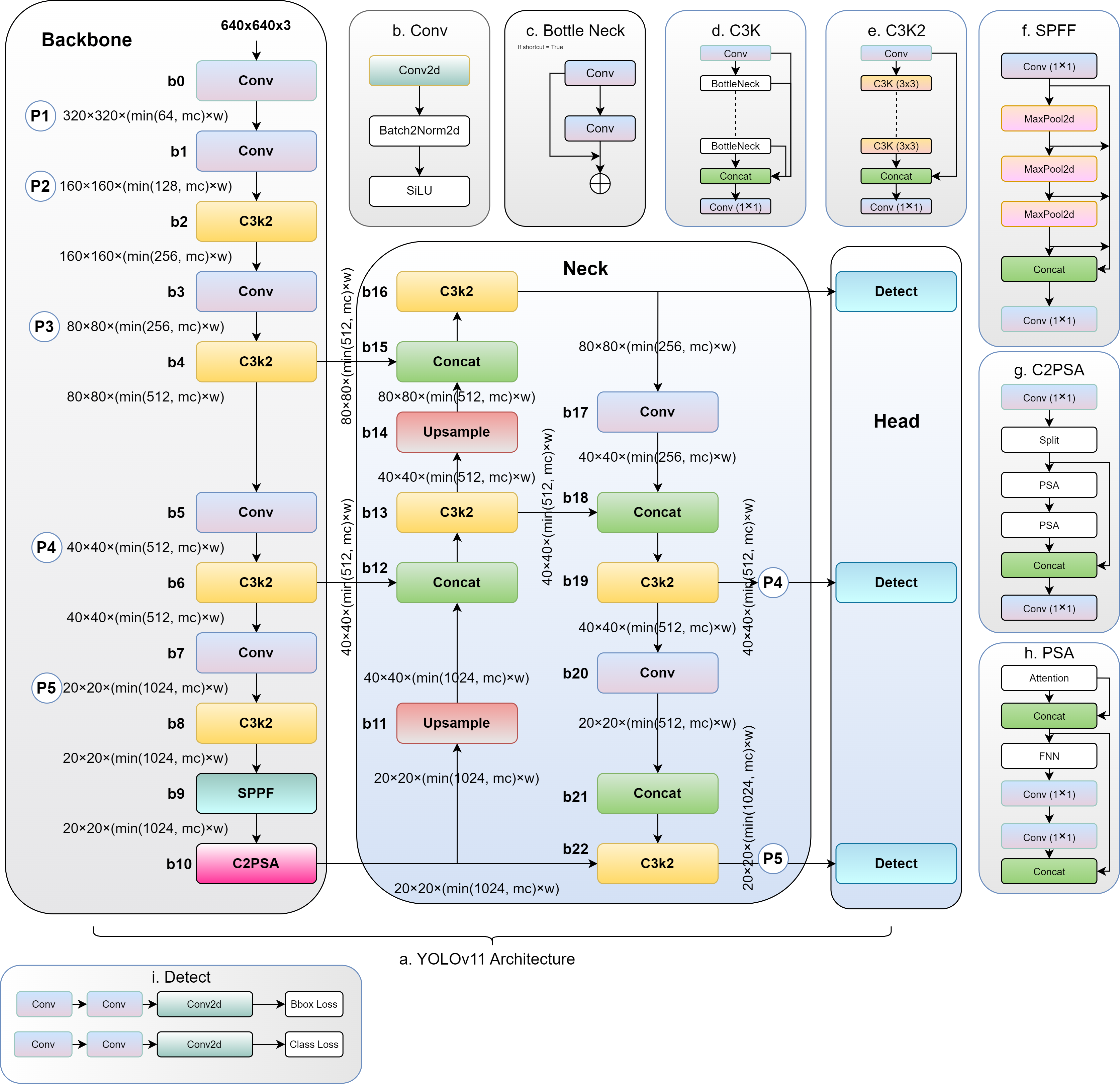
- Propose six YOLOv11 variants: YOLOv11-small, -medium, -large, -sm, -ml, -sl each targeting specific object-size ranges.
- Systematically prune and reconfigure backbone/neck/head blocks to remove size-unrelated components per variant.
- Use an object size classifier to analyze dataset labels and select the most suitable model.
- Evaluate models on six datasets using standard detection metrics (recall, precision, mAP@50) and resource metrics (model size, GFLOPs, inference time, power).
- Compare modified models to original YOLOv11 and YOLOv8 to assess trade-offs between accuracy and efficiency.
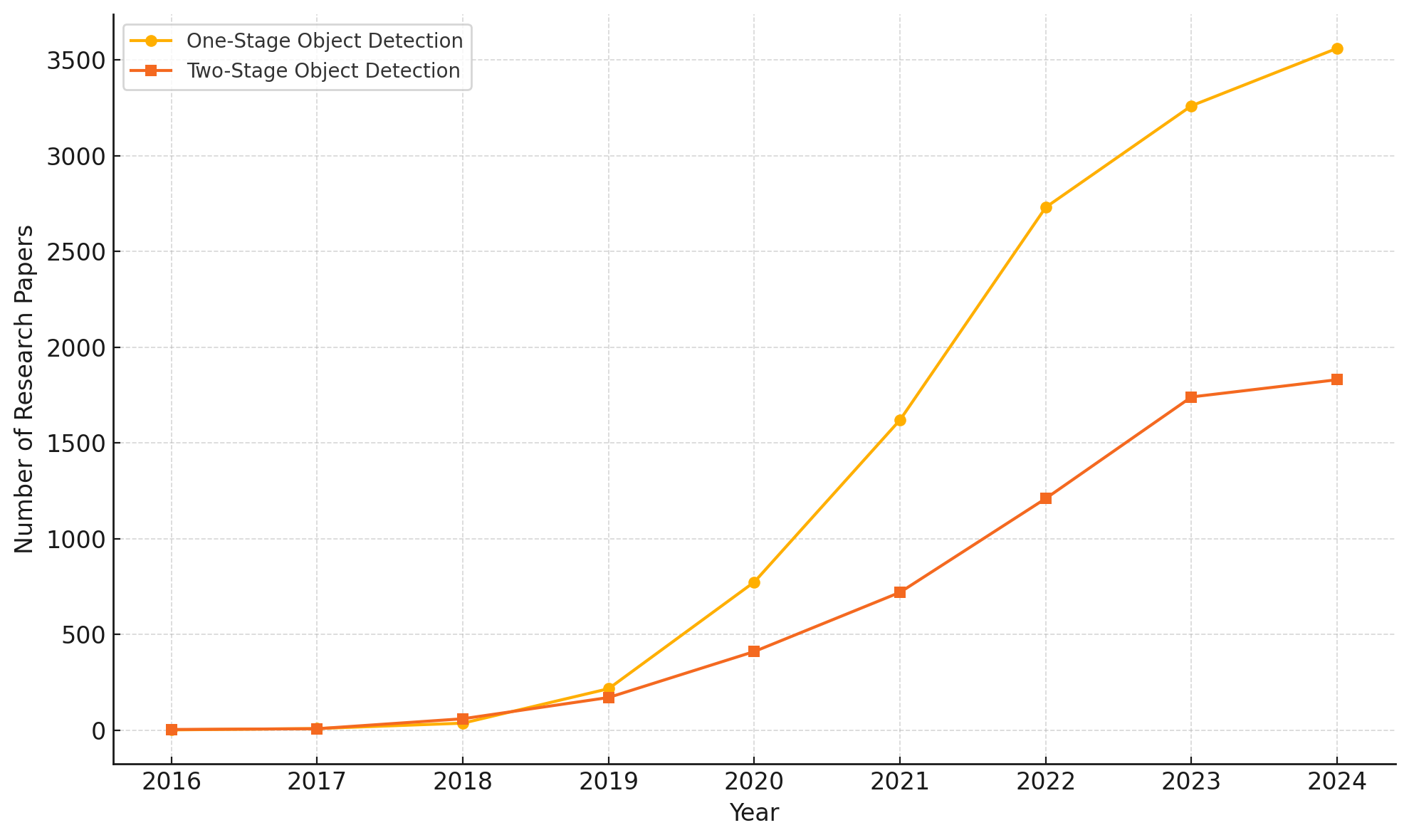
Experimental results
Research questions
- RQ1Can size-specific pruning of YOLOv11 maintain accuracy while reducing resource usage?
- RQ2Does an automated object-size classifier reliably select the most appropriate model for a given dataset?
- RQ3How do the runtime and size metrics of the modified YOLOv11 variants compare to YOLOv11 and YOLOv8 across diverse datasets?
- RQ4Are certain object-size-focused variants superior for particular application domains (e.g., agriculture, medical imaging, aerial surveillance)?
Key findings
- Modified YOLOv11 variants generally outperform YOLOv8 in recall, precision, and mAP@50 across most datasets.
- All proposed variants have smaller model sizes than the original YOLOv11 and are more (or similarly) efficient in GFLOPs and inference time.
- Some modified variants (e.g., YOLOv11-small, YOLOv11-large, YOLOv11-sm, YOLOv11-sl) achieve higher mAP@50 than the original YOLOv11 on certain datasets.
- The original YOLOv11 sometimes outperforms some modified variants (e.g., YOLOv11-medium and YOLOv11-sm) but the maximum performance gap is under 2%.
- Inference times for all models are under 5 ms per image, with the modified variants showing reduced inference times on average.
- Power consumption is lower for several modified variants (YOLOv11-small, -medium, -large, -ml) compared to YOLOv11 and YOLOv8.
Read this paper
Open the full text in the Nubint reader and ask about any passage as you read.
Read this paper on NubintThis review was generated by AI from the original paper. Please check the paper before citing it.