
[Paper Review] You Only Segment Once: Towards Real-Time Panoptic Segmentation
YOSO is a real-time panoptic segmentation framework that unifies instance and semantic segmentation into a single forward pass using dynamic convolutions between learned panoptic kernels and feature maps. It achieves state-of-the-art speed-accuracy trade-offs, attaining 46.4 PQ at 45.6 FPS on COCO, 52.5 PQ at 22.6 FPS on Cityscapes, and competitive results on ADE20K and Mapillary Vistas, enabled by a convolution-first aggregation module and a separable dynamic decoder with weight-sharing cross-attention.
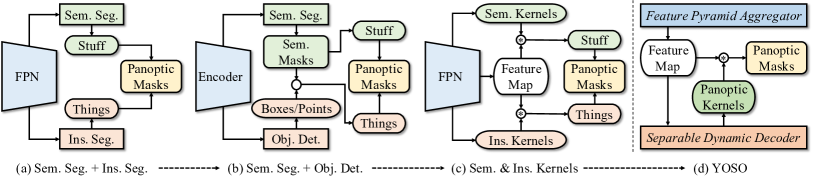
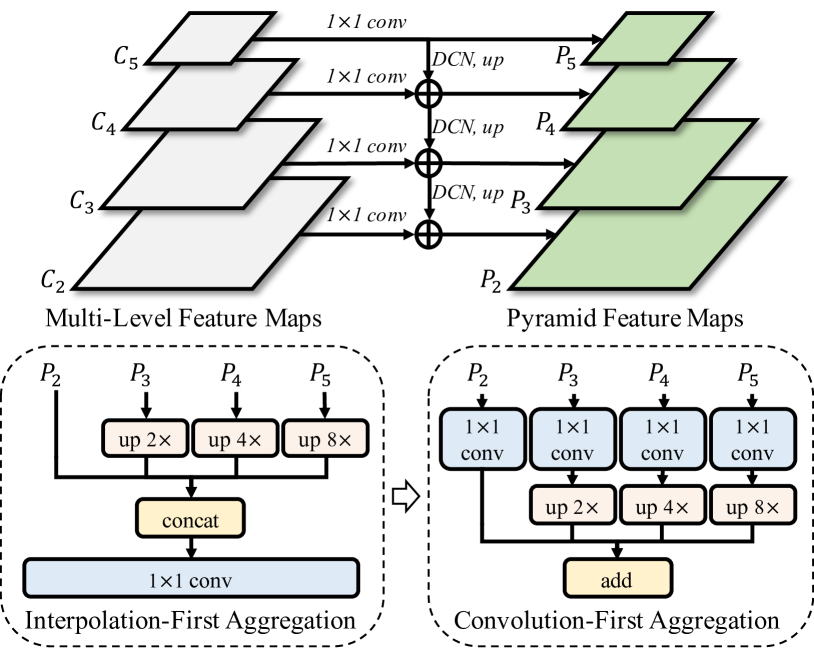
In this paper, we propose YOSO, a real-time panoptic segmentation framework. YOSO predicts masks via dynamic convolutions between panoptic kernels and image feature maps, in which you only need to segment once for both instance and semantic segmentation tasks. To reduce the computational overhead, we design a feature pyramid aggregator for the feature map extraction, and a separable dynamic decoder for the panoptic kernel generation. The aggregator re-parameterizes interpolation-first modules in a convolution-first way, which significantly speeds up the pipeline without any additional costs. The decoder performs multi-head cross-attention via separable dynamic convolution for better efficiency and accuracy. To the best of our knowledge, YOSO is the first real-time panoptic segmentation framework that delivers competitive performance compared to state-of-the-art models. Specifically, YOSO achieves 46.4 PQ, 45.6 FPS on COCO; 52.5 PQ, 22.6 FPS on Cityscapes; 38.0 PQ, 35.4 FPS on ADE20K; and 34.1 PQ, 7.1 FPS on Mapillary Vistas. Code is available at https://github.com/hujiecpp/YOSO.
Motivation & Objective
- To address the challenge of achieving real-time panoptic segmentation with competitive accuracy by unifying instance and semantic segmentation into a single inference pass.
- To reduce computational overhead in feature extraction and kernel generation without sacrificing performance.
- To design a lightweight, efficient architecture that maintains generalization across diverse datasets.
- To introduce novel modules that improve speed and accuracy trade-offs in panoptic segmentation pipelines.
Proposed method
- Proposes a feature pyramid aggregator based on convolution-first aggregation (CFA), re-parameterizing interpolation-first modules to reduce latency by ~2.6× without performance loss.
- Introduces a separable dynamic decoder with separable dynamic convolution attention (SDCA) that performs multi-head cross-attention via weight-sharing, improving efficiency and accuracy.
- Uses dynamic convolutions between learned panoptic kernels and image feature maps to generate masks for both stuff and things in a single segmentation pass.
- Employs a lightweight head with shared parameters across attention heads, reducing FLOPs while maintaining representation capacity.
- Applies a multi-stage refinement process with 2 stages, 100 proposal kernels, and kernel size 5 as optimal settings for speed-accuracy balance.
- Replaces standard FPN necks and heavy decoders with efficient alternatives to enable real-time inference on standard hardware.
Experimental results
Research questions
- RQ1Can a unified panoptic segmentation framework achieve real-time inference while maintaining competitive accuracy?
- RQ2Does re-parameterizing interpolation-first modules into convolution-first ones reduce latency without degrading performance?
- RQ3Can separable dynamic convolution with weight-sharing improve both speed and accuracy in multi-head cross-attention for panoptic kernels?
- RQ4What is the optimal configuration of stages, proposal kernels, and kernel size for balancing speed and accuracy in real-time panoptic segmentation?
- RQ5How does the proposed framework generalize across diverse datasets such as COCO, Cityscapes, ADE20K, and Mapillary Vistas?
Key findings
- YOSO achieves 46.4 PQ at 45.6 FPS on COCO, setting a new state-of-the-art for real-time panoptic segmentation.
- On Cityscapes, YOSO attains 52.5 PQ at 22.6 FPS, demonstrating strong performance on a high-resolution urban scene dataset.
- On ADE20K, YOSO achieves 38.0 PQ at 35.4 FPS, showing robustness on a fine-grained, complex scene dataset.
- On Mapillary Vistas, YOSO reaches 34.1 PQ at 7.1 FPS, indicating scalability to large-scale, diverse datasets despite lower speed.
- The CFA module reduces GPU latency by approximately 2.6× compared to standard interpolation-first modules without performance drop.
- The SDCA module improves PQ by +1.0 and reduces latency by ~1.2× compared to standard multi-head cross-attention.
Read this paper
Open the full text in the Nubint reader and ask about any passage as you read.
Read this paper on NubintThis review was generated by AI from the original paper. Please check the paper before citing it.