
[Paper Review] Zero-Knowledge Proof-based Verifiable Decentralized Machine Learning in Communication Network: A Comprehensive Survey
This paper provides a comprehensive survey of zero-knowledge proof-based verifiable machine learning (ZKP-VML), defining the concept, surveying existing schemes, and outlining challenges and future directions.
Over recent decades, machine learning has significantly advanced network communication, enabling improved decision-making, user behavior analysis, and fault detection. Decentralized approaches, where participants exchange computation results instead of raw private data, mitigate these risks but introduce challenges related to trust and verifiability. A critical issue arises: How can one ensure the integrity and validity of computation results shared by other participants? Existing survey articles predominantly address security and privacy concerns in decentralized machine learning, whereas this survey uniquely highlights the emerging issue of verifiability. Recognizing the critical role of zero-knowledge proofs in ensuring verifiability, we present a comprehensive review of Zero-Knowledge Proof-based Verifiable Machine Learning (ZKP-VML). To clarify the research problem, we present a definition of ZKP-VML consisting of four algorithms, along with several corresponding key security properties. Besides, we provide an overview of the current research landscape by systematically organizing the research timeline and categorizing existing schemes based on their security properties. Furthermore, through an in-depth analysis of each existing scheme, we summarize their technical contributions and optimization strategies, aiming to uncover common design principles underlying ZKP-VML schemes. Building on the reviews and analysis presented, we identify current research challenges and suggest future research directions. To the best of our knowledge, this is the most comprehensive survey to date on verifiable decentralized machine learning and ZKP-VML.
Motivation & Objective
- Introduce zero-knowledge proof-based verifiable machine learning (ZKP-VML) and its importance for verifiable outsourced and federated learning.
- Formally define ZKP-VML, its properties, and the verifiability requirements in ML contexts.
- Classify and analyze existing ZKP-VML schemes by application scenario and technical characteristics.
- Discuss key challenges, limitations, and future directions to guide further research in ZKP-based verifiable ML.
Proposed method
- Provide background on ML and zero-knowledge proofs relevant to verifiability in ML.
- Formalize ZKP-VML with definitions and properties (completeness, soundness, zero-knowledge).
- Classify existing schemes into application classes and analyze their technical approaches.
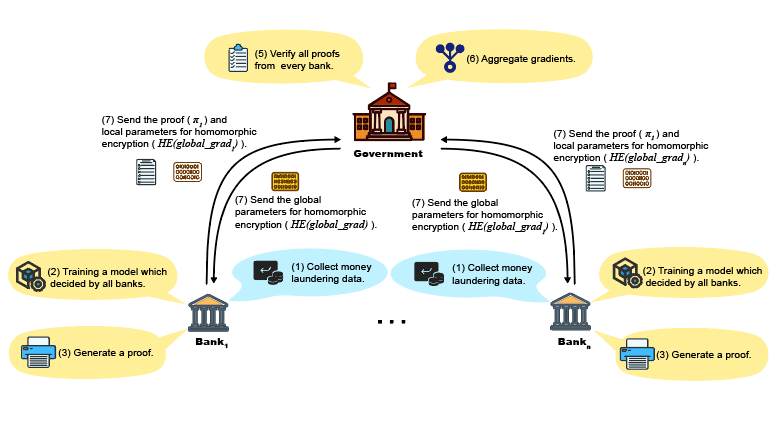
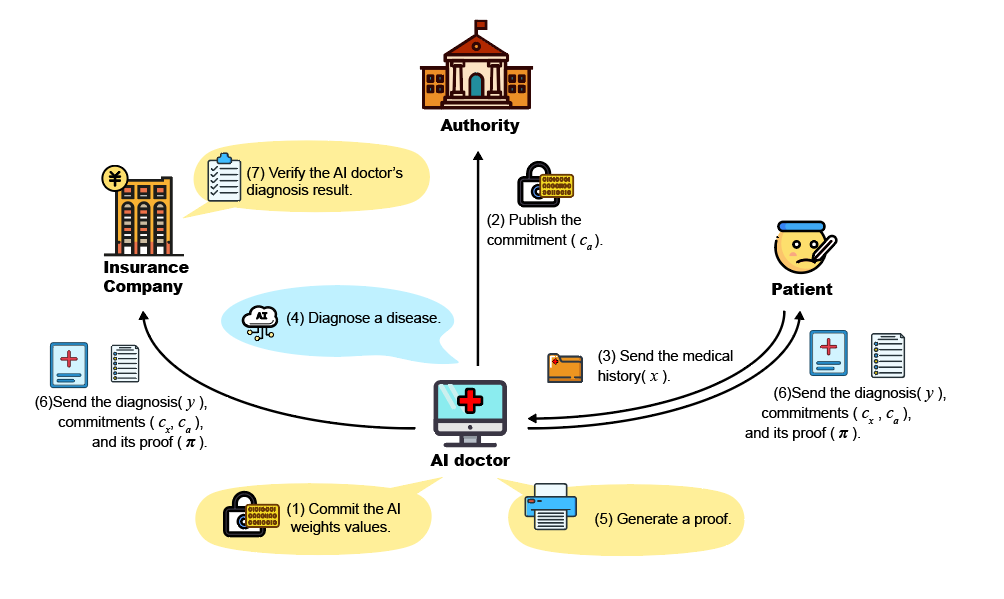
- Discuss architectural workflows (outsourced ML, pipeline, and federated learning) and how ZKP verifies computations.
- Compare related surveys and position this work as the first comprehensive ZKP-VML study up to June 2023.
Experimental results
Research questions
- RQ1What verifiability issues arise in different ML scenarios (outsourced training, inference, and pipelines)?
- RQ2How can zero-knowledge proofs be defined and applied to verify ML computations without revealing private data?
- RQ3What are the existing ZKP-VML schemes, and how do they differ in architecture, cryptographic primitives, and efficiency?
- RQ4What are the main challenges and open research directions in ZKP-based verifiable ML?
- RQ5How does ZKP-VML compare to related secure ML surveys in coverage of verifiability and ZKP techniques?
Key findings
- ZKP-VML has emerged as a formal framework to verify ML computations without disclosing private data.
- The survey provides a formal definition of ZKP-VML and its core properties (completeness, soundness, zero-knowledge).
- Existing schemes are categorized by application class and technical characteristics, with analysis of their workflow in outsourced ML, ML pipelines, and federated learning.
- The work identifies practical challenges, such as efficiency, communication overhead, and integration with diverse ML models and data privacy regimes.
- This is positioned as the first systematic study of ZKP-VML achieving coverage up to June 2023, highlighting gaps and future research directions.
Read this paper
Open the full text in the Nubint reader and ask about any passage as you read.
Read this paper on NubintThis review was generated by AI from the original paper. Please check the paper before citing it.