
[Paper Review] Zero-Shot Contrastive Loss for Text-Guided Diffusion Image Style Transfer
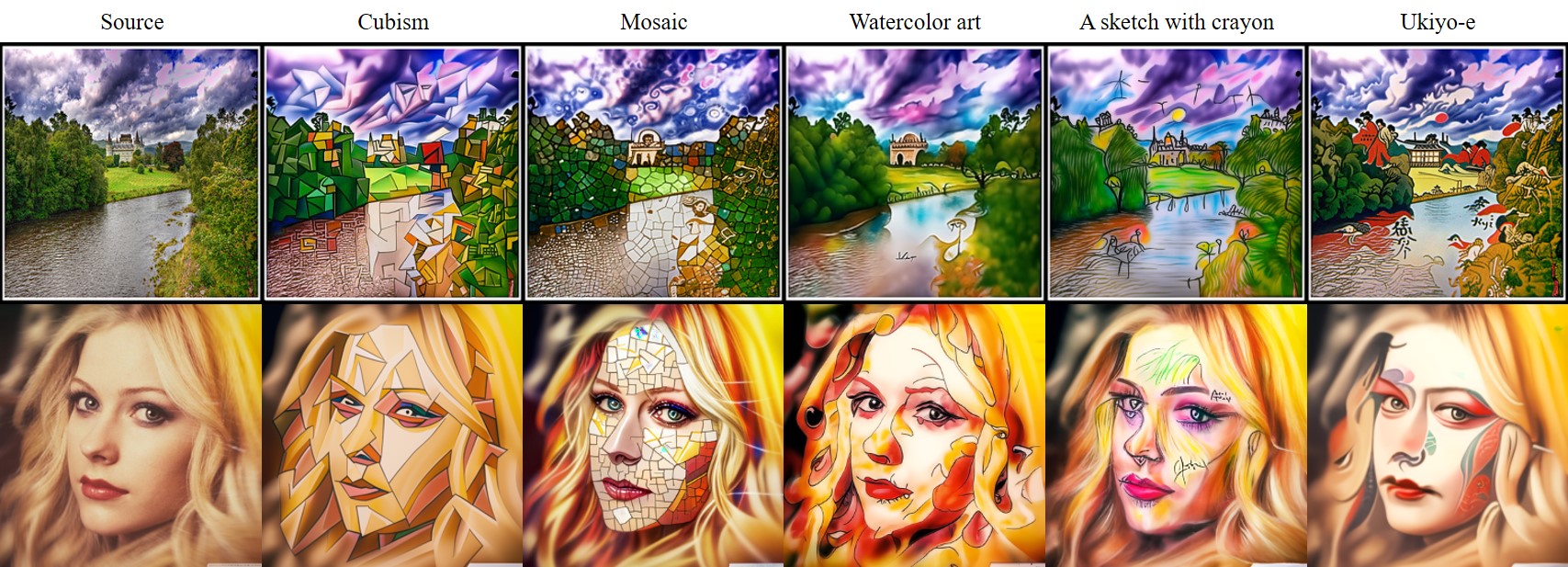
This paper proposes a training-free, zero-shot contrastive loss (ZeCon) for text-guided diffusion models that preserves content while transferring style by leveraging patch-wise contrastive learning between input and generated image embeddings in a pre-trained diffusion model. The method outperforms existing approaches in style transfer, image-to-image translation, and manipulation without fine-tuning or auxiliary networks.
Diffusion models have shown great promise in text-guided image style transfer, but there is a trade-off between style transformation and content preservation due to their stochastic nature. Existing methods require computationally expensive fine-tuning of diffusion models or additional neural network. To address this, here we propose a zero-shot contrastive loss for diffusion models that doesn't require additional fine-tuning or auxiliary networks. By leveraging patch-wise contrastive loss between generated samples and original image embeddings in the pre-trained diffusion model, our method can generate images with the same semantic content as the source image in a zero-shot manner. Our approach outperforms existing methods while preserving content and requiring no additional training, not only for image style transfer but also for image-to-image translation and manipulation. Our experimental results validate the effectiveness of our proposed method.
Motivation & Objective
- To address the trade-off between style transfer and content preservation in diffusion-based image generation.
- To eliminate the need for fine-tuning or additional neural networks in text-guided style transfer.
- To enable zero-shot content preservation by leveraging pre-trained diffusion model embeddings.
- To improve style transfer quality while maintaining structural and semantic content fidelity.
- To extend applicability to image-to-image translation and image manipulation tasks.
Proposed method
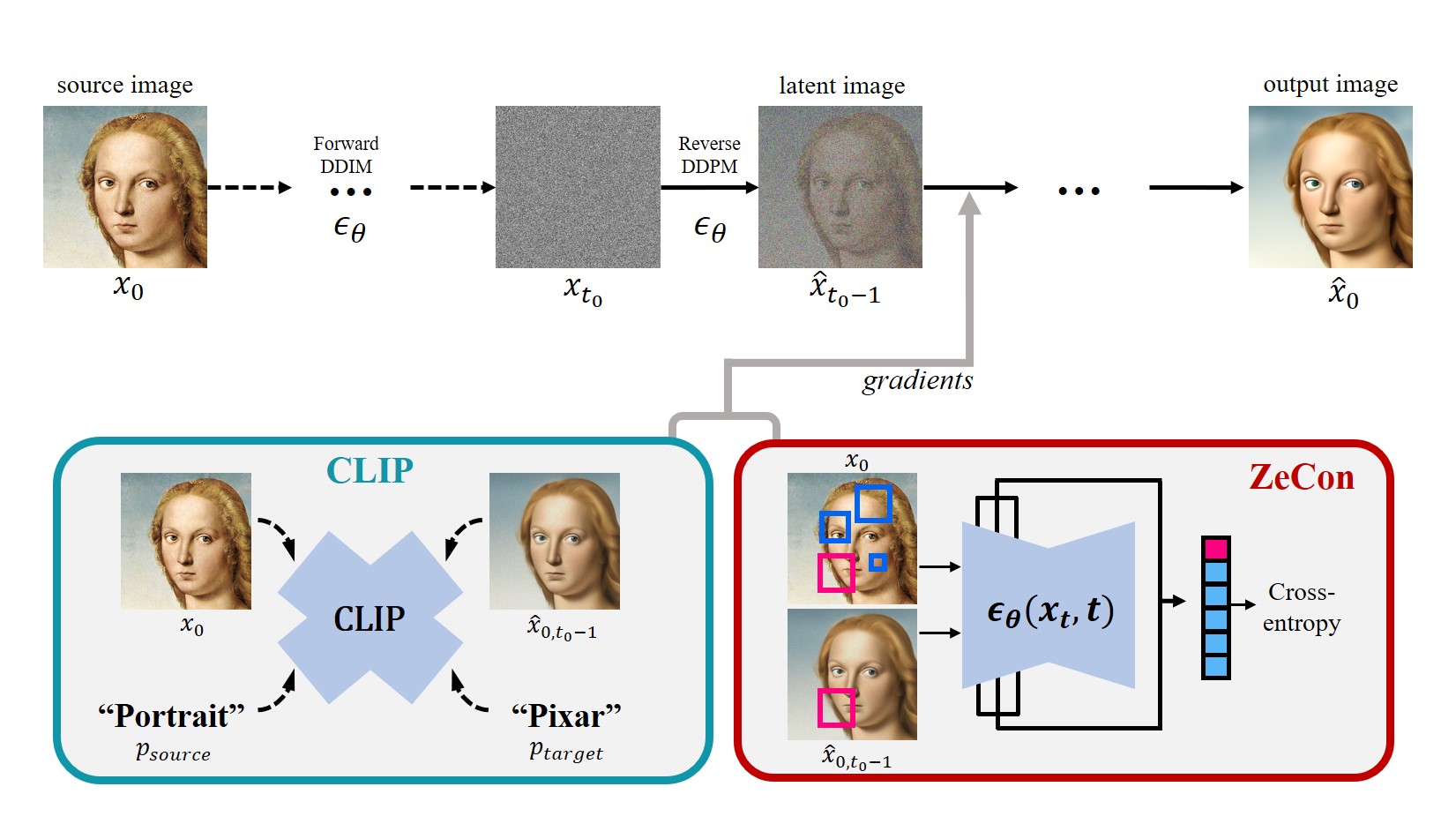
- Proposes a zero-shot contrastive loss (ZeCon) that operates on patch-wise features extracted from the pre-trained diffusion model's latent space.
- Uses the pre-trained diffusion model's own feature embeddings to compute contrastive loss between input and generated image patches.
- Integrates the ZeCon loss with CLIP-based text guidance to steer the diffusion process toward desired styles.
- Applies the loss during the reverse denoising process, updating the denoised image at each step using gradients from both ZeCon and CLIP losses.
- Employs patch-based contrastive learning to preserve fine-grained structural details while enabling global style transfer.
- Does not require any additional training, fine-tuning, or auxiliary networks, making it computationally efficient and deployable out-of-the-box.
Experimental results
Research questions
- RQ1Can a zero-shot contrastive loss preserve semantic content in text-guided diffusion image style transfer without fine-tuning?
- RQ2How does patch-wise contrastive learning compare to VGG or MSE losses in preserving structural details?
- RQ3Can the proposed method achieve high-quality style transfer while maintaining content fidelity across diverse styles?
- RQ4Does the method generalize to image-to-image translation and image manipulation beyond style transfer?
- RQ5What is the relative contribution of global vs. directional CLIP loss and patch-based vs. whole-image guidance in style transfer quality?
Key findings
- The ZeCon loss significantly improves content preservation, outperforming MSE and VGG losses individually and in combination, as shown in user studies (4.81 vs. 4.29 and 3.29 for content score).
- Ablation studies confirm that ZeCon is essential for preserving fine-grained structural details, such as building windows, which are lost when excluded.
- The combination of global and directional CLIP losses leads to more stylized outputs than global loss alone, indicating directional guidance enhances style modulation.
- Patch-based guidance enables more consistent and large-area style transfer compared to whole-image guidance, which tends to stylize local regions only.
- The method achieves inference time of 38 seconds, significantly faster than DiffusionCLIP (96 sec) and DDIB (12 sec), while requiring no training or data preparation.
- The method generalizes effectively to image-to-image translation and appearance manipulation (e.g., age, gender, makeup), demonstrating broad applicability.
Read this paper
Open the full text in the Nubint reader and ask about any passage as you read.
Read this paper on NubintThis review was generated by AI from the original paper. Please check the paper before citing it.