
[Paper Review] Zero-Shot Text-Guided Object Generation with Dream Fields
Dream Fields proposes a zero-shot text-guided 3D object generation method that synthesizes detailed, multi-view consistent 3D geometry and color from natural language prompts using a Neural Radiance Field (NeRF) optimized via CLIP-based image-text similarity. By combining CLIP supervision with geometric priors like transmittance regularization and scene bounds, the method achieves high-fidelity, diverse 3D object generation without any 3D training data, enabling open-vocabulary 3D synthesis from diverse captions.
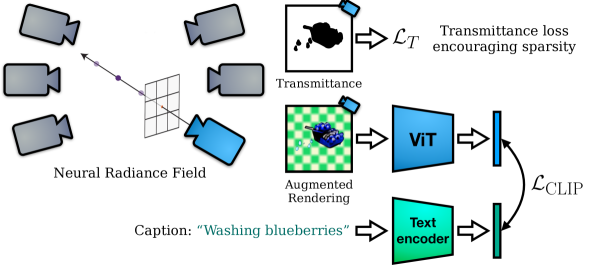
We combine neural rendering with multi-modal image and text representations to synthesize diverse 3D objects solely from natural language descriptions. Our method, Dream Fields, can generate the geometry and color of a wide range of objects without 3D supervision. Due to the scarcity of diverse, captioned 3D data, prior methods only generate objects from a handful of categories, such as ShapeNet. Instead, we guide generation with image-text models pre-trained on large datasets of captioned images from the web. Our method optimizes a Neural Radiance Field from many camera views so that rendered images score highly with a target caption according to a pre-trained CLIP model. To improve fidelity and visual quality, we introduce simple geometric priors, including sparsity-inducing transmittance regularization, scene bounds, and new MLP architectures. In experiments, Dream Fields produce realistic, multi-view consistent object geometry and color from a variety of natural language captions.
Motivation & Objective
- To enable 3D object generation from natural language descriptions without requiring 3D-annotated training data.
- To overcome the limited generalization of prior 3D generative models restricted to predefined categories like ShapeNet.
- To leverage pre-trained image-text models (e.g., CLIP) for zero-shot, text-guided 3D synthesis with high perceptual alignment.
- To improve NeRF-based 3D generation fidelity under text supervision by introducing simple, effective geometric priors.
- To demonstrate open-set 3D generation across diverse, real-world object categories using compositional language prompts.
Proposed method
- Optimize a Neural Radiance Field (NeRF) to maximize CLIP's image-text similarity score between rendered images and a given text prompt.
- Use a frozen CLIP model to score rendered images from random camera poses, enabling differentiable optimization of the NeRF without 3D supervision.
- Apply transmittance regularization to enforce sparsity and reduce artifacts in the radiance field, improving geometric realism.
- Enforce scene bounds to constrain the 3D volume and prevent unrealistic object extensions.
- Use a modified MLP architecture with positional encoding to improve feature representation and training stability.
- Sample camera poses across a full 360° azimuth range to ensure multi-view consistency and generalization.
Experimental results
Research questions
- RQ1Can a NeRF be effectively optimized using only text prompts and CLIP-based image-text similarity, without any 3D supervision or multi-view images?
- RQ2How do geometric priors such as transmittance regularization and scene bounds affect the realism and fidelity of text-guided 3D generation?
- RQ3To what extent can the compositional nature of language enable diverse and controllable 3D object generation across open-vocabulary categories?
- RQ4How does the choice of pre-trained image-text model (e.g., CLIP vs. LiT) impact the quality and alignment of generated 3D objects?
- RQ5What is the effect of camera pose sampling strategy on multi-view consistency and viewpoint generalization in text-to-3D synthesis?
Key findings
- Dream Fields achieves high retrieval precision (up to 86.6% R-Precision) when evaluated with CLIP B/32, indicating strong semantic alignment between generated 3D objects and input captions.
- CLIP B/32 outperforms CLIP B/16 in retrieval metrics, suggesting that larger patch size may be advantageous for low-resolution renders.
- Using LiT${}_{\text{uu}}$ B/32 as the retrieval model yields the highest R-Precision (88.9%), indicating strong generalization to open-set prompts.
- Training with diverse camera poses (360° azimuth sampling) significantly improves multi-view consistency, reducing artifacts in side and rear views.
- Transmittance regularization and scene bounds are critical for reducing NeRF artifacts and improving geometric realism in the absence of multi-view supervision.
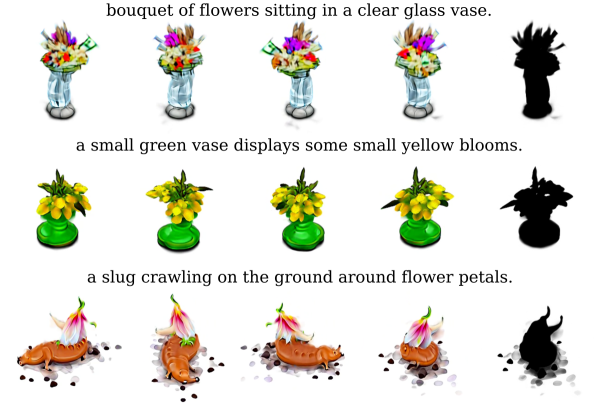
- Qualitative results show that Dream Fields can generate detailed, textured, and diverse 3D objects from complex, compositional captions such as 'a red flower in a blue vase with green leaves'.
Read this paper
Open the full text in the Nubint reader and ask about any passage as you read.
Read this paper on NubintThis review was generated by AI from the original paper. Please check the paper before citing it.