
[Paper Review] ZeroNVS: Zero-Shot 360-Degree View Synthesis from a Single Image
ZeroNVS trains a 3D-aware diffusion model on diverse real-world scene data to synthesize 360-degree novel views from a single image, introducing camera conditioning and SDS anchoring to achieve state-of-the-art zero-shot performance on DTU and Mip-NeRF 360 benchmarks.
We introduce a 3D-aware diffusion model, ZeroNVS, for single-image novel view synthesis for in-the-wild scenes. While existing methods are designed for single objects with masked backgrounds, we propose new techniques to address challenges introduced by in-the-wild multi-object scenes with complex backgrounds. Specifically, we train a generative prior on a mixture of data sources that capture object-centric, indoor, and outdoor scenes. To address issues from data mixture such as depth-scale ambiguity, we propose a novel camera conditioning parameterization and normalization scheme. Further, we observe that Score Distillation Sampling (SDS) tends to truncate the distribution of complex backgrounds during distillation of 360-degree scenes, and propose "SDS anchoring" to improve the diversity of synthesized novel views. Our model sets a new state-of-the-art result in LPIPS on the DTU dataset in the zero-shot setting, even outperforming methods specifically trained on DTU. We further adapt the challenging Mip-NeRF 360 dataset as a new benchmark for single-image novel view synthesis, and demonstrate strong performance in this setting. Our code and data are at http://kylesargent.github.io/zeronvs/
Motivation & Objective
- Address zero-shot 360-degree novel view synthesis for in-the-wild scenes with multiple objects and complex backgrounds.
- Develop a diffusion-based prior trained on a large mixture of real scene datasets (CO3D, RealEstate10K, ACID) to handle diverse geometries and backgrounds.
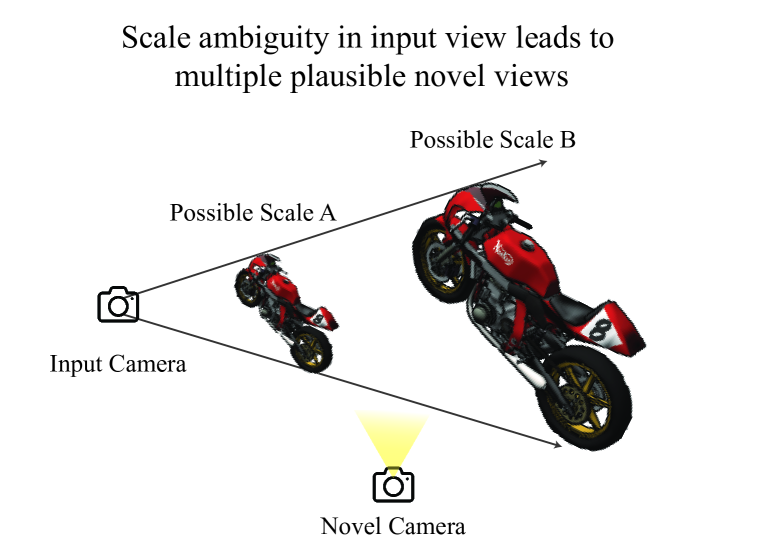
- Create a robust camera conditioning scheme and scene normalization to resolve scale ambiguity and improve 3D consistency.
- Mitigate background diversity loss in SDS-based distillation with SDS anchoring to promote varied, plausible backgrounds.
- Demonstrate strong zero-shot generalization and establish a new scene-level single-image NVS benchmark (Mip-NeRF 360).
Proposed method
- Train a 2D conditional diffusion model followed by 3D SDS distillation to obtain 3D-consistent novel views from a single image.
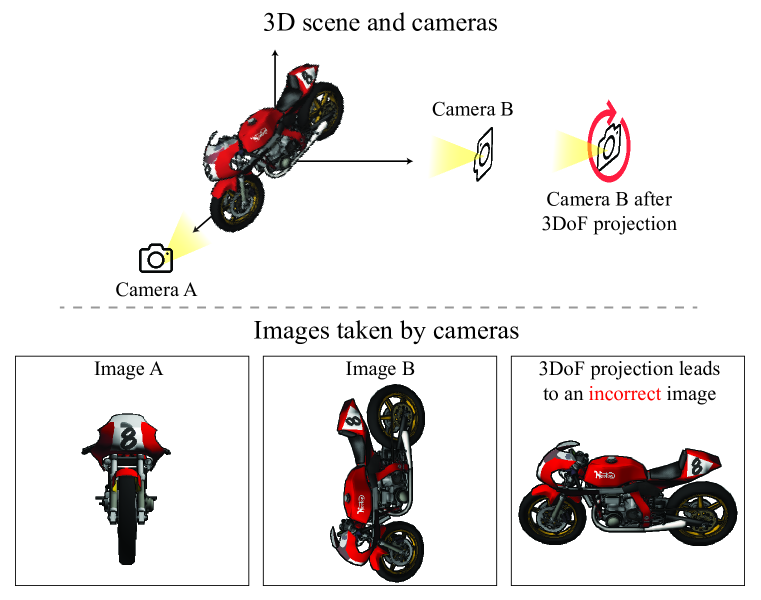
- Introduce a 6DoF+1 camera conditioning representation (relative pose with field of view) and a viewer-centric normalization scheme to handle scale and pose variations across in-the-wild data.
- Normalize camera translations using a scene-scale parameter q from depth statistics to reduce scale ambiguity.
- Apply depth-infilled dense maps for consistent scale estimation during training via a novel normalization, called 6DoF+1, viewer, to unify conditioning across datasets.
- Propose SDS anchoring: sample multiple anchor views with DDIM, then use the nearest anchor as conditioning during SDS optimization to increase background diversity.
- Evaluate with LPIPS, PSNR, SSIM on DTU (zero-shot) and introduce Mip-NeRF 360 as a new zero-shot scene-level NVS benchmark.
Experimental results
Research questions
- RQ1How can a diffusion-based prior trained on diverse real scenes enable zero-shot 360-degree novel view synthesis from a single image?
- RQ2What camera conditioning and normalization strategies best cope with scale and pose ambiguities in in-the-wild scenes?
- RQ3Can background diversity be improved in SDS-based distillation for scene-level NVS without sacrificing 3D consistency?
Key findings
- ZeroNVS achieves state-of-the-art LPIPS on DTU in zero-shot settings, outperforming methods trained on DTU.
- On Mip-NeRF 360, ZeroNVS achieves the best LPIPS among zero-shot baselines.
- A viewer-centric 6DoF+1 conditioning with depth-informed scale normalization improves 2D-to-3D conditioning and generalization across diverse datasets (CO3D, ACID, RealEstate10K).
- SDS anchoring increases background diversity and is preferred in user studies for realism and creativity.
- Ablations show that training on a mix of CO3D, ACID, RealEstate10K improves performance across evaluated datasets.
Read this paper
Open the full text in the Nubint reader and ask about any passage as you read.
Read this paper on NubintThis review was generated by AI from the original paper. Please check the paper before citing it.