
[Paper Review] ZeroShotDataAug: Generating and Augmenting Training Data with ChatGPT
The paper demonstrates that zero-shot prompting of ChatGPT can generate effective synthetic training data that outperforms several traditional augmentation methods across SST-2, SNIPS, and TREC, with comparisons to few-shot ChatGPT.
In this paper, we investigate the use of data obtained from prompting a large generative language model, ChatGPT, to generate synthetic training data with the aim of augmenting data in low resource scenarios. We show that with appropriate task-specific ChatGPT prompts, we outperform the most popular existing approaches for such data augmentation. Furthermore, we investigate methodologies for evaluating the similarity of the augmented data generated from ChatGPT with the aim of validating and assessing the quality of the data generated.
Motivation & Objective
- Motivate data augmentation for low-resource NLP tasks using prompts to a large language model (ChatGPT).
- Evaluate zero-shot ChatGPT data augmentation against established baselines across multiple datasets.
- Propose and assess methods to measure similarity between ChatGPT-generated data and original data to validate quality.
- Quantify how augmentation size impacts performance and explore data sufficiency without training data.
Proposed method
- Compare zero-shot ChatGPT augmentation with EDA, Back-Translation, and transformer-based augmentation baselines.
- Use three datasets (SST-2, SNIPS, TREC) under low-resource settings (10 examples per class).
- Generate synthetic data via task-specific zero-shot prompts for ChatGPT and evaluate across 15 runs.
- Fine-tune BERT-base-uncased with augmented data and report accuracy and standard deviation.
- Assess data contamination and similarity using Sentence Embedding (MiniLM), TF-IDF, and Word Overlap metrics.
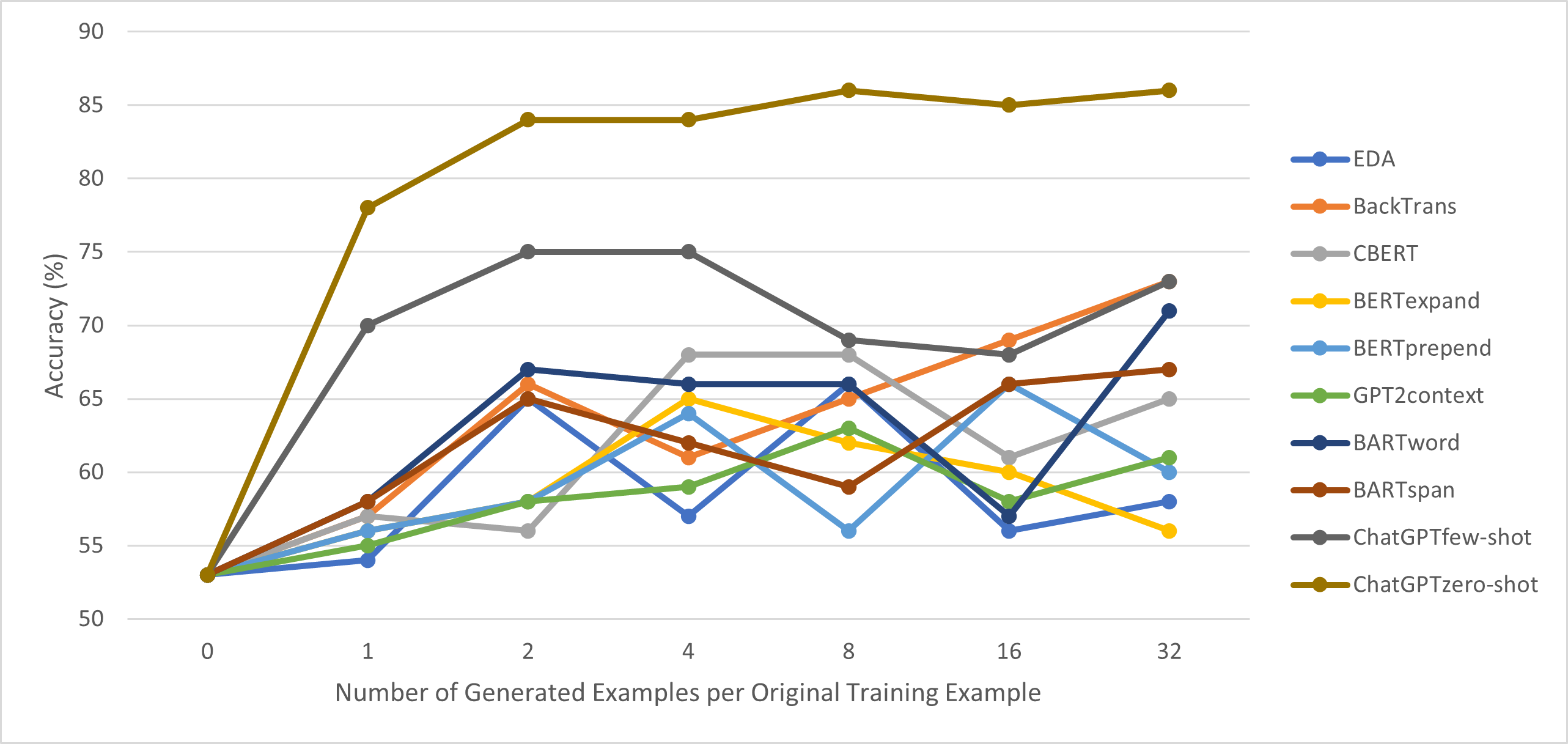
- Experiment with varying augmentation counts to study performance trends.
Experimental results
Research questions
- RQ1How effective is zero-shot ChatGPT prompting for data augmentation compared to traditional methods on text classification tasks?
- RQ2What is the impact of the amount of ChatGPT-generated data on model performance in low-resource settings?
- RQ3Can we reliably assess the similarity between ChatGPT-generated data and real data to rule out memorization or contamination?
- RQ4Is zero-shot ChatGPT augmentation capable of outperforming other methods even without any original training data?
Key findings
- Zero-shot ChatGPT augmentation achieves 78.1% (SST-2), 91.2% (SNIPS), and 75.3% (TREC) accuracy, outperforming all baselines except few-shot ChatGPT on SNIPS.
- Zero-shot ChatGPT outperforms the best non-ChatGPT augmentation on SST-2 and TREC by 20% and 8% respectively, and by 4% on SNIPS.
- Performance gains persist as the number of ChatGPT-generated augmentation examples per original example increases (K in {1,2,4,8,16,32}).
- Even with no original training data, ChatGPT zero-shot augmentation yields mean accuracies of 0.80 (SST-2), 0.78 (SNIPS), and 0.62 (TREC), competitive with or better than existing methods on SST-2 and near-best on TREC.
- Similarity analyses (Cosine Sentence Embedding, Cosine TF-IDF, Word Overlap) show little evidence of data memorization or contamination from ChatGPT-generated data.
- The data similarity results indicate ChatGPT-generated data is on average slightly more similar to training data than to test data, suggesting generalization rather than memorization.
Read this paper
Open the full text in the Nubint reader and ask about any passage as you read.
Read this paper on NubintThis review was generated by AI from the original paper. Please check the paper before citing it.