
[论文解读] Fluidisation of yield stress fluids under vibration
本研究通过垂直正弦振动研究了屈服应力流体(熔融巧克力与Carbopol微凝胶)的振动流态化行为。结果表明,尽管两种材料在临界驱动力加速度以上均发生铺展,但Carbopol迅速松弛至新的平衡形状并伴随大振幅振荡,表明其在屈服阈值附近表现出复杂的非线性粘弹性行为;而巧克力则表现出缓慢且依赖历史的铺展行为。
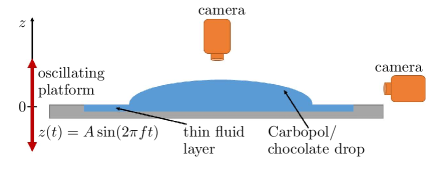
Motivated by the industrial processing of chocolate, we study experimentally the fluidisation of a sessile drop of yield-stress fluid on a pre-existing layer of the same fluid under vertical sinusoidal oscillations. We compare the behaviours of molten chocolate and Carbopol which are both shear-thinning with a similar yield stress but exhibit very different elastic properties. We find that these materials spread when the forcing acceleration exceeds a threshold which is determined by the initial deposition process. However, they exhibit very different spreading behaviours: whereas chocolate exhibits slow long-term spreading, the Carbopol drop rapidly relaxes its stress by spreading to a new equilibrium shape with an enlarged footprint. This spreading is insensitive to the history of the forcing. In addition, the Carbopol drop performs large-amplitude oscillations with the forcing frequency, both above and below the threshold. We investigate these viscoelastic oscillations and provide evidence of complex nonlinear viscoelastic behaviour in the vicinity of the spreading threshold. In fact, for forcing accelerations greater than the spreading threshold, our drop automatically adjusts its shape to remain at the yield stress. We discuss how our vibrated-drop experiment offers a new and powerful approach to probing the yield transition in elastoviscoplastic fluids.
研究动机与目标
- 理解在垂直振动作用下屈服应力流体的流态化机理,动机源于巧克力等工业材料的加工过程。
- 比较两种剪切变稀、屈服应力相近但弹性性质不同的流体(熔融巧克力与Carbopol微凝胶)的铺展行为。
- 研究粘弹性与激励历史在屈服阈值附近铺展的起始与动力学过程中的作用。
- 通过循环流变测量与应力斜坡实验,表征Carbopol微凝胶的动态屈服应力与屈服后流变行为。
- 开发一种振动液滴实验,作为探测弹性粘塑性流体屈服转变的新型工具。
提出的方法
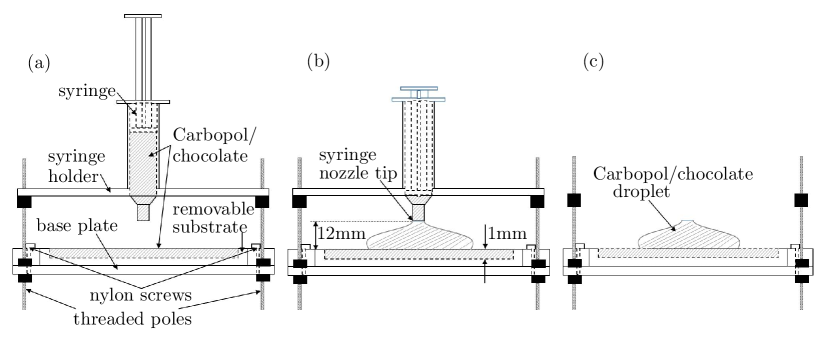
- 在预置相同流体层上对熔融巧克力与Carbopol微凝胶的悬挂液滴施加垂直正弦振动,开展实验。
- 通过改变驱动力加速度,识别铺展的临界阈值,实验涵盖多种频率与振幅。
- 采用恒定速率应力斜坡(0.83–2.67 Pa/s)进行循环流变测量,以确定动态屈服应力与屈服后流动曲线。
- 使用数值反演方法求解逆问题,从圆筒形几何中的角速度提取剪切速率,无需假设流变模型。
- 将屈服后数据拟合至Herschel-Bulkley模型,以量化粘度与流动行为指数,参数由实验数据确定。
- 分析应力上升与下降阶段之间的滞后行为,以评估结构稀释性与粘弹性记忆效应。
实验结果
研究问题
- RQ1在垂直振动作用下,屈服应力流体开始铺展所需的临界驱动力加速度是多少?
- RQ2在相同振动激励下,粘性较强、弹性较弱的流体(熔融巧克力)与高度弹性、剪切变稀的凝胶(Carbopol)的铺展动力学有何差异?
- RQ3Carbopol的铺展行为在多大程度上依赖于激励历史或预剪切历史?
- RQ42.2 g/L浓度的Carbopol微凝胶的动态屈服应力是多少?其与静态屈服应力相比如何?
- RQ5粘弹性效应(如粘滑现象与大振幅振荡)在屈服阈值附近的流态化过程中起何作用?
主要发现
- 巧克力与Carbopol的铺展均发生在临界驱动力加速度以上,但该阈值取决于初始沉积过程。
- Carbopol表现出快速、与历史无关的铺展,最终达到新的平衡形状并扩大接触面积,表明其通过粘弹性流动实现应力松弛。
- 在铺展阈值之上与之下,Carbopol液滴均以激励频率进行大振幅振荡,表明其在屈服阈值附近呈现非线性粘弹性响应。
- 2.2 g/L浓度的Carbopol微凝胶的动态屈服应力测定为35 ± 3 Pa,且在多次实验中保持一致(35 ± 5 Pa)。
- Carbopol的屈服后流动行为可用Herschel-Bulkley模型良好描述,参数为K = 8.2 Pa s^n与n = 0.49 ± 0.02(对应2.2 g/L浓度)。
- 应力上升与下降循环之间的滞后极小(小于5%),表明在测试参数范围内粘弹性结构稀释效应可忽略。
更好的研究,从现在开始
从阅读论文到最终审阅,大幅缩短您的研究时间。
无需绑定信用卡
本解读由 AI 生成,并经人工编辑审核。