
[论文解读] The cost of solving linear differential equations on a quantum computer: fast-forwarding to explicit resource counts
本文首次为在量子计算机上模拟线性常微分方程(ODE)提供了非渐近资源估计,表明稳定性特性可实现快进,将查询复杂度降低至 O(√T)(针对负对数范数的系统)。在某些参数范围内,其性能相比现有最优方法提升高达4个数量级,而哈密顿动力学仍受制于无快进定理。
How well can quantum computers simulate classical dynamical systems? There is increasing effort in developing quantum algorithms to efficiently simulate dynamics beyond Hamiltonian simulation, but so far exact resource estimates are not known. In this work, we provide two significant contributions. First, we give the first non-asymptotic computation of the cost of encoding the solution to general linear ordinary differential equations into quantum states -- either the solution at a final time, or an encoding of the whole history within a time interval. Second, we show that the stability properties of a large class of classical dynamics allow their fast-forwarding, making their quantum simulation much more time-efficient. From this point of view, quantum Hamiltonian dynamics is a boundary case that does not allow this form of stability-induced fast-forwarding. In particular, we find that the history state can always be output with complexity $O(T^{1/2})$ for any stable linear system. We present a range of asymptotic improvements over state-of-the-art in various regimes. We illustrate our results with a family of dynamics including linearized collisional plasma problems, coupled, damped, forced harmonic oscillators and dissipative nonlinear problems. In this case the scaling is quadratically improved, and leads to significant reductions in the query counts after inclusion of all relevant constant prefactors.
研究动机与目标
- 为求解线性 ODE 的量子算法提供明确的、非渐近的资源计数,超越渐近分析。
- 研究经典动力系统稳定性特性如何在量子模拟中实现快进,从而降低模拟时间的缩放复杂度。
- 将量子线性系统求解器(QLSA)的资源估计扩展至动力系统,包括历史态输出和最终态输出。
- 建立一个将李雅普诺夫稳定性(对数范数)纳入复杂度分析的框架,以提升效率。
- 证明具有负对数范数的稳定系统在模拟时间 T 上表现出亚线性缩放,与哈密顿动力学不同。
提出的方法
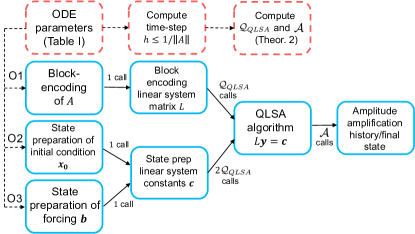
- 将线性 ODE 嵌入线性方程组 L y = c,利用量子线性求解器(QLS)子程序进行态制备。
- 应用块编码技术表示系统矩阵 A 和时间演化算符,通过 QLSA 实现高效的量子模拟。
- 引入一种变换,将系统转化为新形式 ẋ′ = A′x′,其具有负对数范数,从而通过稳定性诱导的时间演化压缩实现快进。
- 采用时间推进法与历史态编码,输出与 x(t) 在离散时间点成比例的量子态,且误差在 1-范数内有界。
- 采用参考文献 [3] 中的非渐近 QLSA 边界,推导出包含预因子和失败概率修正项的显式查询复杂度表达式。
- 通过约化至线性求解器推导复杂度下界,表明在最坏情况下,稳定系统所需资源为 Ω(min(log^γ(1/ε), T^γ))。
实验结果
研究问题
- RQ1经典动力系统的稳定性特性是否可使量子模拟在模拟时间 T 上实现亚线性缩放?
- RQ2在容错量子计算机上模拟线性 ODE 的显式、非渐近资源成本(查询次数、量子比特需求)是多少?
- RQ3通过负对数范数系统实现的快进如何影响查询复杂度,相较于标准量子 ODE 模拟方法?
- RQ4常数预因子和非渐近边界在多大程度上提升了量子 ODE 模拟的实际相关性,相较于以往的渐近分析?
- RQ5为何哈密顿动力学仍处于快进范围之外?这与无快进定理是否一致?
主要发现
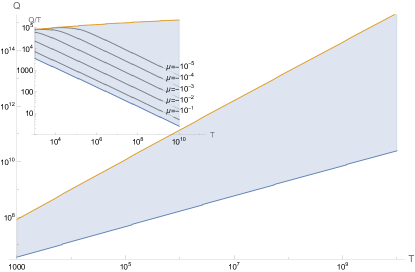
- 对于具有负对数范数(稳定系统)的线性 ODE,查询复杂度缩放为 O(√T),相比现有最优渐近分析,性能最高可提升 4 个数量级。
- 历史态输出的显式资源计数在 T ∈ [10⁶, 10¹⁵] 且 ε = 10⁻¹⁰ 时,介于 11,900√T log(T) 和 10,300T log(T) 之间。
- 向具有负对数范数的系统变换可实现快进,但误差约束 ε′_TD = e^(-zT)ε_TD 恢复了 Ω(T) 的复杂度下界,与无快进定理保持一致。
- 具有 A⁻¹b 为平衡点的稳定系统在长时间极限下退化为线性求解器,因此在最坏情况下复杂度下界为 Ω(min(log^γ(1/ε), T^γ))。
- 该框架将先前的 QLSA 边界扩展至动力系统,提供了包含失败概率修正项的预期查询次数的显式公式。
- 哈密顿动力学(A = -iH)是边界情况:其不支持由稳定性诱导的快进,与无快进定理一致。
更好的研究,从现在开始
从阅读论文到最终审阅,大幅缩短您的研究时间。
无需绑定信用卡
本解读由 AI 生成,并经人工编辑审核。