
[论文解读] The recent gravitational wave observation by pulsar timing arrays and primordial black holes: the importance of non-gaussianities
本文分析 NANOGrav/PTA GW 信号是否来自与原始扰动和 PBHs 相关的标量感应 GW,关注非高斯性及其对 PBH 过度产生的影响。
We study whether the signal seen by pulsar timing arrays (PTAs) may originate from gravitational waves (GWs) induced by large primordial perturbations. Such perturbations may be accompanied by a sizable primordial black hole (PBH) abundance. We improve existing analyses and show that PBH overproduction disfavors Gaussian scenarios for scalar-induced GWs at 2σ and single-field inflationary scenarios, accounting for non-Gaussianity, at 3σ as the explanation of the most constraining NANOGrav 15-year data. This tension can be relaxed in models where non-Gaussianities suppress the PBH abundance. On the flip side, the PTA data does not constrain the abundance of PBHs.
研究动机与目标
- 评估是否存在大曲率扰动能够产生 PTA SGWB 并伴随 PBH 产生的情况。
- 量化非高斯性如何影响 PBH 的过度产生以及膨胀理论情景的可行性。
- 确定 PBH 丰度约束是否与拟合 NANOGrav15 数据相冲突。
提出的方法
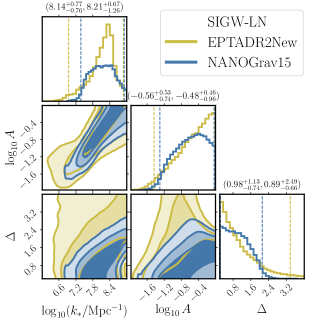
- 用带断裂幂律和对数正态峰值(在 k_* 附近)的标量感应 GW 光谱进行建模;将其与曲率幂谱 P_{\u00000}_{\u0006} (Eq. 1-2) 相关。
- 利用传输函数和曲率谱计算当前时刻的 SIGW h^2 Omega_GW(方程 3-7)。
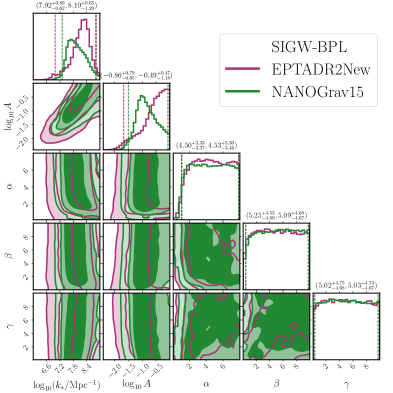
- 使用分别为 14 和 9 个频带,对 NANOGrav15 与 EPTA 数据进行对数似然分析。
- 通过曲率与密度涨落的非线性关系以及针对准拐点与颈引模型的特定 F(\u0018) 映射(方程 9-13)来引入非高斯性(NG)。
- 使用带有 NG 修正的紧缩函数阈值统计计算 PBH 丰度(方程 14-18)。
- 探讨非高斯性(包括 f_NL 与模型特定的 NG)如何影响 PBH 形成与 SIGW 振幅。
实验结果
研究问题
- RQ1由增强的小尺度曲率扰动产生的 SIGWs 是否能够解释 PTA GW 信号而不使 PBHs 过度产生?
- RQ2原初非高斯性如何改变 PBH 豐度及产生大曲率峰值的膨胀理论情景的可允许参数空间?
- RQ3PBH 丰度约束是否独立地限制或排除对 NANOGrav15 的 SIGW 解释?
- RQ4在何种 NG 条件下可以缓解 PTA 的紧张关系,同时与 PBH 和 CMB 约束保持一致?
主要发现
- 高斯曲率扰动或正的非高斯性倾向于过度产生 PBHs,与 NANOGrav15 数据在高达 3σ 的水平上产生张力。
- 具有大负的 f_NL 或具高 r_dec 的 curvaton 情景可以抑制 PBH 丰度并缓解紧张关系。
- 最佳拟合 PTA 区域对应于峰值尺度 k_* > 10^7 Mpc^-1,意味着亚太阳质量的 PBH;QCD 效应在该区域对 PBH 丰度几乎没有影响。
- NGs 可以非微扰地显著改变 PBH 产生,影响允许的振幅 A 和峰值位置以拟合 PTA 数据。
- PTA 数据本身并不限制总体 PBH 丰度,尽管 PBH 过度产生的约束不利于某些膨胀理论峰值情景。
更好的研究,从现在开始
从阅读论文到最终审阅,大幅缩短您的研究时间。
无需绑定信用卡
本解读由 AI 生成,并经人工编辑审核。