
[論文レビュー] A Bright First Day for Tidal Disruption Event
本研究では、3次元放射移動流体力学シミュレーションを用いて、潮汐破壊現象(TDE)におけるストリーム同士の衝突が、ストリームの運動エネルギーの5%以上を放射エネルギーに変換することで、明るいピーク前の光学的発光を駆動できることを示している。この過程で得られる放射率は約10⁴²–10⁴⁴ erg s⁻¹に達する。衝突領域では超Eddington放射率が発生し、非球形の流出が発生する。光球半径は1〜2桁のスケールで拡大し、温度は約10⁴ Kに達する。これは観測されたTDEと整合的である。
Stream-stream collision may be an important pre-peak energy dissipation mechanism in tidal disruption events (TDEs). We perform local three-dimensional radiation hydrodynamic simulations in a wedge geometry including the gravity to study stream self-crossing, with emphasis on resolving the collision and following the subsequent outflow. We find that the collision can contribute to pre-peak optical emissions by converting $\gtrsim5\%$ of stream kinetic energy to radiation, yielding prompt emission of $\sim10^{42-44} m erg~s^{-1}$. The radiative efficiency is sensitive to stream mass fallback rates, and strongly depends on the downstream gas optical depth. Even for a sub-Eddington ($10\%$) mass fallback rate, the strong radiation pressure produced in the collision can form a local super-Eddington region near the collision site, where a fast, aspherical outflow is launched. Higher mass fallback rate usually leads to more optically-thick outflow and lower net radiative efficiency. For $\dot{M}\gtrsim0.1\dot{M}_{ m Edd}$, the estimated photosphere size of the outflow can expand by one to two orders of magnitudes reaching $\sim10^{14} m cm$. The average gas temperature at this photospheric surface is a few $ imes10^{4}$K, roughly consistent with inferred pre-peak photosphere properties for some optical TDEs. We find that the dynamics is sensitive to collision angle and collision radius, but the radiative efficiency or outflow properties show more complex dependency than is often assumed in ballistic models.
研究の動機と目的
- 潮汐破壊現象(TDE)におけるストリーム同士の衝突が、ピーク前のエネルギー散逸機構として果たす役割を調査すること。
- TDEにおけるストリーム同士の自己交差によって生じる放射効率および流出の性質を定量化すること。
- 質量降着率と光学的厚さが放射生成および流出ダイナミクスに与える影響を評価すること。
- 高解像度の放射移動流体力学を用いて、衝突駆動型発光モデルの妥当性を検証すること。
提案手法
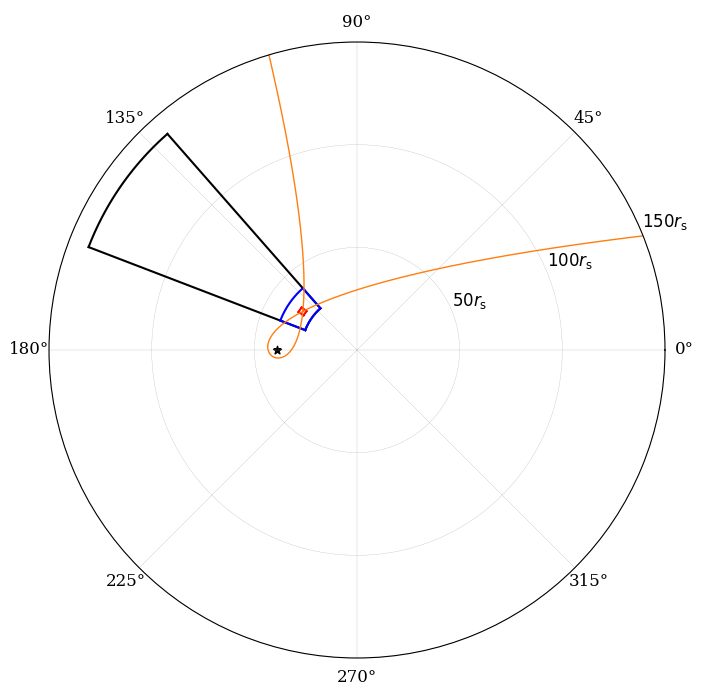
- 重力および放射移動を含む、楔型幾何構造における局所的3次元放射移動流体力学シミュレーションを実行する。
- 衝突領域では6段階のアダプティブメッシュリファインメント(AMR)を適用し、放射場には4段階のリファインメントを用いる。
- 偏心率の進化を考慮した軌道力学を用いてストリームの自己交差をモデル化し、衝突を誘発する。
- 放射圧および熱化過程を介して、運動エネルギーから放射エネルギーへのエネルギー変換を追跡する。
- 空間的および角度的解像度を変化させた解像度スタディを実施し、数値的収束性を評価する。
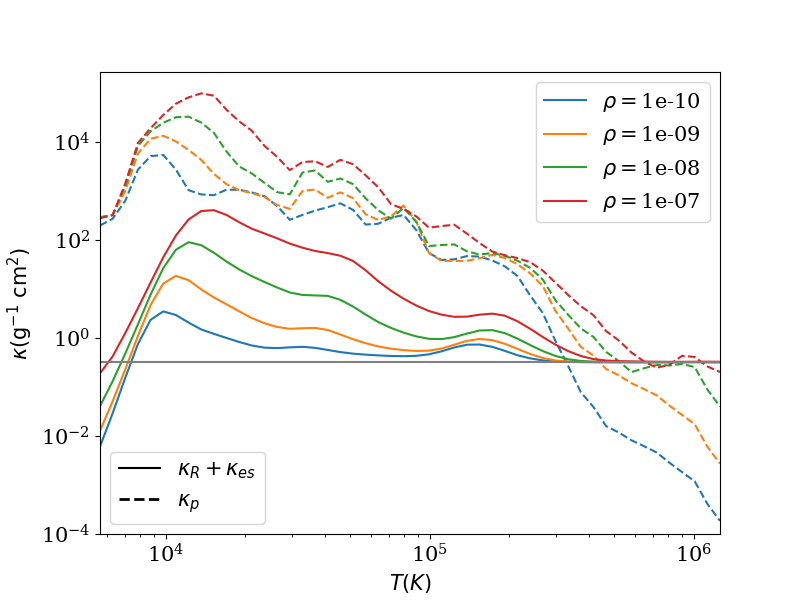
- 光球半径を光学厚さτ=1の位置として定義し、放射エネルギー密度プロファイルから温度および放射率を計算する。
実験結果
リサーチクエスチョン
- RQ1TDEにおけるストリーム同士の衝突時に、ストリームの運動エネルギーの何パーセントが放射エネルギーに変換されるか?
- RQ2質量降着率および下流の光学的厚さに依存する放射効率はどのように変化するか?
- RQ3ストリーム同士の衝突が、TDE光曲線と整合的な観測可能なピーク前の光学的発光を生成できるか?
- RQ4衝突領域における放射圧によって駆動される流出の性質は何か?
- RQ5解像度および数値的設定が、放射媒導型衝撃のシミュレーションにどのように影響を与えるか?
主な発見
- ストリーム同士の衝突により、ストリームの運動エネルギーの5%以上が放射エネルギーに変換され、即時の発光が約10⁴²–10⁴⁴ erg s⁻¹の強度で発生する。
- Eddington率の10%程度の状態でも、衝突地点付近に局所的な超Eddington放射領域が形成される。
- 流出は非球形であり、衝突領域における強い放射圧のため、高い速度で発射される。
- 質量降着率が0.1 M_Edd以上の場合、光球半径は1〜2桁のスケールで拡大し、約10¹⁴ cmに達する。
- 平均的な光球温度は約10⁴ Kであり、ピーク前の光学的TDEで推定された温度と整合的である。
- 質量降着率が高くなると、光学的厚さが増加し、流出がより不透明になるため、放射効率は低下する。
この論文を読む
Nubintのビューアで原文を開き、読みながら気になる箇所をすぐに質問できます。
Nubintでこの論文を読むこのレビューはAIが論文の原文をもとに作成しました。引用する前に原文をご確認ください。